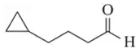
For each of the following ketones/aldehydes, indicate whether it is possible to synthesize it from an alkyne as the only compound in good (> 50%) yield. If so, how would you do it? (d)
Verified step by step guidance
1
Analyze the given compound: The structure is an aldehyde with a cyclopropyl group attached to a chain of three carbons. The aldehyde functional group is located at the terminal carbon.
Recall the general method for synthesizing aldehydes from alkynes: Terminal alkynes can undergo hydroboration-oxidation to yield aldehydes. This reaction involves the addition of a borane reagent followed by oxidation with hydrogen peroxide in a basic solution.
Determine the precursor alkyne: The precursor alkyne must have the same carbon skeleton as the target aldehyde. In this case, the alkyne should be a terminal alkyne with the cyclopropyl group attached to the same position as in the target molecule.
Outline the reaction conditions: Use a hydroboration reagent such as disiamylborane (Sia₂BH) or 9-BBN to ensure regioselective addition to the terminal carbon of the alkyne. Follow this step with oxidation using H₂O₂ and NaOH to convert the intermediate organoborane into the aldehyde.
Verify the feasibility: Since hydroboration-oxidation of terminal alkynes is a well-established method for synthesizing aldehydes in good yield (>50%), this approach is feasible for the given compound.
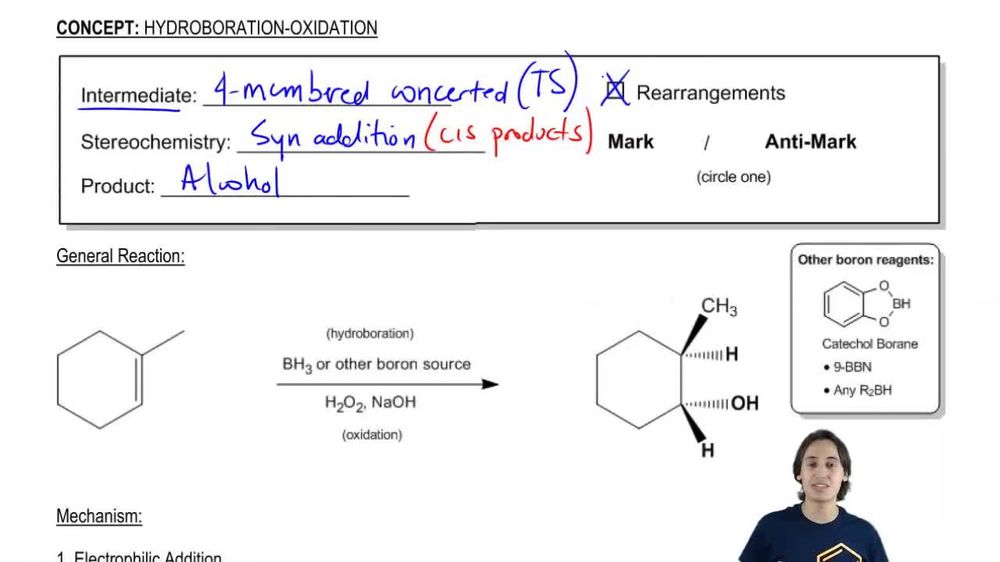
Verified video answer for a similar problem:
This video solution was recommended by our tutors as helpful for the problem above
Play a video:
0 Comments
Key Concepts
Here are the essential concepts you must grasp in order to answer the question correctly.
Alkynes and Their Reactivity
Alkynes are hydrocarbons containing at least one carbon-carbon triple bond. They are highly reactive due to the presence of this triple bond, which can undergo various reactions such as electrophilic addition, hydrogenation, and nucleophilic attack. Understanding the reactivity of alkynes is crucial for determining how they can be transformed into other functional groups, such as ketones and aldehydes.
Hydroboration-oxidation is a two-step reaction process used to convert alkynes into aldehydes or ketones. In the first step, the alkyne reacts with diborane (B2H6) to form an organoborane intermediate, which is then oxidized with hydrogen peroxide (H2O2) in the presence of a base. This method is particularly useful for synthesizing aldehydes from terminal alkynes and ketones from internal alkynes.
Markovnikov's Rule states that in the addition of HX to an alkene or alkyne, the hydrogen atom will attach to the carbon with the greater number of hydrogen atoms already attached. This principle is essential for predicting the outcome of reactions involving alkynes, especially when determining the regioselectivity of the product formed during the synthesis of ketones and aldehydes from alkynes.

 Verified step by step guidance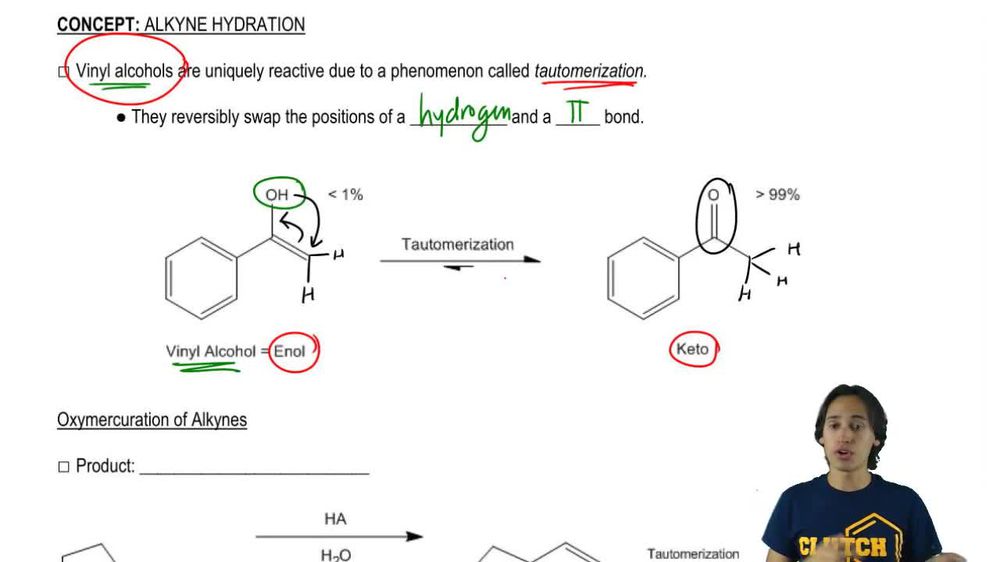
 09:11
09:11