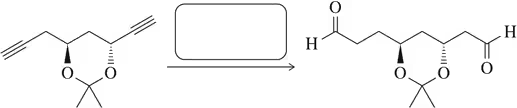
Predict the reagents or reactant(s) necessary to complete the following syntheses. (c)
Verified step by step guidance
1
Analyze the starting material: The molecule contains two terminal alkynes and an acetal protecting group. The acetal is stable under basic conditions but can be hydrolyzed under acidic conditions.
Examine the product: The final molecule has two aldehyde groups, indicating that the terminal alkynes have undergone oxidative cleavage to form aldehydes. Additionally, the acetal group has been hydrolyzed to reveal the aldehyde functionality.
Determine the reagent for oxidative cleavage: To convert terminal alkynes into aldehydes, use an oxidative cleavage reagent such as ozone (O₃) followed by a reducing agent like dimethyl sulfide (DMS) or zinc (Zn) with acetic acid.
Address the acetal hydrolysis: To hydrolyze the acetal group into an aldehyde, use an acidic aqueous solution, such as dilute HCl or H₂SO₄ in water.
Combine the steps: First, perform the oxidative cleavage of the alkynes using O₃ and DMS. Then, hydrolyze the acetal group using dilute acid to complete the synthesis.
Verified video answer for a similar problem:
This video solution was recommended by our tutors as helpful for the problem above
Play a video:
0 Comments
Key Concepts
Here are the essential concepts you must grasp in order to answer the question correctly.
Alkyne Hydration
Alkyne hydration is a chemical reaction where an alkyne reacts with water in the presence of an acid or a catalyst to form an alcohol. This process typically involves the addition of water across the triple bond of the alkyne, resulting in the formation of a carbonyl compound or an enol, which can further tautomerize to a ketone or aldehyde. Understanding this reaction is crucial for predicting the necessary reagents for the synthesis shown.
The common reagents used for alkyne hydration include water (H2O), a strong acid like sulfuric acid (H2SO4), and sometimes mercuric sulfate (HgSO4) as a catalyst. These reagents facilitate the addition of water to the alkyne, leading to the formation of the desired product. Recognizing the role of these reagents is essential for completing the synthesis reaction depicted in the question.
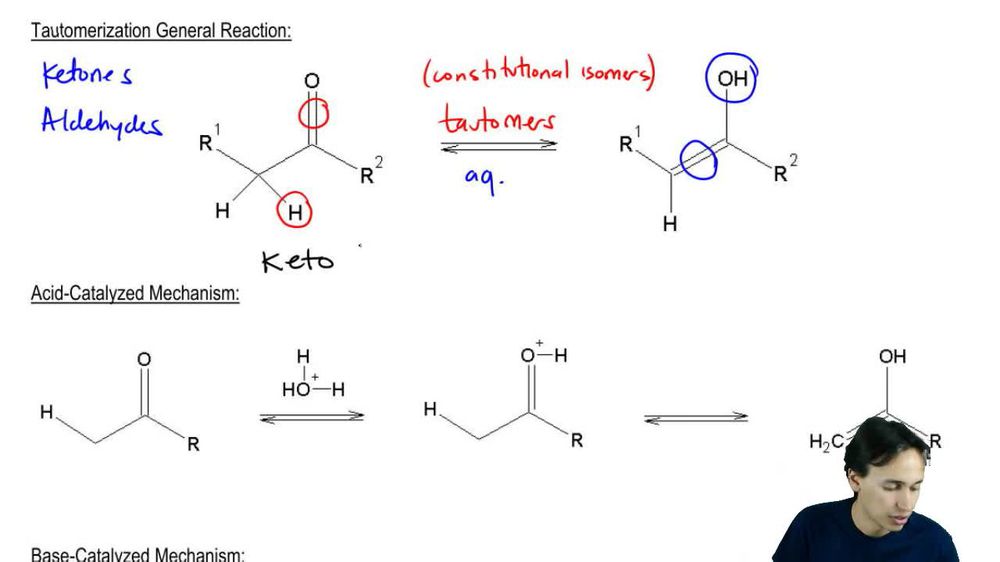
Tautomerization is a chemical process where a compound can exist in two interconvertible forms, typically involving the migration of a hydrogen atom and a switch of a double bond. In the context of alkyne hydration, the initial product (enol) can tautomerize to form a more stable ketone or aldehyde. This concept is important for understanding the final product of the synthesis and the stability of the resulting compounds.

 Verified step by step guidance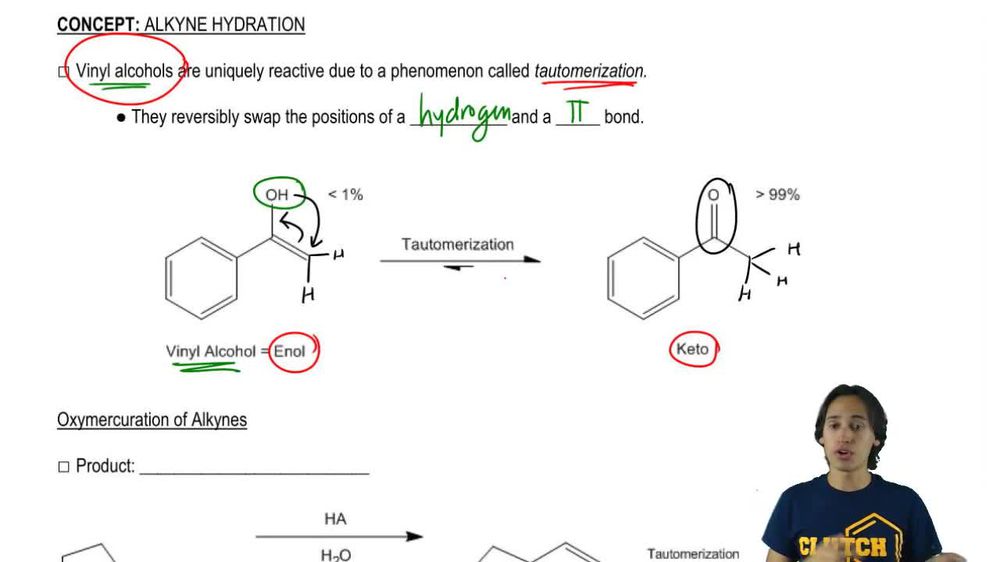
 09:11
09:11