Imidazole boils at 257 °C, whereas N-methylimidazole boils at 199 °C. Explain the difference in boiling points.
Verified step by step guidance
1
Step 1: Begin by analyzing the molecular structures of imidazole and N-methylimidazole. Imidazole is a five-membered aromatic heterocyclic compound containing two nitrogen atoms, one of which is part of an NH group. N-methylimidazole is similar, but the NH group is replaced by an N-CH₃ group.
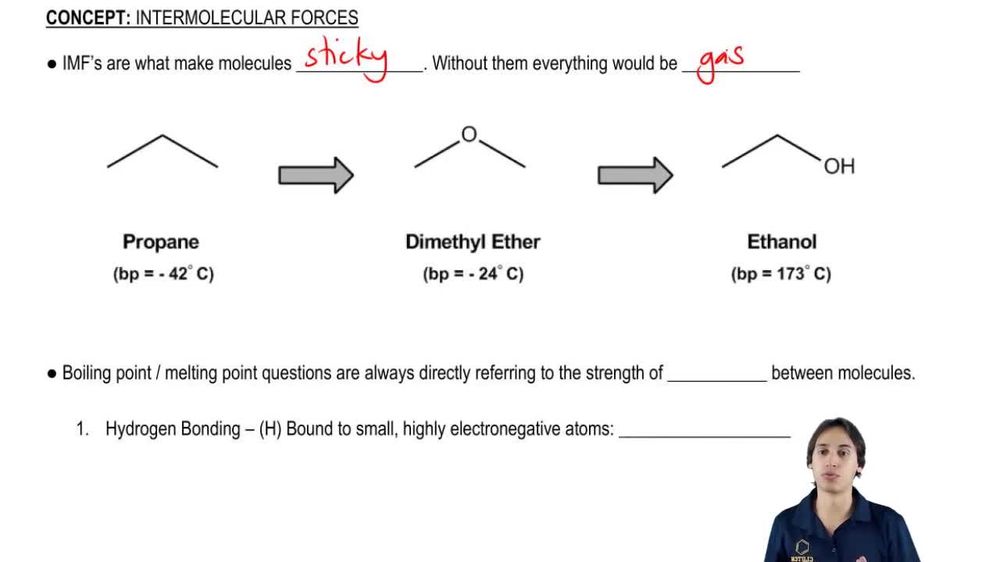
Step 2: Consider the role of hydrogen bonding in boiling points. Imidazole has an NH group capable of forming strong hydrogen bonds with other molecules, which increases intermolecular forces and raises the boiling point. N-methylimidazole lacks this NH group, so it cannot form hydrogen bonds as effectively.
Step 3: Evaluate the impact of the methyl group in N-methylimidazole. The methyl group is nonpolar and contributes to weaker van der Waals forces compared to the hydrogen bonding in imidazole. This results in a lower boiling point for N-methylimidazole.
Step 4: Discuss the overall intermolecular forces. Imidazole experiences both hydrogen bonding and van der Waals forces, while N-methylimidazole primarily relies on van der Waals forces. Stronger intermolecular forces in imidazole require more energy to overcome, leading to a higher boiling point.
Step 5: Conclude that the difference in boiling points is primarily due to the presence of hydrogen bonding in imidazole, which is absent in N-methylimidazole due to the substitution of the NH group with a methyl group.
Verified video answer for a similar problem:

This video solution was recommended by our tutors as helpful for the problem above
Video duration:
2m
Play a video:
0 Comments
Key Concepts
Here are the essential concepts you must grasp in order to answer the question correctly.
Intermolecular Forces
Intermolecular forces are the attractive forces between molecules that influence physical properties like boiling points. Stronger intermolecular forces, such as hydrogen bonding or dipole-dipole interactions, typically result in higher boiling points. In the case of imidazole and N-methylimidazole, the presence of additional methyl groups in N-methylimidazole alters the hydrogen bonding capabilities, affecting the overall strength of these forces.
The molecular structure and polarity of a compound significantly impact its boiling point. Imidazole has a planar structure with polar N-H bonds, allowing for effective hydrogen bonding. N-methylimidazole, however, has a methyl group that increases steric hindrance and reduces the molecule's ability to form strong hydrogen bonds, leading to a lower boiling point compared to imidazole.
Boiling point is also influenced by molecular weight, as heavier molecules generally have higher boiling points due to increased van der Waals forces. However, in this case, the difference in boiling points between imidazole and N-methylimidazole is more significantly attributed to the changes in intermolecular forces and molecular structure rather than molecular weight alone, as both compounds have similar molecular weights.