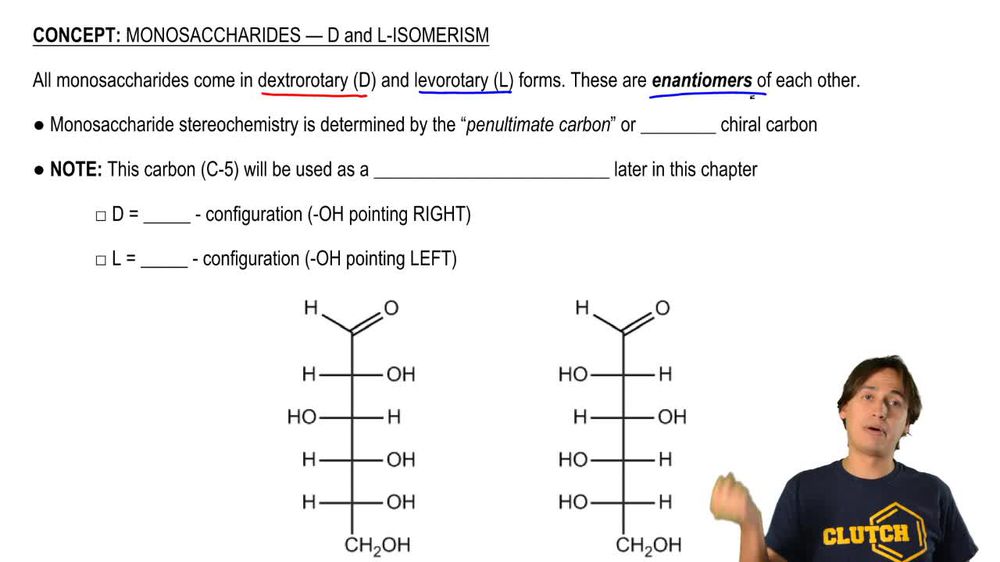
Rank the following isomers in order of increasing boiling point, and explain the reasons for your order of ranking.
Verified step by step guidance
1
Identify the structural features of each isomer that influence boiling point, such as molecular weight, branching, and functional groups.
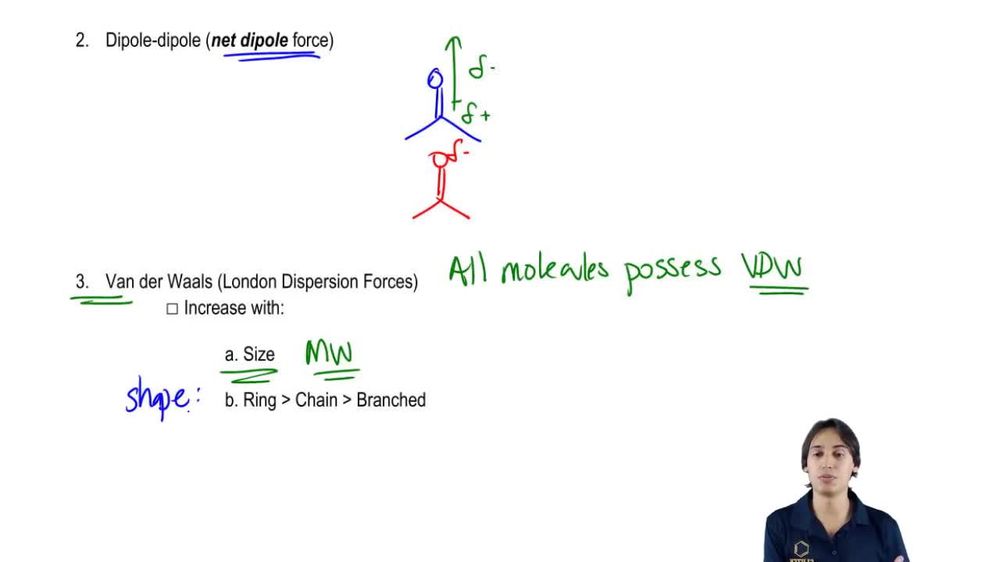
Consider the impact of molecular weight: Generally, higher molecular weight leads to higher boiling points due to increased van der Waals forces.
Evaluate the degree of branching: More branching typically results in lower boiling points because it reduces the surface area available for intermolecular interactions.
Assess the presence and type of functional groups: Polar functional groups or those capable of hydrogen bonding can significantly increase boiling points.
Rank the isomers based on the analysis of these factors, starting with the isomer with the lowest boiling point and ending with the one with the highest boiling point.
Verified video answer for a similar problem:
This video solution was recommended by our tutors as helpful for the problem above
Video duration:
3m
Play a video:
0 Comments
Key Concepts
Here are the essential concepts you must grasp in order to answer the question correctly.
Intermolecular Forces
Intermolecular forces, such as hydrogen bonding, dipole-dipole interactions, and London dispersion forces, play a crucial role in determining the boiling points of molecules. Stronger intermolecular forces result in higher boiling points because more energy is required to separate the molecules during the phase transition from liquid to gas.
The structure and shape of a molecule influence its boiling point by affecting how closely molecules can pack together. Linear or elongated molecules typically have higher boiling points than branched ones due to increased surface area, which enhances London dispersion forces. Understanding the geometry of isomers helps predict their boiling behavior.
Isomers are compounds with the same molecular formula but different structural arrangements. This structural variation can lead to differences in physical properties, such as boiling points. For example, cis-trans isomers may exhibit different boiling points due to variations in polarity and intermolecular interactions, making isomerism a key factor in ranking boiling points.