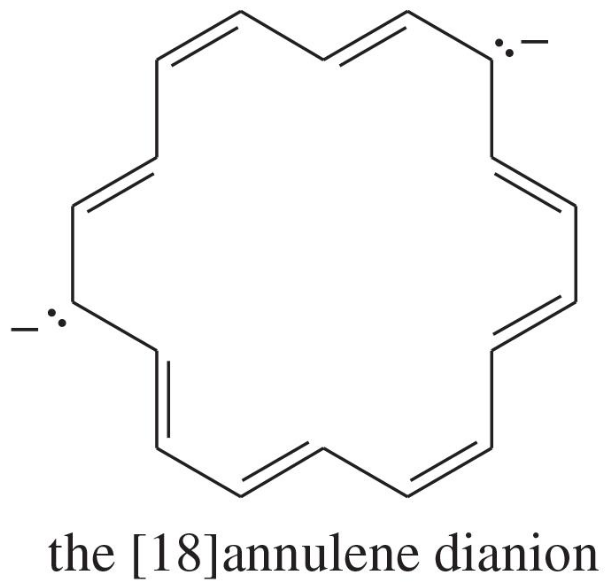
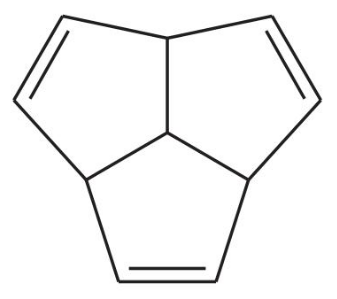
Explain why each compound or ion should be aromatic, antiaromatic, or nonaromatic. (d) (e) (f) the [20]annulene dication
Verified step by step guidance
1
Step 1: Recall the criteria for aromaticity. A compound is aromatic if it satisfies the following conditions: (a) It is cyclic, (b) It is planar, (c) It has a conjugated π-electron system, and (d) It follows Hückel's rule, which states that the molecule must have (4n + 2) π-electrons, where n is an integer.
Step 2: Analyze compound (i). This structure is cyclic and conjugated, with alternating double bonds. It has 10 π-electrons (counting the electrons from the double bonds and lone pairs). Applying Hückel's rule, 10 π-electrons fit the formula (4n + 2) with n = 2, making it aromatic. Additionally, the molecule appears planar, which supports aromaticity.
Step 3: Analyze compound (ii). This structure is cyclic and conjugated, but it has 4 π-electrons (from the two double bonds). Applying Hückel's rule, 4 π-electrons do not fit the formula (4n + 2). Instead, it fits the formula 4n, which makes it antiaromatic. Furthermore, the molecule is planar, which supports antiaromaticity.
Step 4: Analyze compound (iii), the [20]annulene dication. This structure is cyclic and conjugated, with alternating double bonds. The dication removes two electrons from the π-system, leaving 18 π-electrons. Applying Hückel's rule, 18 π-electrons fit the formula (4n + 2) with n = 4, making it aromatic. The molecule is also planar, which supports aromaticity.
Step 5: Summarize the findings. Compound (i) is aromatic due to its cyclic, planar structure and 10 π-electrons satisfying Hückel's rule. Compound (ii) is antiaromatic due to its cyclic, planar structure and 4 π-electrons fitting the 4n formula. Compound (iii), the [20]annulene dication, is aromatic due to its cyclic, planar structure and 18 π-electrons satisfying Hückel's rule.
Verified video answer for a similar problem:
This video solution was recommended by our tutors as helpful for the problem above
Video duration:
12m
Play a video:
0 Comments
Key Concepts
Here are the essential concepts you must grasp in order to answer the question correctly.
Aromaticity
Aromaticity refers to the property of cyclic compounds that exhibit enhanced stability due to delocalized π electrons. For a compound to be aromatic, it must be cyclic, planar, and follow Hückel's rule, which states that it should have 4n + 2 π electrons, where n is a non-negative integer. This delocalization allows for resonance, contributing to the compound's stability and unique chemical properties.
Antiaromaticity
Antiaromaticity is the opposite of aromaticity and describes cyclic compounds that are destabilized by the presence of π electrons. A compound is considered antiaromatic if it is cyclic, planar, and contains 4n π electrons, leading to increased electron-electron repulsion and instability. This instability often results in a higher reactivity compared to nonaromatic compounds.
Nonaromaticity
Nonaromatic compounds do not meet the criteria for either aromaticity or antiaromaticity. These compounds can be acyclic, non-planar, or lack the required number of π electrons. As a result, they do not exhibit the special stability associated with aromatic compounds nor the instability of antiaromatic compounds, leading to typical reactivity patterns found in aliphatic compounds.