For each of the following reactions, identify the bonds that are broken and formed. Be sure to indicate whether the bond that is broken is a σ bond or a π bond. (a)
Verified step by step guidance
1
Step 1: Analyze the reactants and products. The reactants are acetic acid (CH3COOH) and isopropyl bromide ((CH3)2CHBr). The products are isopropyl acetate (CH3COOCH(CH3)2) and HBr.
Step 2: Identify the bonds broken in the reaction. In acetic acid, the O-H σ bond is broken. In isopropyl bromide, the C-Br σ bond is broken.
Step 3: Identify the bonds formed in the reaction. A new C-O σ bond is formed between the carbonyl oxygen of acetic acid and the isopropyl group. Additionally, an H-Br σ bond is formed.
Step 4: Classify the bonds broken and formed. Both the bonds broken (O-H and C-Br) and the bonds formed (C-O and H-Br) are σ bonds. No π bonds are involved in this reaction.
Step 5: Summarize the reaction mechanism. This is an example of a nucleophilic acyl substitution reaction, where the nucleophile (isopropyl group) replaces the hydroxyl group of acetic acid, forming an ester and HBr as byproducts.
Verified video answer for a similar problem:
This video solution was recommended by our tutors as helpful for the problem above
Play a video:
0 Comments
Key Concepts
Here are the essential concepts you must grasp in order to answer the question correctly.
Types of Chemical Bonds
In organic chemistry, bonds between atoms can be classified as sigma (σ) or pi (π) bonds. Sigma bonds are formed by the head-on overlap of atomic orbitals and are the first bonds formed between two atoms. Pi bonds, on the other hand, result from the side-to-side overlap of p orbitals and are typically found in double and triple bonds. Understanding these bond types is crucial for analyzing reactions.
Chemical Reactions of Phosphate Anhydrides Concept 1
Reaction Mechanisms
A reaction mechanism describes the step-by-step process by which reactants are converted into products. It includes the breaking and forming of bonds, which can involve the movement of electrons. Identifying the specific bonds broken and formed during a reaction helps in understanding the mechanism and predicting the outcome of the reaction.
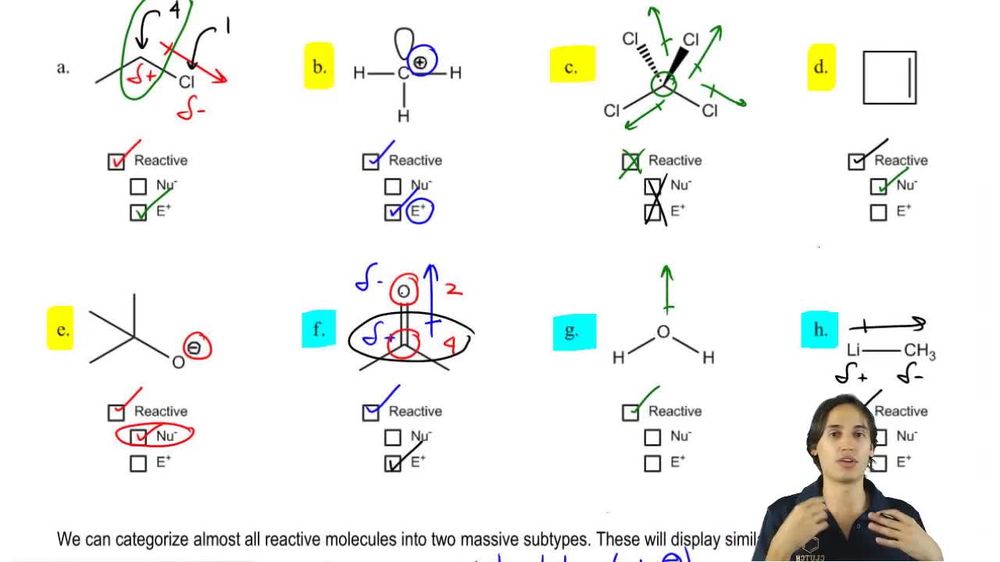
In organic reactions, nucleophiles are species that donate an electron pair to form a bond, while electrophiles are electron-deficient species that accept an electron pair. In the given reaction, the hydroxyl group (OH) acts as a nucleophile, attacking the electrophilic carbon in the alkyl bromide. Recognizing these roles is essential for determining which bonds are broken and formed during the reaction.


 Verified step by step guidance
 3:11
3:11