In Chapter 4, we explain that molecules like CH3- are Lewis bases or electron pair donors. What makes it a Lewis base?
Verified step by step guidance
1
Understand the concept of a Lewis base: A Lewis base is a species that donates an electron pair to form a covalent bond. This is a fundamental concept in acid-base chemistry.
Analyze the structure of CH₃⁻: The methyl anion (CH₃⁻) consists of a carbon atom bonded to three hydrogen atoms, with a lone pair of electrons on the carbon atom. This lone pair is key to its behavior as a Lewis base.
Identify the electron pair donor: The lone pair of electrons on the carbon atom in CH₃⁻ is available for donation. This makes CH₃⁻ capable of acting as a Lewis base by donating this electron pair to an electron-deficient species (a Lewis acid).
Relate to electron density: The negative charge on CH₃⁻ increases the electron density around the carbon atom, enhancing its ability to donate the lone pair of electrons. This is why CH₃⁻ is a strong Lewis base.
Connect to Chapter 4: In Chapter 4, you will explore more examples of Lewis bases and their interactions with Lewis acids, as well as the role of electron pair donation in forming covalent bonds.
Verified video answer for a similar problem:
This video solution was recommended by our tutors as helpful for the problem above
Play a video:
0 Comments
Key Concepts
Here are the essential concepts you must grasp in order to answer the question correctly.
Lewis Acid-Base Theory
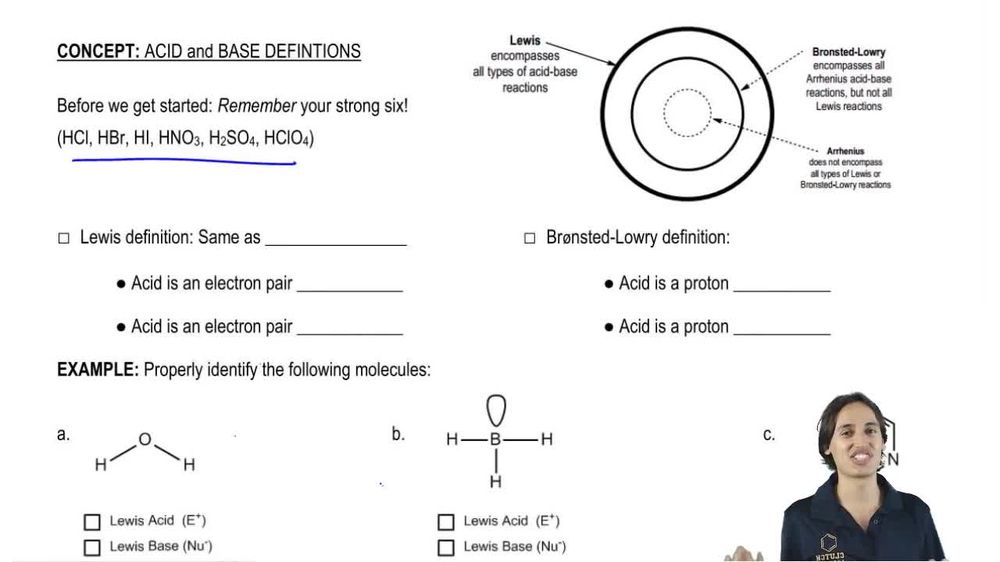
The Lewis acid-base theory expands the definition of acids and bases beyond the Brønsted-Lowry theory. In this framework, a Lewis acid is an electron pair acceptor, while a Lewis base is an electron pair donor. This theory is crucial for understanding how molecules interact in terms of electron transfer, which is fundamental in organic chemistry.
Electron pair donation refers to the ability of a molecule to provide a pair of electrons to another molecule or ion during a chemical reaction. In the case of CH₃⁻, the negative charge indicates an excess of electrons, allowing it to act as a Lewis base by donating its lone pair to a Lewis acid, facilitating bond formation.
The molecular structure and charge of a compound significantly influence its reactivity and classification as a Lewis base. For CH₃⁻, the presence of a negative charge indicates a high electron density, making it more likely to donate electrons. Understanding how molecular geometry and charge distribution affect electron availability is essential for predicting chemical behavior.