In comparison to CH3+ in Assessment 2.82, the related molecule H3O+ is not a Lewis acid at oxygen. Why?
Verified step by step guidance
1
Understand the concept of a Lewis acid: A Lewis acid is a species that can accept a pair of electrons to form a new covalent bond. In this case, we are analyzing whether H₃O⁺ (hydronium ion) can act as a Lewis acid at the oxygen atom.
Examine the electronic structure of H₃O⁺: The oxygen atom in H₃O⁺ is bonded to three hydrogen atoms and carries a formal positive charge. Oxygen typically has a lone pair of electrons, but in H₃O⁺, the positive charge indicates that the oxygen is already electron-deficient.
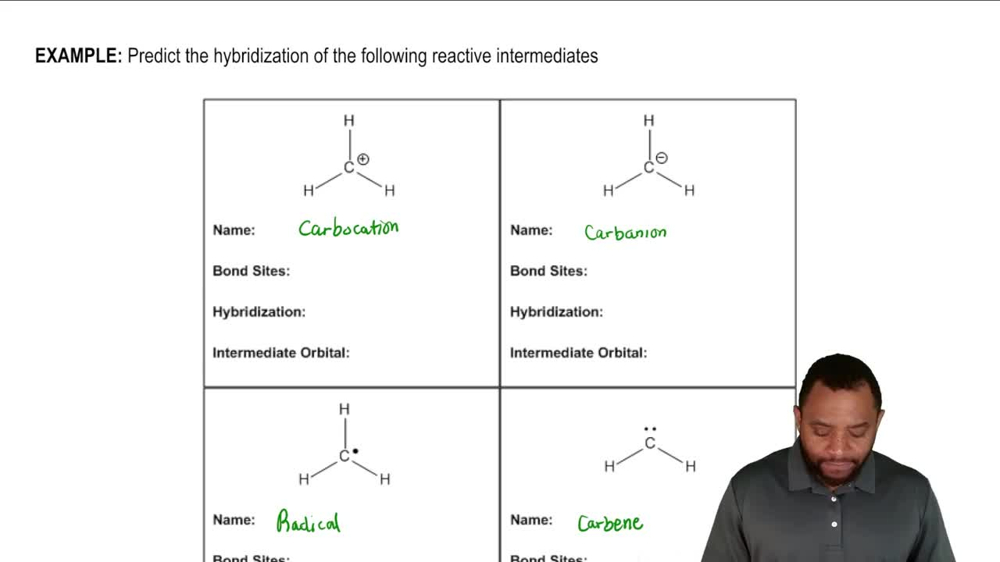
Compare H₃O⁺ to CH₃⁺: In CH₃⁺, the carbon atom has an empty p orbital, making it highly electrophilic and capable of accepting a pair of electrons. This is why CH₃⁺ is a strong Lewis acid. However, in H₃O⁺, the oxygen atom does not have an empty orbital available to accept electrons.
Consider the steric and electronic factors: The oxygen atom in H₃O⁺ is surrounded by three hydrogen atoms, and its lone pairs are already involved in bonding or are tightly held due to the positive charge. This makes it unlikely for the oxygen to act as a Lewis acid.
Conclude why H₃O⁺ is not a Lewis acid at oxygen: The lack of an empty orbital on oxygen and the electron-deficient nature of the molecule prevent H₃O⁺ from accepting a pair of electrons at the oxygen atom. Therefore, H₃O⁺ is not a Lewis acid at oxygen, unlike CH₃⁺, which has an empty orbital on carbon.
Verified video answer for a similar problem:
This video solution was recommended by our tutors as helpful for the problem above
Play a video:
0 Comments
Key Concepts
Here are the essential concepts you must grasp in order to answer the question correctly.
Lewis Acids and Bases
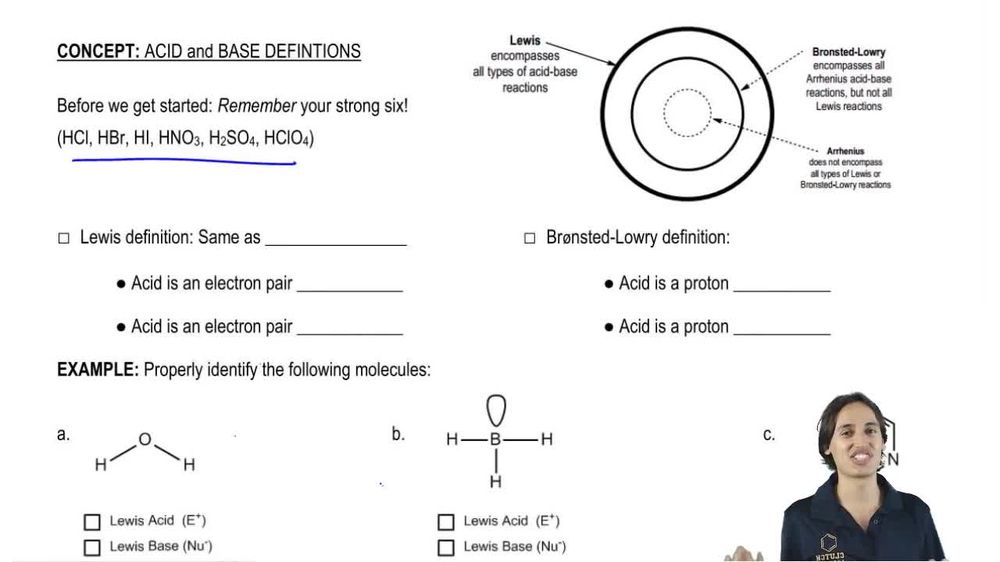
Lewis acids are defined as electron pair acceptors, while Lewis bases are electron pair donors. This theory expands the concept of acidity beyond protons (H⁺) to include any species that can accept an electron pair. Understanding this definition is crucial for analyzing the behavior of molecules like CH₃⁺ and H₃O⁺ in terms of their reactivity and interactions with other species.
The molecular structure and hybridization of atoms within a molecule significantly influence its chemical properties. In H₃O⁺, the oxygen atom is sp³ hybridized, leading to a tetrahedral geometry. This arrangement affects the availability of lone pairs on oxygen, which is essential for determining whether it can act as a Lewis acid or base.
Bond sites, hybridization, and intermediate orbitals
Acidity and Protonation
Acidity in organic chemistry often involves the ability of a molecule to donate protons (H⁺). While H₃O⁺ is a strong acid due to its ability to donate protons, it does not act as a Lewis acid at oxygen because the oxygen atom is already fully satisfied with its bonding and lone pairs. This distinction is important for understanding the reactivity of H₃O⁺ compared to other cations like CH₃⁺.