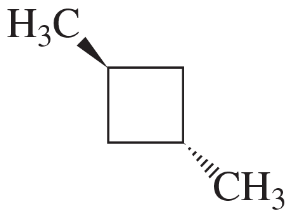
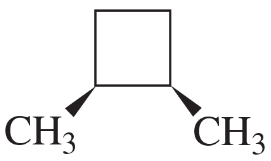
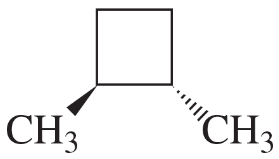
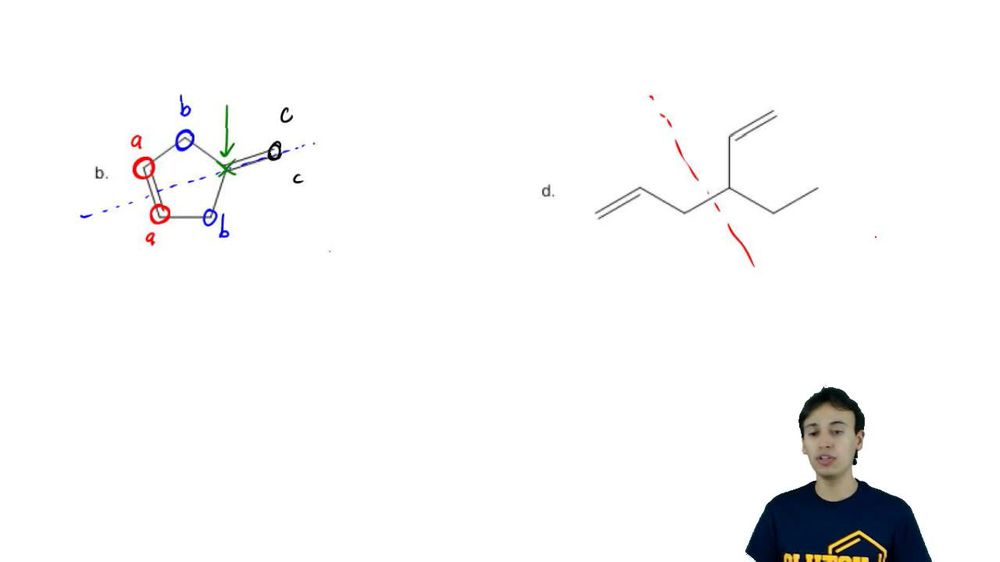
How many signals are produced by each of the following compounds in its a. 1H NMR spectrum? 4. 5. 6.
Verified step by step guidance
1
Analyze the structure of the compound: The molecule is a cyclobutane ring with two chlorine atoms attached. One chlorine is on a wedge (pointing out of the plane), and the other is on a dash (pointing into the plane). This indicates stereochemistry and suggests the molecule is chiral.
Determine the symmetry of the molecule: The presence of two different chlorine atoms on opposite sides of the cyclobutane ring breaks symmetry. This means the hydrogens on the ring are not equivalent and will produce distinct signals in the 1H NMR spectrum.
Identify the unique hydrogen environments: The hydrogens on the cyclobutane ring are in different environments due to the stereochemistry of the chlorine atoms. Each hydrogen will experience a different electronic environment depending on its proximity to the chlorine atoms and the spatial arrangement.
Consider the splitting patterns: Each unique hydrogen environment will produce a signal in the 1H NMR spectrum. The splitting of these signals will depend on the coupling between neighboring hydrogens, which is influenced by the ring strain and stereochemistry.
Count the number of signals: Based on the analysis, determine the number of unique hydrogen environments in the molecule. Each unique environment corresponds to a distinct signal in the 1H NMR spectrum.
Verified video answer for a similar problem:
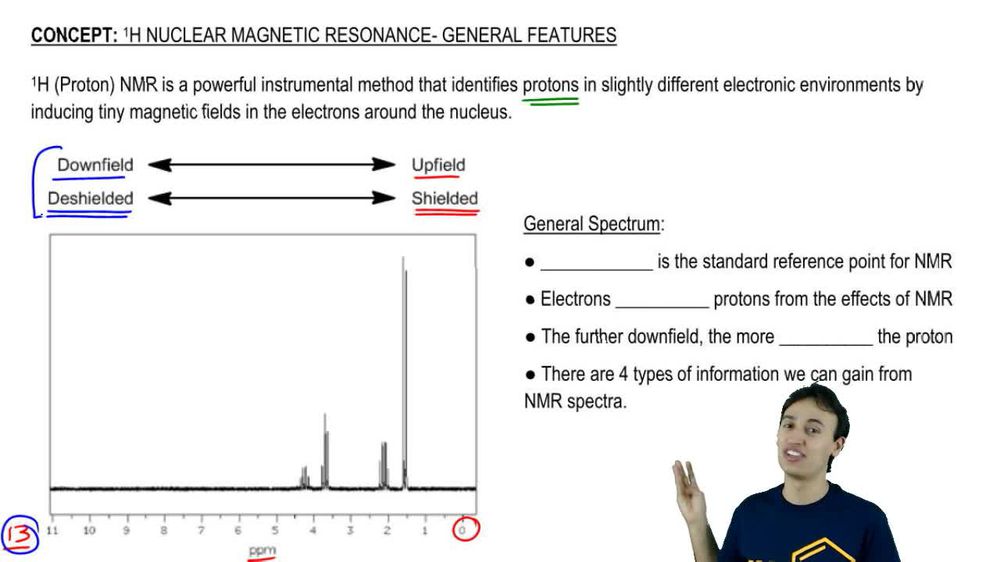
This video solution was recommended by our tutors as helpful for the problem above
Video duration:
5m
Play a video:
0 Comments
Key Concepts
Here are the essential concepts you must grasp in order to answer the question correctly.
Nuclear Magnetic Resonance (NMR) Spectroscopy
NMR spectroscopy is a powerful analytical technique used to determine the structure of organic compounds. It relies on the magnetic properties of certain nuclei, primarily hydrogen (1H), to provide information about the number and environment of hydrogen atoms in a molecule. The resulting spectrum displays signals that correspond to different hydrogen environments, allowing chemists to infer structural details.
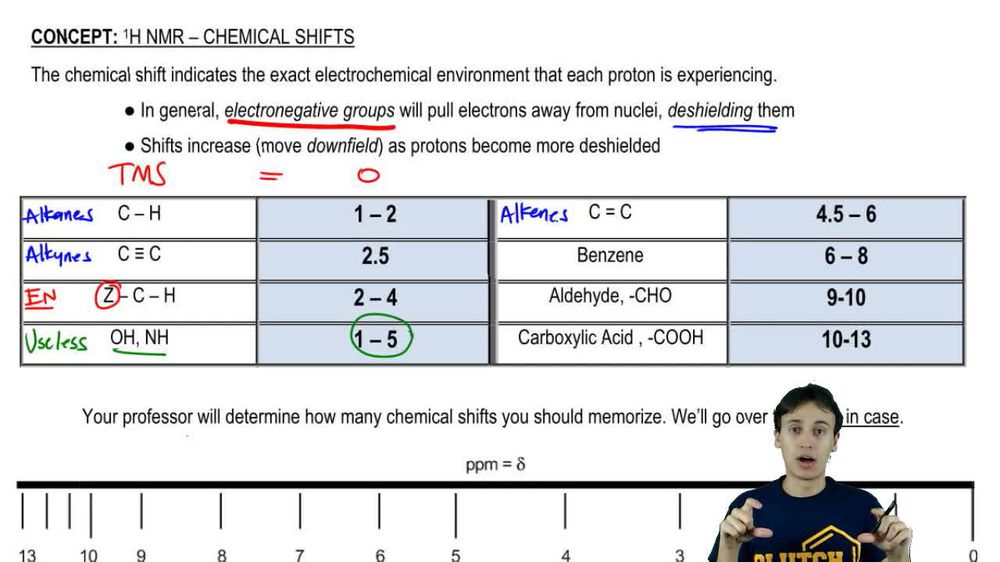
Chemical shifts in NMR spectroscopy refer to the variation in resonance frequency of a nucleus due to its electronic environment. Different functional groups and neighboring atoms can cause shifts in the position of signals on the NMR spectrum. Understanding chemical shifts is crucial for interpreting the spectrum, as they help identify the types of hydrogen atoms present and their relative positions in the molecule.
Signal multiplicity in NMR refers to the splitting of a signal into multiple peaks, which occurs due to spin-spin coupling between neighboring hydrogen atoms. The number of peaks in a signal can provide insight into the number of adjacent hydrogen atoms (n+1 rule). Recognizing the multiplicity of signals is essential for deducing the connectivity and arrangement of atoms within a compound.