How can 1H NMR be used to prove that the addition of HBr to propene follows the rule that says that the electrophile adds to the sp2 carbon bonded to the most hydrogens?
Verified step by step guidance
1
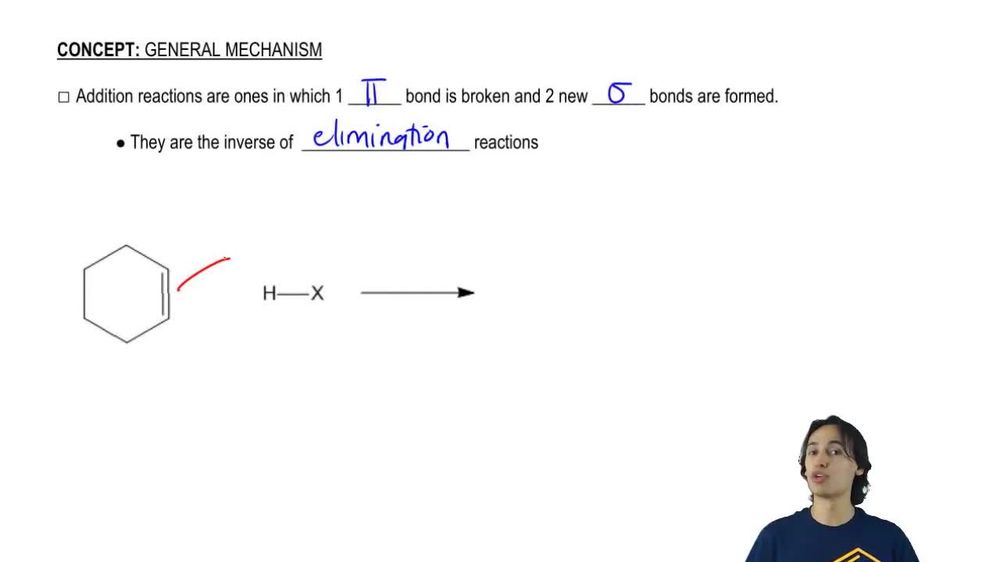
Understand the reaction: The addition of HBr to propene follows Markovnikov's rule, which states that the electrophile (H⁺) adds to the sp² carbon with the most hydrogens, forming 2-bromopropane as the major product.
Analyze the products: If Markovnikov's rule is followed, the major product will be 2-bromopropane. If the rule is not followed, the product would be 1-bromopropane. These two products have distinct ¹H NMR spectra.
Identify key signals in the ¹H NMR spectrum: For 2-bromopropane, the methyl group attached to the brominated carbon will show a doublet due to splitting by the adjacent methine proton. The methine proton will appear as a multiplet. For 1-bromopropane, the methylene group adjacent to the bromine will show a triplet, and the terminal methyl group will show a triplet as well.
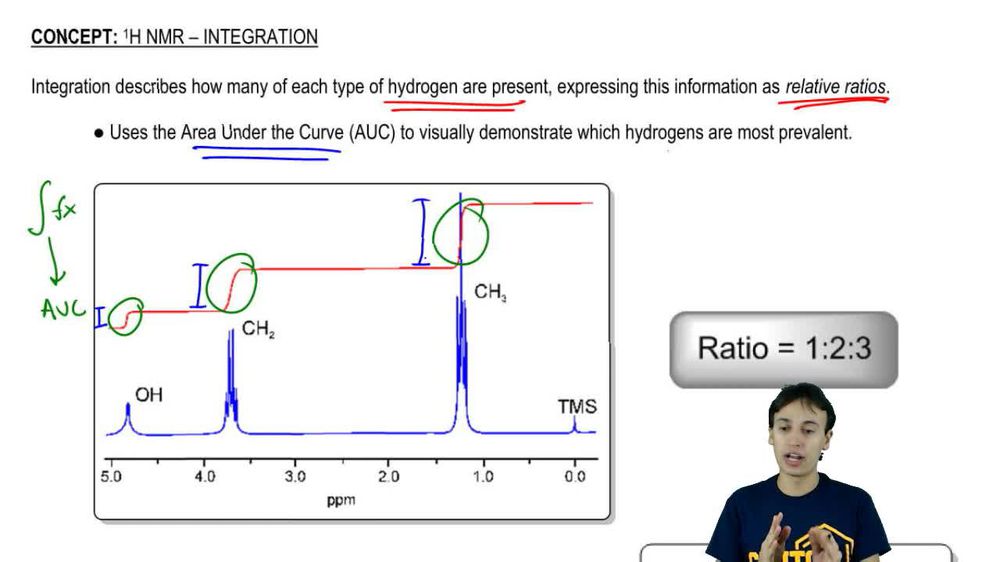
Compare the integration of peaks: The integration of the peaks in the ¹H NMR spectrum will correspond to the number of protons in each environment. For 2-bromopropane, the integration ratio will match the expected proton counts for the methyl, methine, and other groups. For 1-bromopropane, the integration will differ due to the different proton environments.
Conclude based on the spectrum: If the ¹H NMR spectrum matches the expected pattern for 2-bromopropane, it confirms that the addition of HBr to propene followed Markovnikov's rule, with the electrophile (H⁺) adding to the sp² carbon bonded to the most hydrogens.
Verified video answer for a similar problem:
This video solution was recommended by our tutors as helpful for the problem above
Video duration:
7m
Play a video:
0 Comments
Key Concepts
Here are the essential concepts you must grasp in order to answer the question correctly.
1H NMR Spectroscopy
1H NMR (Proton Nuclear Magnetic Resonance) spectroscopy is a powerful analytical technique used to determine the structure of organic compounds. It provides information about the number of hydrogen atoms in different environments within a molecule, allowing chemists to infer connectivity and functional groups. In the context of propene and HBr addition, 1H NMR can reveal the relative positions of hydrogen atoms, helping to confirm the regioselectivity of the reaction.
The electrophilic addition mechanism describes how electrophiles react with alkenes, such as propene, to form more saturated products. In this process, the electrophile (HBr) adds to the sp2 carbon of the alkene, which is more electron-rich. According to Markovnikov's rule, the electrophile will preferentially add to the carbon atom that is bonded to the most hydrogens, leading to the formation of the more stable carbocation intermediate.
Markovnikov's rule states that in the addition of HX (where X is a halogen) to an alkene, the hydrogen atom will attach to the carbon with the greater number of hydrogen atoms already attached. This rule helps predict the outcome of reactions involving alkenes and is crucial for understanding regioselectivity. In the case of propene reacting with HBr, applying this rule allows chemists to anticipate the major product formed and verify it through 1H NMR analysis.