What is the major product(s) of each of the following reactions? e. nitration of p-methoxybenzaldehyde f. nitration of p-tert-butylmethylbenzene
Verified step by step guidance
1
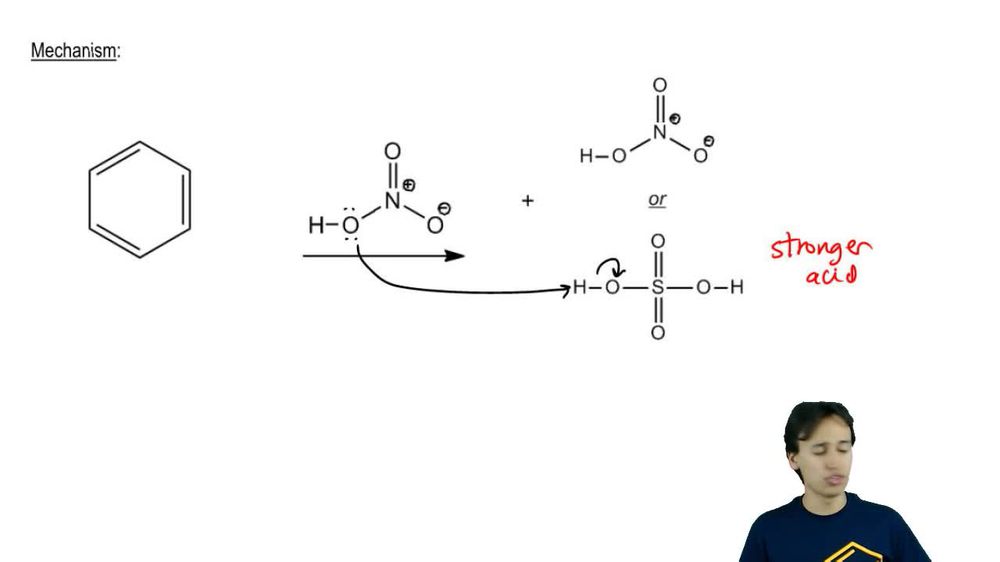
Step 1: Understand the reaction type. Nitration is an electrophilic aromatic substitution reaction where a nitro group (-NO₂) is introduced to the aromatic ring. The reaction typically involves a mixture of concentrated nitric acid (HNO₃) and sulfuric acid (H₂SO₄) as the nitrating agent.
Step 2: Analyze the substituents on the aromatic ring for each compound. For p-methoxybenzaldehyde, the substituents are a methoxy group (-OCH₃) and an aldehyde group (-CHO). For p-tert-butylmethylbenzene, the substituents are a tert-butyl group (-C(CH₃)₃) and a methyl group (-CH₃).
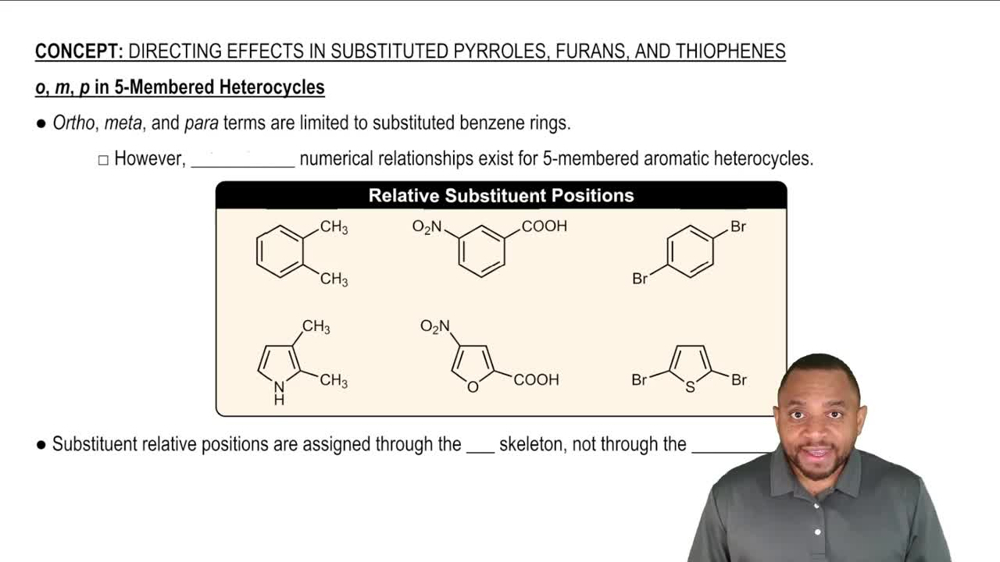
Step 3: Determine the directing effects of the substituents. The methoxy group (-OCH₃) is an electron-donating group and an ortho/para-director, while the aldehyde group (-CHO) is an electron-withdrawing group and a meta-director. In p-tert-butylmethylbenzene, both the tert-butyl group and the methyl group are electron-donating and ortho/para-directors.
Step 4: Predict the major product for p-methoxybenzaldehyde. The methoxy group is a stronger activator than the aldehyde group, so it will dominate the directing effects. The nitro group will preferentially add to the ortho or para position relative to the methoxy group. However, the para position is already occupied by the aldehyde group, so the nitro group will add to the ortho position relative to the methoxy group.
Step 5: Predict the major product for p-tert-butylmethylbenzene. Both substituents are ortho/para-directors, but steric hindrance plays a role. The nitro group will preferentially add to the position that is para to the tert-butyl group, as this position is less sterically hindered compared to the ortho positions.
Verified video answer for a similar problem:
This video solution was recommended by our tutors as helpful for the problem above
Video duration:
5m
Play a video:
0 Comments
Key Concepts
Here are the essential concepts you must grasp in order to answer the question correctly.
Electrophilic Aromatic Substitution
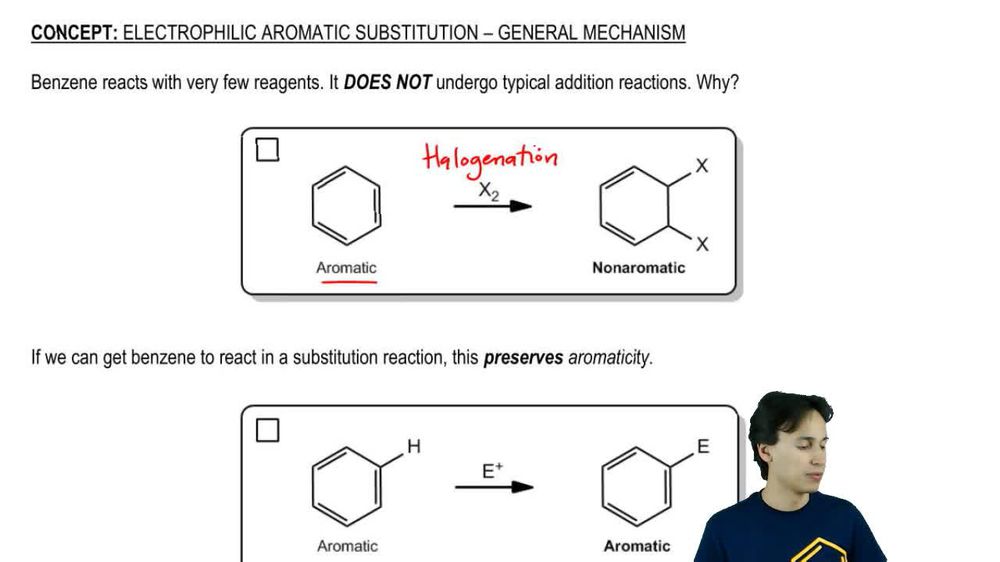
Electrophilic aromatic substitution (EAS) is a fundamental reaction in organic chemistry where an electrophile replaces a hydrogen atom on an aromatic ring. This process is crucial for understanding how substituents on the ring influence the reactivity and orientation of further substitutions. The nature of the substituents, whether they are electron-donating or electron-withdrawing, significantly affects the position where the electrophile will attack.
Nitration is a specific type of electrophilic aromatic substitution where a nitro group (NO2) is introduced into an aromatic compound. This reaction typically involves the use of a nitrating mixture, such as concentrated nitric acid and sulfuric acid, which generates the nitronium ion (NO2+), the active electrophile. The position of nitration is influenced by existing substituents on the aromatic ring, which can direct the electrophile to ortho, meta, or para positions.
Substituent effects refer to how different groups attached to an aromatic ring can influence the reactivity and orientation of electrophilic substitutions. Electron-donating groups, like methoxy (-OCH3), activate the ring and direct incoming electrophiles to the ortho and para positions, while electron-withdrawing groups, like carbonyls, can deactivate the ring and direct electrophiles to the meta position. Understanding these effects is essential for predicting the major products of nitration reactions.

 5:43 minutes
 Verified step by step guidance
 03:07
03:07