Give the products, if any, of each of the following reactions: a. benzonitrile + methyl chloride + AlCl3 b. phenol + Br2
Verified step by step guidance
1
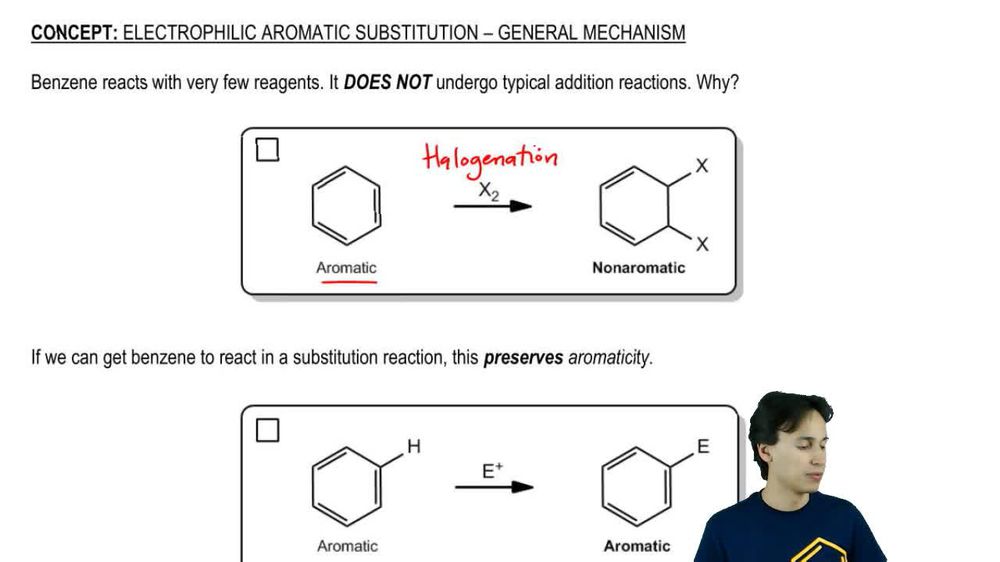
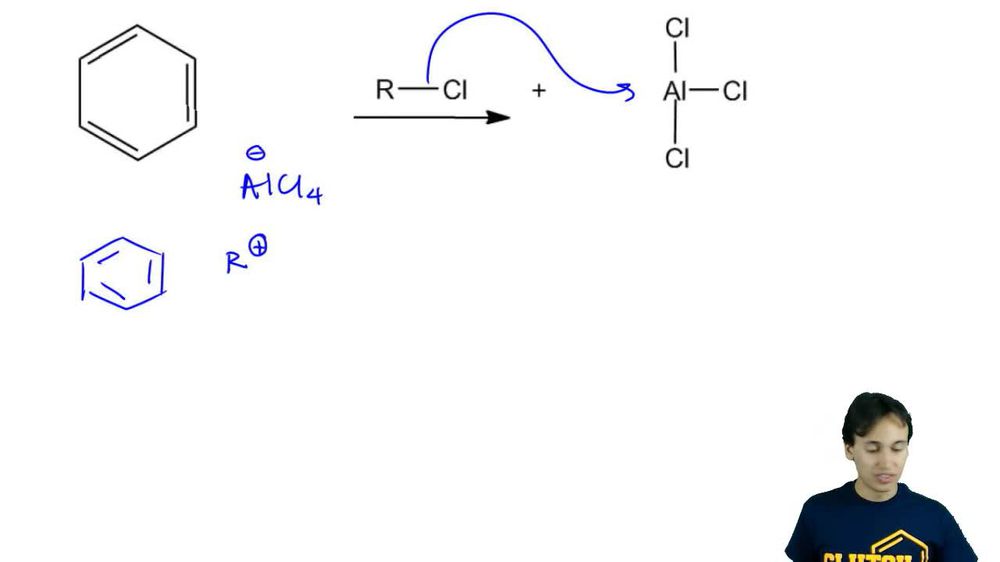
Step 1: For reaction (a), recognize that benzonitrile (C6H5CN) contains a nitrile group (-CN) attached to a benzene ring. The reaction involves methyl chloride (CH3Cl) and aluminum chloride (AlCl3), which is a Lewis acid catalyst. This setup suggests a Friedel-Crafts alkylation reaction. However, the nitrile group is an electron-withdrawing group, which deactivates the benzene ring and makes it less reactive toward electrophilic substitution. Therefore, no reaction occurs in this case.
Step 2: For reaction (b), phenol (C6H5OH) contains a hydroxyl group (-OH) attached to a benzene ring. The hydroxyl group is an electron-donating group, which activates the benzene ring toward electrophilic substitution, especially at the ortho and para positions.
Step 3: Bromine (Br2) is the electrophile in this reaction. In the presence of phenol, bromine reacts readily without the need for a catalyst. The hydroxyl group directs the bromine to the ortho and para positions on the benzene ring.
Step 4: The reaction typically results in the formation of 2-bromophenol (ortho product) and 4-bromophenol (para product). However, under excess bromine, further substitution can occur, leading to the formation of 2,4,6-tribromophenol as the major product.
Step 5: Summarize the outcomes: (a) No reaction occurs due to the deactivating effect of the nitrile group. (b) Phenol reacts with bromine to form brominated products, with 2,4,6-tribromophenol being the major product under excess bromine.
Verified video answer for a similar problem:
This video solution was recommended by our tutors as helpful for the problem above
Video duration:
5m
Play a video:
0 Comments
Key Concepts
Here are the essential concepts you must grasp in order to answer the question correctly.
Friedel-Crafts Alkylation
This is a reaction where an alkyl group is introduced to an aromatic ring using an alkyl halide and a Lewis acid catalyst, such as AlCl3. In the case of benzonitrile and methyl chloride, the AlCl3 activates the methyl chloride, allowing it to react with the aromatic system of benzonitrile, potentially leading to the formation of a methyl-substituted product.
This is a fundamental mechanism in organic chemistry where an electrophile replaces a hydrogen atom on an aromatic ring. In the reaction of phenol with Br2, the hydroxyl group (–OH) activates the aromatic ring, making it more reactive towards electrophiles like bromine, resulting in brominated phenol products.
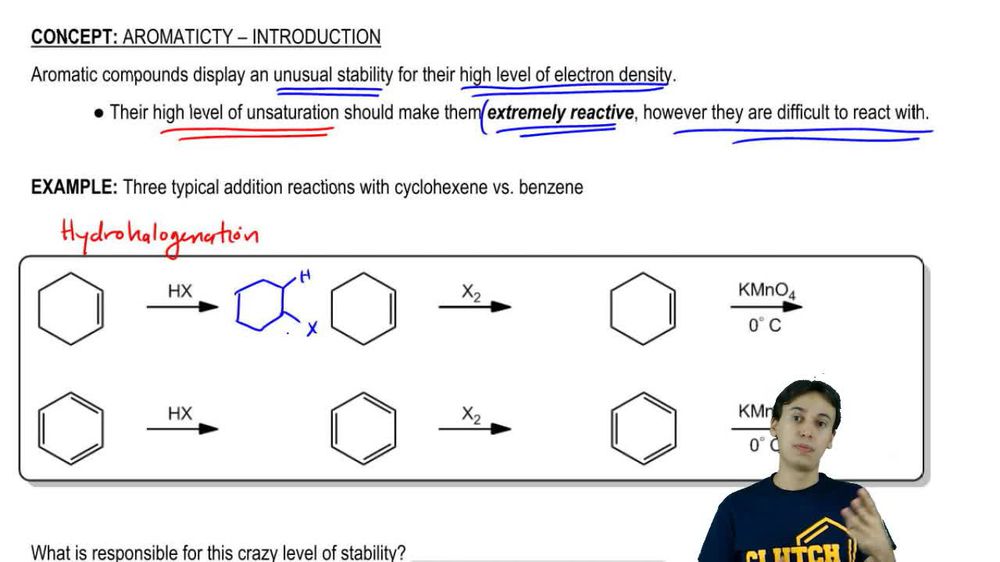
Aromatic compounds exhibit unique reactivity patterns due to their stable resonance structures. The presence of substituents, such as –CN in benzonitrile or –OH in phenol, can influence the reactivity and orientation of further substitutions, affecting the products formed in reactions with electrophiles like methyl chloride or bromine.