Give the products, if any, of each of the following reactions: c. benzoic acid + CH3CH2Cl + AlCl3 d. benzene + 2 CH3Cl + AlCl3
Verified step by step guidance
1
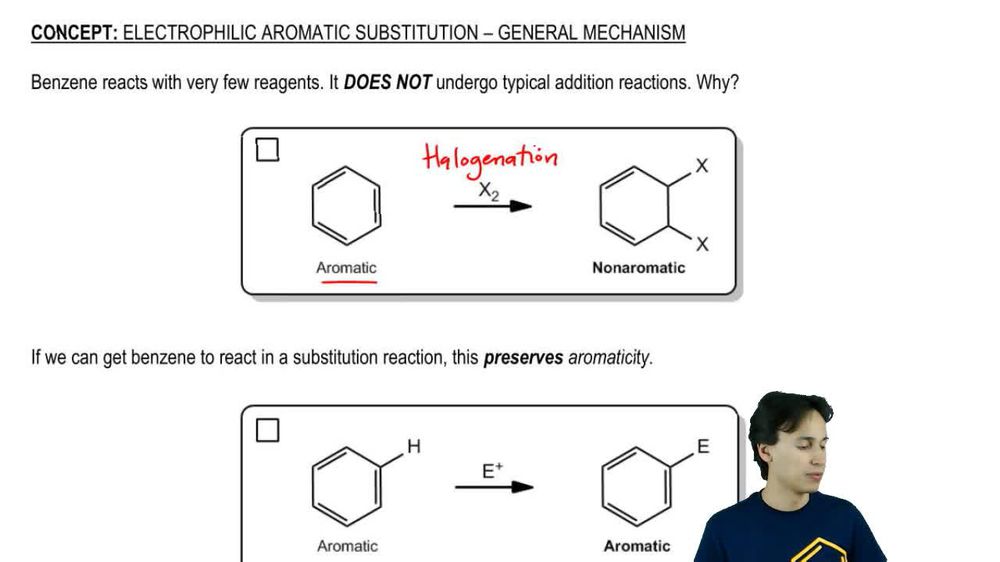
Step 1: Recognize the type of reaction. Both reactions involve a benzene ring and a reagent with an alkyl halide (R-Cl) in the presence of AlCl3, which is a Lewis acid catalyst. This suggests that these are Friedel-Crafts reactions, specifically alkylation reactions.
Step 2: For reaction (c), benzoic acid + CH3CH2Cl + AlCl3: Understand that the carboxylic acid group (-COOH) on benzoic acid is an electron-withdrawing group. This deactivates the benzene ring and makes it less reactive toward electrophilic aromatic substitution reactions like Friedel-Crafts alkylation. Therefore, no reaction occurs in this case.
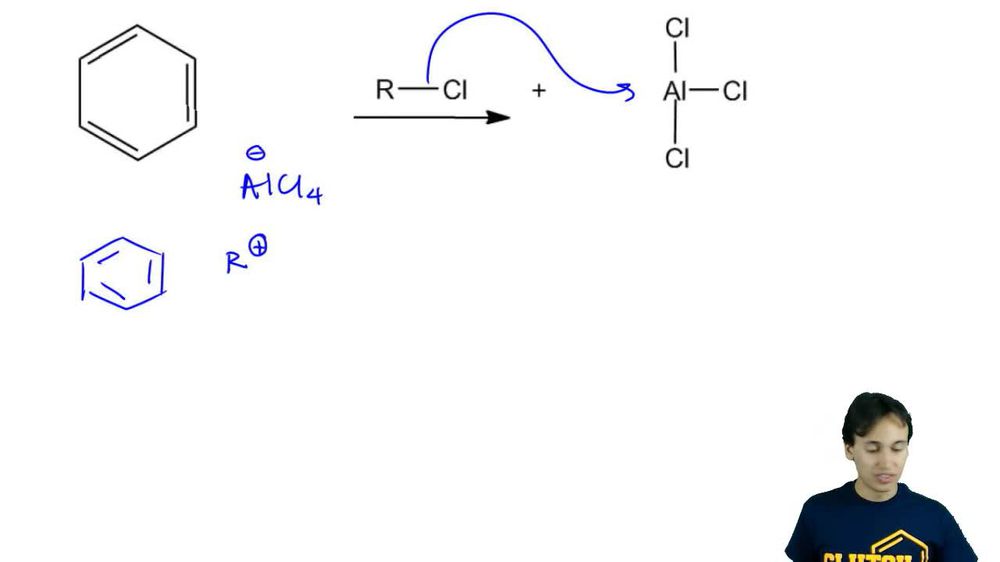
Step 3: For reaction (d), benzene + 2 CH3Cl + AlCl3: The first step involves the generation of the electrophile. AlCl3 reacts with CH3Cl to form a methyl carbocation (CH3⁺), which is the electrophile in this reaction. This is represented as: CH3Cl + AlCl3 → CH3⁺ + AlCl4⁻.
Step 4: The methyl carbocation (CH3⁺) reacts with the benzene ring in an electrophilic aromatic substitution reaction. The benzene ring donates a pair of π-electrons to the CH3⁺, forming a sigma complex (arenium ion). This intermediate then loses a proton (H⁺) to regenerate the aromaticity of the benzene ring, resulting in toluene (methylbenzene).
Step 5: The second CH3Cl molecule can undergo the same process, leading to the formation of a second methyl group on the benzene ring. The position of the second methyl group will depend on the directing effects of the first methyl group. Since the methyl group is an electron-donating group, it is an ortho/para director. Therefore, the final product will be a mixture of ortho-xylene and para-xylene.
Verified video answer for a similar problem:
This video solution was recommended by our tutors as helpful for the problem above
Video duration:
6m
Play a video:
0 Comments
Key Concepts
Here are the essential concepts you must grasp in order to answer the question correctly.
Friedel-Crafts Alkylation
Friedel-Crafts alkylation is a reaction that introduces alkyl groups into an aromatic ring using an alkyl halide and a Lewis acid catalyst, such as AlCl3. The Lewis acid activates the alkyl halide, generating a more reactive carbocation that can then attack the aromatic system. This reaction is crucial for synthesizing substituted aromatic compounds.
Electrophilic aromatic substitution (EAS) is a fundamental reaction mechanism in organic chemistry where an electrophile replaces a hydrogen atom on an aromatic ring. The aromatic system donates electrons to the electrophile, forming a sigma complex, which then loses a proton to restore aromaticity. Understanding EAS is essential for predicting the outcomes of reactions involving aromatic compounds.
The reactivity of alkyl halides in electrophilic aromatic substitution depends on the structure of the alkyl group and the leaving group. Primary alkyl halides tend to react via a carbocation mechanism, while tertiary halides can stabilize carbocations more effectively. This concept is important for determining the products of reactions involving alkyl halides and aromatic compounds.