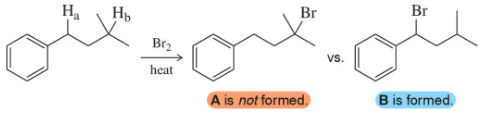
A halogenation intended to make compound A formed B instead. (a) Suggest a mechanism for the intended formation of A.
Verified step by step guidance
1
Step 1: Identify the starting compound and the halogenation reagent. Halogenation typically involves the addition of a halogen (such as Cl₂ or Br₂) to an organic compound, often in the presence of a catalyst like FeCl₃ or light.
Step 2: Consider the type of halogenation reaction. For example, if the compound is an alkane, the reaction might proceed via a radical mechanism. If it's an alkene or aromatic compound, it might proceed via electrophilic addition or substitution.
Step 3: For radical halogenation, initiate the reaction by homolytic cleavage of the halogen molecule to form two halogen radicals. This can be represented as:
Step 4: Propagation steps involve the halogen radical reacting with the organic compound to form a new radical and a halogenated product. For example, , followed by
Step 5: Termination steps involve the combination of radicals to form stable products, ending the chain reaction. For example, or
Verified video answer for a similar problem:
This video solution was recommended by our tutors as helpful for the problem above
Play a video:
0 Comments
Key Concepts
Here are the essential concepts you must grasp in order to answer the question correctly.
Halogenation Reaction
Halogenation is a chemical reaction that involves the addition of one or more halogens to a compound. In organic chemistry, it typically refers to the substitution of hydrogen atoms in hydrocarbons with halogen atoms, often using reagents like chlorine or bromine. Understanding the conditions and reagents used is crucial for predicting the outcome of such reactions.
A reaction mechanism is a detailed step-by-step description of how a chemical reaction occurs at the molecular level. It includes the sequence of elementary steps, the intermediates formed, and the transition states. Mechanisms help in understanding the pathway from reactants to products, which is essential for predicting and controlling chemical reactions.
Regioselectivity refers to the preference of a chemical reaction to occur at one location over another within a molecule. In halogenation, regioselectivity determines which hydrogen atom is replaced by a halogen, influenced by factors like steric hindrance and electronic effects. Understanding regioselectivity is key to predicting the major product of a reaction.

 Verified step by step guidance
 03:45
03:45