Ch. 9 - Substitution and Elimination Reactions of Alkyl Halides
Bruice - Organic Chemistry 8th Edition
Bruice8th EditionOrganic ChemistryISBN: 9780135213711Not the one you use?Change textbook
Chapter 10, Problem 52

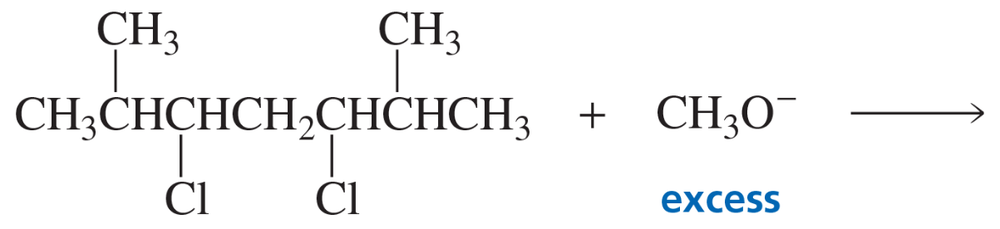
What product is obtained when the following compound undergoes two successive elimination reactions?

Verified step by step guidance
1
Step 1: Analyze the structure of the given compound. The molecule contains two chlorine atoms attached to adjacent carbon atoms, making it a vicinal dihalide. This setup is ideal for elimination reactions to form alkenes.
Step 2: Recognize the reagent provided, CH3O⁻ (methoxide ion) in excess. Methoxide is a strong base, which will promote elimination reactions via the E2 mechanism. In the E2 mechanism, a proton is abstracted from a β-carbon, and the leaving group (Cl⁻) is expelled simultaneously, forming a double bond.
Step 3: Perform the first elimination reaction. The base (CH3O⁻) will abstract a proton from one of the β-carbons adjacent to a chlorine atom, and the chlorine atom will leave. This results in the formation of the first double bond, creating an alkene.
Step 4: Perform the second elimination reaction. The remaining chlorine atom and a proton from the β-carbon adjacent to it will undergo another E2 elimination reaction, facilitated by the excess CH3O⁻. This results in the formation of a second double bond, creating a conjugated diene.
Step 5: Consider the stereochemistry and regiochemistry of the product. The final product will likely be a conjugated diene with the most stable configuration, as elimination reactions tend to favor the formation of the most stable (thermodynamic) product. The double bonds will be in conjugation, enhancing stability.

Verified video answer for a similar problem:

This video solution was recommended by our tutors as helpful for the problem above.
Video duration:
5m
Was this helpful?

Key Concepts

Here are the essential concepts you must grasp in order to answer the question correctly.

Elimination Reactions

Elimination reactions involve the removal of atoms or groups from a molecule, resulting in the formation of a double bond or a ring structure. In organic chemistry, common types include E1 and E2 mechanisms, where E2 is a concerted process requiring a strong base, while E1 involves a carbocation intermediate. Understanding these mechanisms is crucial for predicting the products of reactions involving halides and other leaving groups.
Recommended video:
Guided course
00:40
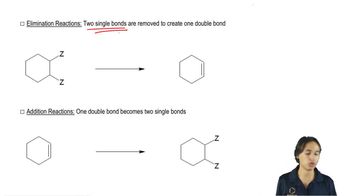
Recognizing Elimination Reactions.

Base Strength and Reaction Conditions

The strength of the base used in elimination reactions significantly influences the reaction pathway and product formation. Strong bases, like CH3O− (methoxide), favor E2 mechanisms, leading to the formation of alkenes. Additionally, the presence of excess base can drive the reaction to completion, promoting multiple elimination steps, which is essential for understanding the final product in this scenario.
Recommended video:
2:56
Base Pairing Concept 1

Regioselectivity and Stereochemistry

Regioselectivity refers to the preference of a chemical reaction to yield one structural isomer over others, while stereochemistry involves the spatial arrangement of atoms in the product. In elimination reactions, the Zaitsev rule often applies, predicting that the more substituted alkene will be the major product. Recognizing these concepts helps in determining the expected products from successive eliminations, especially when multiple elimination pathways are possible.
Recommended video:
1:38
Polymer Stereochemistry Concept 1