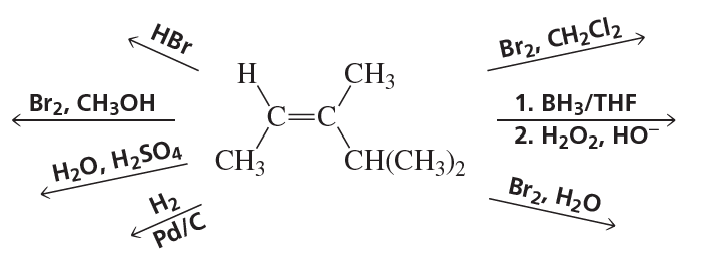
Draw the products of the following reactions, including their configurations:
Verified step by step guidance
1
Step 1: Analyze the starting compound, which is a cyclohexene derivative with a double bond and two methyl groups attached to the ring. The reactions involve hydrogenation, hydration, and hydrohalogenation.
Step 2: For reaction A (H2, Pd/C), this is a catalytic hydrogenation reaction. The double bond in the cyclohexene will be reduced to a single bond, resulting in a cyclohexane derivative. The stereochemistry of the product will be syn addition, meaning both hydrogens will add to the same face of the ring.
Step 3: For reaction B (H2O, H2SO4), this is an acid-catalyzed hydration reaction. The double bond will react with water in the presence of sulfuric acid, following Markovnikov's rule. The hydroxyl group (-OH) will add to the more substituted carbon of the double bond, forming an alcohol. Consider the stereochemistry of the product.
Step 4: For reaction C (H-Br), this is a hydrohalogenation reaction. The double bond will react with HBr, following Markovnikov's rule. The bromine atom will add to the more substituted carbon of the double bond, forming an alkyl bromide. Consider the stereochemistry of the product.
Step 5: Draw the products for each reaction, ensuring that the configurations (stereochemistry) are correctly represented. For reaction A, the product is a saturated cyclohexane derivative. For reaction B, the product is an alcohol. For reaction C, the product is an alkyl bromide.
Verified video answer for a similar problem:
This video solution was recommended by our tutors as helpful for the problem above
Video duration:
10m
Play a video:
0 Comments
Key Concepts
Here are the essential concepts you must grasp in order to answer the question correctly.
Hydrogenation
Hydrogenation is a chemical reaction that involves the addition of hydrogen (H2) to an unsaturated compound, typically an alkene or alkyne, to convert it into a saturated compound. In the presence of a catalyst, such as palladium on carbon (Pd/C), the double or triple bonds are reduced, resulting in the formation of alkanes. This process is crucial for understanding how to manipulate the structure of organic molecules.
Electrophilic addition is a reaction mechanism where an electrophile reacts with a nucleophile, leading to the formation of a more saturated product. In the context of the reaction with HBr, the double bond in the benzene derivative acts as a nucleophile, attacking the electrophilic hydrogen of HBr, resulting in the addition of bromine to the molecule. This concept is essential for predicting the products of reactions involving alkenes and alkynes.
Regioselectivity refers to the preference of a chemical reaction to yield one structural isomer over others when multiple possibilities exist. In the case of the addition of HBr to the benzene derivative, the regioselectivity will determine which carbon atom of the double bond the bromine atom attaches to, influencing the final product's structure. Understanding regioselectivity is vital for predicting the outcomes of organic reactions.