One of the principal components of lemongrass oil is limonene, C10H16. When limonene is treated with excess hydrogen and a platinum catalyst, the product is an alkane of formula C10H20. What can you conclude about the structure of limonene?
Verified step by step guidance
1
Identify the molecular formula of limonene, which is C10H16. This indicates that limonene is an unsaturated hydrocarbon, as it has fewer hydrogens than the corresponding alkane (C10H22).
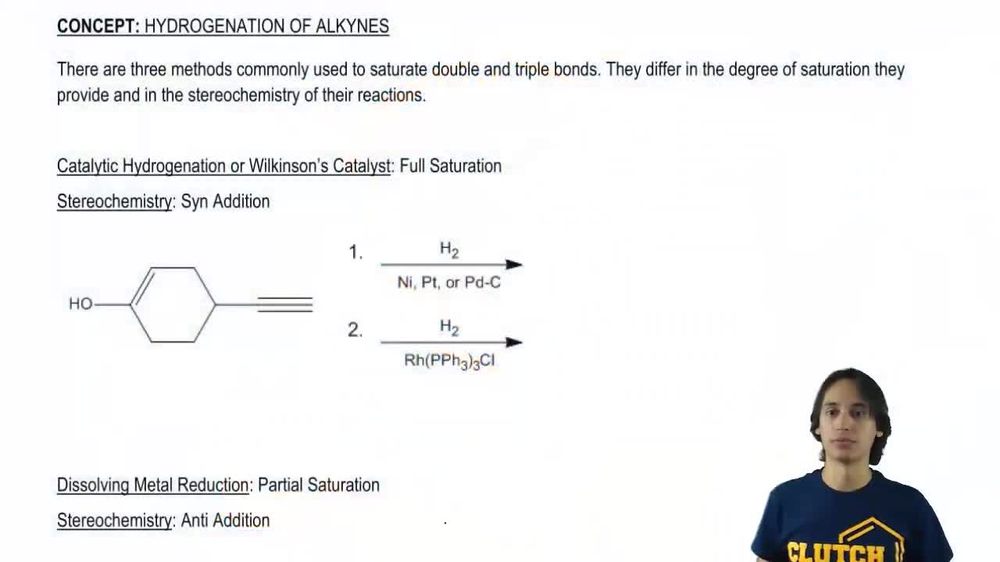
Recognize that treating limonene with excess hydrogen and a platinum catalyst results in hydrogenation, a process that adds hydrogen atoms to double bonds or triple bonds in the molecule.
Note that the product of the reaction has the formula C10H20, which is an alkane. This suggests that limonene originally contained two double bonds, as the addition of hydrogen converts each double bond into a single bond, increasing the hydrogen count by two for each double bond.
Conclude that limonene is likely a diene (a compound with two double bonds) based on the molecular formula and the reaction outcome. The double bonds are responsible for the unsaturation in the original molecule.
Consider the possibility that limonene has a cyclic structure, as many terpenes (like limonene) are cyclic hydrocarbons. The presence of double bonds in a cyclic structure would further explain its reactivity during hydrogenation.
Verified video answer for a similar problem:
This video solution was recommended by our tutors as helpful for the problem above
Video duration:
4m
Play a video:
0 Comments
Key Concepts
Here are the essential concepts you must grasp in order to answer the question correctly.
Hydrogenation
Hydrogenation is a chemical reaction that involves the addition of hydrogen (H2) to an unsaturated compound, typically in the presence of a catalyst. In the case of limonene, which contains double bonds, hydrogenation converts these unsaturated sites into saturated ones, resulting in the formation of an alkane. This process is crucial for understanding how the structure of limonene changes when treated with hydrogen.
Alkenes are hydrocarbons that contain at least one carbon-carbon double bond, while alkanes are saturated hydrocarbons with only single bonds. The transformation of limonene (an alkene) into an alkane (C10H20) through hydrogenation indicates that limonene must have at least one double bond in its structure. Recognizing this distinction helps in deducing the structural features of limonene.
Structural isomerism occurs when compounds have the same molecular formula but different structural arrangements of atoms. Limonene, with the formula C10H16, can exist in various isomeric forms, including different placements of double bonds and branching. Understanding structural isomerism is essential for analyzing the possible configurations of limonene and predicting its reactivity during hydrogenation.

 4:28 minutes
 Verified step by step guidance
 00:48
00:48