

A graduate student was studying enzymatic reductions of cyclohexanones when she encountered some interesting chemistry. When she used an enzyme and NADPH to reduce the following ketone, she was surprised to find that the product was optically active. She carefully repurified the product so that no enzyme, NADPH, or other contaminants were present. Still, the product was optically active. c. If this reaction could be accomplished using H2 and a nickel catalyst, would the product be optically active? Explain.
Verified step by step guidance
1
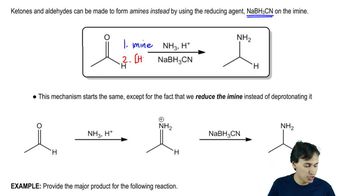
Step 1: Analyze the reaction with NADPH and enzyme. The reduction of the ketone group in cyclohexanones using NADPH and an enzyme leads to the formation of an alcohol. Enzymes are highly stereospecific, meaning they can produce a single enantiomer or a specific ratio of enantiomers, resulting in an optically active product.
Step 2: Understand optical activity. Optical activity arises when a molecule is chiral, meaning it has non-superimposable mirror images. The product of the enzymatic reduction is optically active because the enzyme selectively forms one enantiomer over the other.
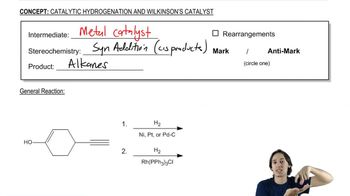
Step 3: Consider the reaction with H2 and nickel catalyst. Nickel catalysts are not stereospecific and typically reduce ketones to alcohols without preference for one enantiomer. This results in a racemic mixture, which contains equal amounts of both enantiomers.
Step 4: Explain the optical activity of the product with H2 and nickel catalyst. A racemic mixture is not optically active because the optical rotations of the two enantiomers cancel each other out.
Step 5: Conclude the comparison. If the reaction were accomplished using H2 and a nickel catalyst, the product would not be optically active because the reduction would produce a racemic mixture rather than a single enantiomer.
Verified video answer for a similar problem:
This video solution was recommended by our tutors as helpful for the problem above
Video duration:
3m
Play a video:
0 Comments
Key Concepts
Here are the essential concepts you must grasp in order to answer the question correctly.
Enzymatic Reduction
Enzymatic reduction involves the use of enzymes to facilitate the addition of electrons to a substrate, typically resulting in the conversion of a carbonyl group (like a ketone) to an alcohol. This process is stereospecific, meaning it can produce a specific enantiomer, leading to optically active products. The enzyme's active site is tailored to the substrate, allowing for selective reduction that can create chiral centers.
Optical activity refers to the ability of a chiral compound to rotate plane-polarized light. This property arises from the presence of chiral centers in the molecule, which can exist in two non-superimposable mirror-image forms (enantiomers). The degree of rotation is measured using a polarimeter, and the presence of optical activity in the product indicates that it is chiral, which is significant in understanding the outcome of reactions involving chiral catalysts or substrates.
Catalytic hydrogenation is a chemical reaction that involves the addition of hydrogen (H2) to a compound, typically using a metal catalyst such as nickel. This process can reduce double bonds or carbonyl groups but often leads to a racemic mixture when applied to achiral substrates, resulting in products that are not optically active. The stereochemistry of the product depends on the reaction conditions and the nature of the catalyst used.