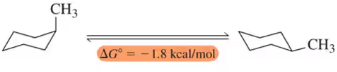
For the following equilibrium processes and the corresponding ∆G°, calculate (i) Keq and (ii) the % composition of the equilibrium mixture (% reactants, % products) at 298 K. (a)
Verified step by step guidance
1
Step 1: Understand the relationship between Gibbs free energy (∆G°) and the equilibrium constant (Keq). The formula to use is: , where R is the gas constant (1.987 cal/(mol·K)), T is the temperature in Kelvin (298 K), and ∆G° is given in kcal/mol (convert to cal/mol for consistency).
Step 2: Convert ∆G° from kcal/mol to cal/mol. Since 1 kcal = 1000 cal, multiply -1.8 kcal/mol by 1000 to get -1800 cal/mol.
Step 3: Substitute the values into the formula to solve for Keq. Rearrange the formula to isolate Keq: . Plug in R = 1.987 cal/(mol·K), T = 298 K, and ∆G° = -1800 cal/mol.
Step 4: Calculate the % composition of the equilibrium mixture using the formula for mole fraction. The mole fraction of products is given by , and the mole fraction of reactants is . Multiply each mole fraction by 100 to get the percentage composition.
Step 5: Interpret the results. A negative ∆G° indicates that the equilibrium favors the products. The calculated Keq will be greater than 1, and the % composition of products will be higher than that of reactants.
Verified video answer for a similar problem:
This video solution was recommended by our tutors as helpful for the problem above
Play a video:
0 Comments
Key Concepts
Here are the essential concepts you must grasp in order to answer the question correctly.
Gibbs Free Energy (∆G°)
Gibbs Free Energy (∆G°) is a thermodynamic potential that indicates the spontaneity of a reaction at constant temperature and pressure. A negative ∆G° value, such as -1.8 kcal/mol, suggests that the reaction is spontaneous in the forward direction, favoring the formation of products. Understanding this concept is crucial for predicting the direction of equilibrium and the extent to which reactants are converted to products.
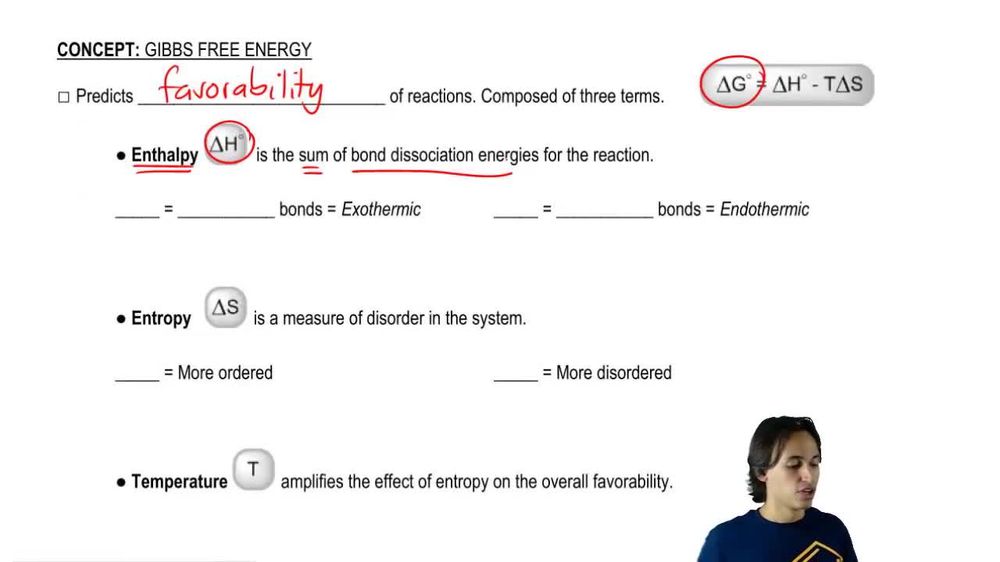
Breaking down the different terms of the Gibbs Free Energy equation.
Equilibrium Constant (K<sub>eq</sub>)
The equilibrium constant (K<sub>eq</sub>) quantifies the ratio of the concentrations of products to reactants at equilibrium for a reversible reaction. It is calculated using the formula K<sub>eq</sub> = [products]/[reactants]. A K<sub>eq</sub> greater than 1 indicates that products are favored at equilibrium, while a value less than 1 suggests that reactants are favored. This concept is essential for determining the composition of the equilibrium mixture.
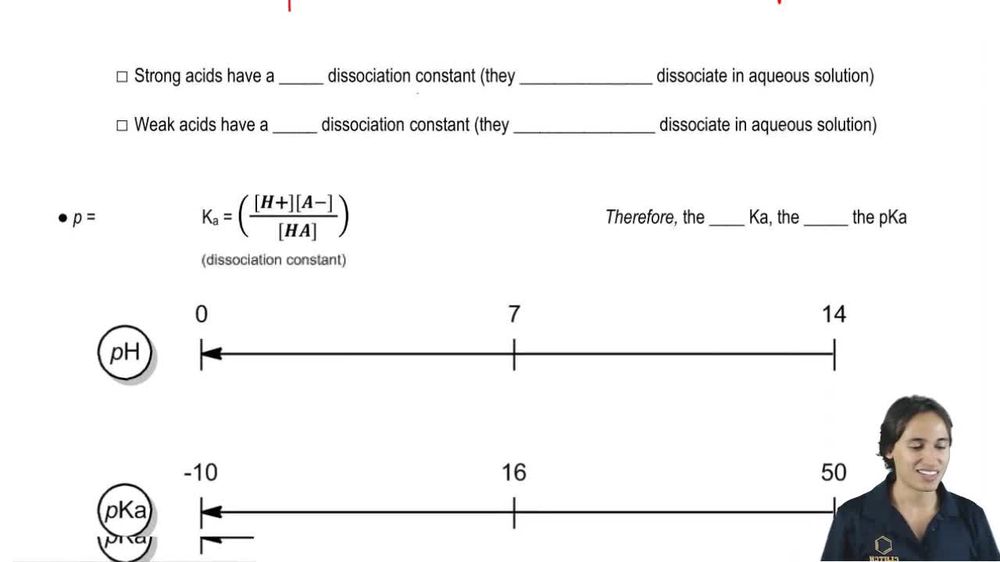
The relationship between equilibrium constant and pKa.
Percent Composition at Equilibrium
Percent composition at equilibrium refers to the distribution of reactants and products in a chemical reaction once it has reached equilibrium. It is calculated by determining the mole fractions of each component and converting these to percentages. This concept is important for understanding how much of each species is present in the mixture at equilibrium, which can be derived from the K<sub>eq</sub> value and the initial concentrations of reactants.