Convert the line-angle drawings into Fischer projections. (b)
Verified step by step guidance
1
Step 1: Identify the chiral centers in the line-angle drawing. Chiral centers are carbon atoms bonded to four different groups. Ensure you recognize the stereochemistry (R or S configuration) at each chiral center.
Step 2: Orient the molecule so that the longest carbon chain is vertical, with the most oxidized carbon (e.g., a carbonyl or carboxylic group) at the top. This orientation is essential for constructing a Fischer projection.
Step 3: Determine the spatial arrangement of substituents around each chiral center. In a Fischer projection, horizontal lines represent bonds coming out of the plane (toward the viewer), and vertical lines represent bonds going into the plane (away from the viewer).
Step 4: Translate the 3D structure into a 2D Fischer projection by placing the substituents appropriately. Ensure that the stereochemistry (R or S) is preserved during this conversion. Double-check the configuration by assigning priorities to the substituents and using the Cahn-Ingold-Prelog rules.
Step 5: Verify the Fischer projection by mentally converting it back into a 3D structure and comparing it to the original line-angle drawing. Ensure that the stereochemistry and connectivity are consistent between the two representations.
Verified video answer for a similar problem:
This video solution was recommended by our tutors as helpful for the problem above
Video duration:
6m
Play a video:
0 Comments
Key Concepts
Here are the essential concepts you must grasp in order to answer the question correctly.
Line-Angle Drawings
Line-angle drawings, also known as skeletal structures, are a simplified way of representing organic molecules. In these drawings, carbon atoms are represented by the ends and intersections of lines, while hydrogen atoms are often omitted for clarity. This method allows chemists to visualize complex structures quickly, focusing on the connectivity of atoms rather than their individual bonds.
Fischer projections are a two-dimensional representation of three-dimensional organic molecules, particularly useful for depicting stereochemistry. In this format, the vertical lines represent bonds that are oriented away from the viewer, while horizontal lines indicate bonds that are coming towards the viewer. Fischer projections are especially important for illustrating the configuration of chiral centers in carbohydrates and amino acids.
Stereochemistry is the study of the spatial arrangement of atoms in molecules and how this affects their chemical behavior. It is crucial for understanding isomerism, where compounds with the same molecular formula can have different structures and properties. In the context of converting line-angle drawings to Fischer projections, recognizing the stereochemical configuration of chiral centers is essential to accurately represent the molecule's 3D orientation.

 6:31 minutes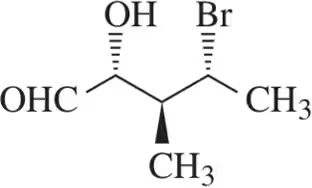
 Verified step by step guidance
 02:46
02:46