Show how the following compounds could be prepared from 2-methylpropane: b. 2-methyl-1-propene
Verified step by step guidance
1
Step 1: Begin with 2-methylpropane, which is an alkane. To convert it into 2-methyl-1-propene, you need to perform a dehydrogenation reaction to remove hydrogen atoms and form a double bond.
Step 2: Use a halogenation reaction to introduce a halogen atom (e.g., bromine or chlorine) into the molecule. This can be achieved by reacting 2-methylpropane with a halogen in the presence of UV light or heat, resulting in the formation of 2-methylpropyl halide.
Step 3: Perform an elimination reaction to remove the halogen atom and a hydrogen atom from adjacent carbon atoms. Use a strong base, such as potassium hydroxide (KOH) or sodium ethoxide (NaOEt), in an alcoholic solution to promote the formation of the double bond.
Step 4: The elimination reaction will result in the formation of 2-methyl-1-propene. Ensure that the reaction conditions favor the formation of the desired product by controlling temperature and solvent choice.
Step 5: Verify the structure of the product using spectroscopic techniques such as IR or NMR to confirm the presence of the double bond and the correct molecular structure of 2-methyl-1-propene.
Verified video answer for a similar problem:
This video solution was recommended by our tutors as helpful for the problem above
Video duration:
1m
Play a video:
0 Comments
Key Concepts
Here are the essential concepts you must grasp in order to answer the question correctly.
Elimination Reactions
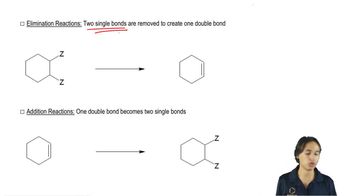
Elimination reactions involve the removal of atoms or groups from a molecule, resulting in the formation of a double bond. In the context of converting 2-methylpropane to 2-methyl-1-propene, a common method is dehydrohalogenation, where a hydrogen halide is eliminated from an alkyl halide. Understanding the mechanism and conditions for elimination reactions is crucial for synthesizing alkenes.
Rearrangement reactions involve the structural reorganization of a molecule, often leading to more stable or reactive forms. In the case of 2-methylpropane, a carbocation intermediate may rearrange during the elimination process, affecting the final product. Recognizing how and when rearrangements occur is essential for predicting the outcome of organic reactions.
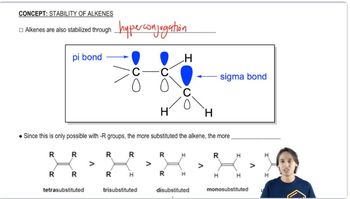
The stability and reactivity of alkenes are influenced by factors such as sterics and electronic effects. For example, 2-methyl-1-propene is a more stable product due to hyperconjugation and the presence of alkyl substituents. Understanding these principles helps in predicting the feasibility of reactions and the stability of intermediates formed during the synthesis process.