Show how you would accomplish the following synthetic conversions. (d) 2−methylbutan-2-ol → 2-bromo-3-methylbutane
Verified step by step guidance
1
Step 1: Identify the functional group in the starting material, 2-methylbutan-2-ol. It contains a tertiary alcohol (-OH group attached to a tertiary carbon). This is important because tertiary alcohols undergo substitution reactions readily under acidic conditions.
Step 2: Recognize that the target molecule, 2-bromo-3-methylbutane, requires the replacement of the hydroxyl (-OH) group with a bromine atom (Br). This suggests a substitution reaction mechanism.
Step 3: Select an appropriate reagent for the substitution reaction. Use hydrobromic acid (HBr) as the reagent, as it is commonly used to convert alcohols to alkyl bromides via an SN1 mechanism. The tertiary alcohol will form a stable carbocation intermediate during the reaction.
Step 4: Write the reaction mechanism. The hydroxyl group is protonated by HBr, forming water as a leaving group. This generates a tertiary carbocation intermediate. Bromide ion (Br⁻) then attacks the carbocation, resulting in the formation of 2-bromo-3-methylbutane.
Step 5: Verify the stereochemistry and structure of the product. Since the reaction proceeds via an SN1 mechanism, the product may be racemic if the carbocation intermediate is chiral. However, in this case, the product is achiral, so stereochemistry is not a concern.
Verified video answer for a similar problem:
This video solution was recommended by our tutors as helpful for the problem above
Video duration:
2m
Play a video:
0 Comments
Key Concepts
Here are the essential concepts you must grasp in order to answer the question correctly.
Alcohols and Their Reactivity
Alcohols, such as 2-methylbutan-2-ol, are organic compounds containing a hydroxyl (-OH) group. Their reactivity is influenced by the structure of the alcohol, including whether it is primary, secondary, or tertiary. In this case, 2-methylbutan-2-ol is a tertiary alcohol, which can undergo substitution reactions to form alkyl halides.
Nucleophilic substitution reactions involve the replacement of a leaving group (like -OH in alcohols) with a nucleophile (such as Br-). In the conversion of 2-methylbutan-2-ol to 2-bromo-3-methylbutane, the hydroxyl group is replaced by a bromine atom through an SN1 or SN2 mechanism, depending on the conditions and substrate structure.
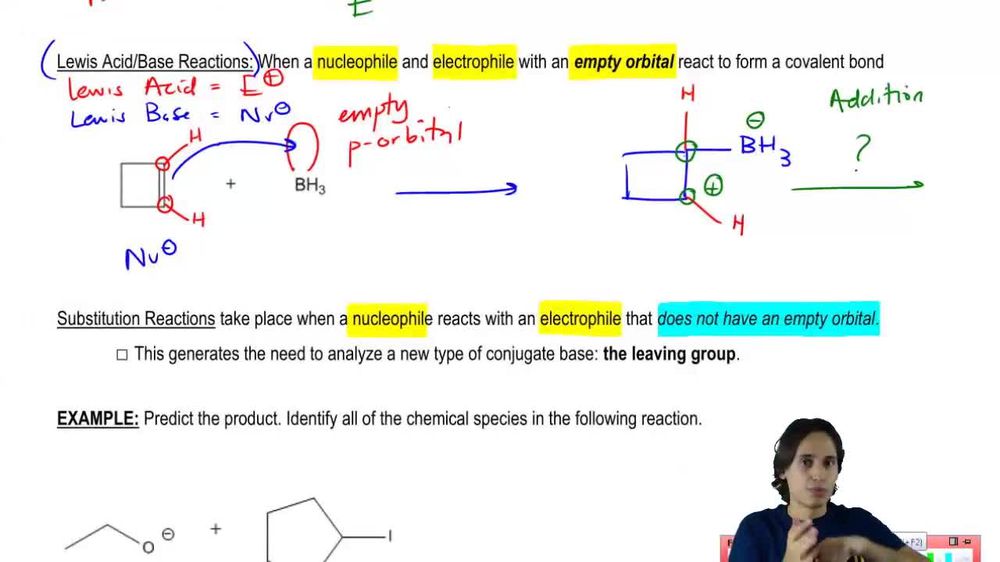
Nucleophiles and Electrophiles can react in Substitution Reactions.
Stereochemistry and Isomerism
Stereochemistry refers to the spatial arrangement of atoms in molecules and is crucial in organic synthesis. The conversion from 2-methylbutan-2-ol to 2-bromo-3-methylbutane may lead to different stereoisomers, depending on the reaction pathway. Understanding how to manage stereochemistry is essential for predicting the outcome of synthetic reactions.