Ch.8 - Reactions of Alkenes
Wade - Organic Chemistry 9th Edition
Wade9th EditionOrganic ChemistryISBN: 9780135213728Not the one you use?Change textbook
Chapter 8, Problem 74

The cationic polymerization of isobutylene (2-methylpropene) is shown in Section 8-16A. Isobutylene is often polymerized under free-radical conditions. Propose a mechanism for the free-radical polymerization of isobutylene.

Verified step by step guidance
1
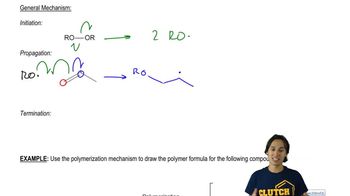
Identify the three main stages of free-radical polymerization: initiation, propagation, and termination. These stages will guide the mechanism for the polymerization of isobutylene.
In the initiation step, a free radical is generated. This is typically achieved by using an initiator such as benzoyl peroxide or AIBN (azobisisobutyronitrile). The initiator decomposes under heat or UV light to form free radicals. Write the decomposition reaction of the initiator to show the formation of free radicals.
In the propagation step, the free radical generated in the initiation step reacts with the double bond of isobutylene (2-methylpropene). This reaction forms a new carbon-centered radical at the terminal carbon of the isobutylene molecule. Represent this step using a curved arrow mechanism to show the movement of electrons from the radical to the double bond and the formation of the new radical.
Continue the propagation step by showing how the newly formed radical reacts with another molecule of isobutylene. This step repeats, leading to the growth of the polymer chain. Use a general structure to represent the growing polymer chain and show the addition of another isobutylene unit.
In the termination step, two growing polymer radicals combine to form a stable, non-radical product. This can occur through coupling (where two radicals directly combine) or disproportionation (where one radical abstracts a hydrogen atom from another radical). Write the possible termination reactions and explain how they lead to the end of the polymerization process.

Verified video answer for a similar problem:

This video solution was recommended by our tutors as helpful for the problem above.
Video duration:
7m
Was this helpful?

Key Concepts

Here are the essential concepts you must grasp in order to answer the question correctly.

Free-Radical Polymerization

Free-radical polymerization is a method of polymer synthesis that involves the formation of free radicals, which are highly reactive species with unpaired electrons. This process typically occurs in three main steps: initiation, propagation, and termination. In the initiation step, a radical initiator generates free radicals that react with monomers, leading to the growth of polymer chains through repeated addition of monomer units.
Recommended video:
Guided course
03:28
The mechanism of Radical Polymerization.

Cationic Polymerization

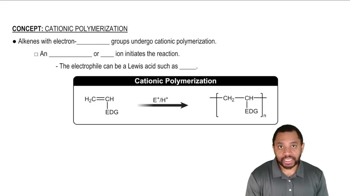
Cationic polymerization is a type of chain-growth polymerization that involves the formation of a positively charged cation as an active center. This mechanism is characterized by the addition of monomers that can stabilize a positive charge, allowing for the growth of the polymer chain. While the question focuses on free-radical conditions, understanding cationic polymerization provides insight into alternative mechanisms and the behavior of isobutylene under different conditions.
Recommended video:
0:57
Cationic Polymerization Concept 1

Isobutylene Structure and Reactivity

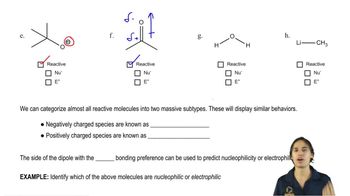
Isobutylene, or 2-methylpropene, is an alkene with a branched structure that influences its reactivity in polymerization processes. The presence of the double bond makes it susceptible to addition reactions, which are fundamental in polymerization. Understanding the structure of isobutylene helps predict how it will behave under free-radical conditions, including the formation of stable radical intermediates during the polymerization process.
Recommended video:
Guided course
01:17
Reactivity of Molecules
Related Practice
Textbook Question

Propose a mechanism for reaction of the first three propylene units in the polymerization of propylene in the presence of a peroxide.

1694
views

Textbook Question

Ozonolysis can be applied selectively to different types of carbon–carbon double bonds. The compound shown below contains two vinyl ether double bonds, which are electron-rich because of the electron-donating alkoxy groups. Ozone reacts more quickly with electron-rich double bonds and more slowly with hindered double bonds. At −78 °C, this compound quickly adds two equivalents of ozone. Immediate reduction of the ozonide gives a good yield of a single product. Show the expected ozonolyis product, and label the functional groups produced, some of which are not typical from ozonolysis of simple alkenes.

1014
views
Textbook Question

When styrene (vinylbenzene) is commercially polymerized, about 1–3% of 1,4-divinylbenzene is often added to the styrene. The incorporation of some divinylbenzene gives a polymer with more strength and better resistance to organic solvents. Explain how a very small amount of divinylbenzene has a marked effect on the properties of the polymer.

1427
views
Textbook Question

An inexperienced graduate student treated dec-5-ene with borane in THF, placed the flask in a refrigerator, and left for a party. When he returned from the party, he discovered that the refrigerator was broken and that it had gotten quite warm inside. Although all the THF had evaporated from the flask, he treated the residue with basic hydrogen peroxide. To his surprise, he recovered a fair yield of decan-1-ol. Use a mechanism to show how this reaction might have occurred. (Hint: The addition of BH3 is reversible.)

1066
views
Textbook Question

A graduate student attempted to form the iodohydrin of the alkene shown below. Her analysis of the products showed a good yield of an unexpected product. Propose a mechanism to explain the formation of this product.

1003
views
Textbook Question

Propose mechanisms to explain the opposite regiochemistry observed in the following two reactions.

907
views