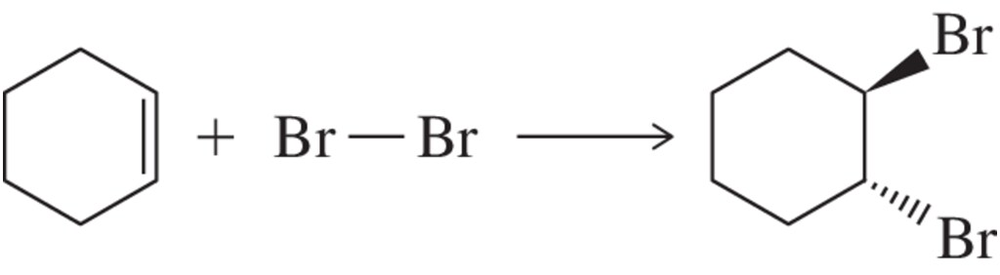
Calculate ∆H° for the following alkene addition reaction, one we discuss further in Chapter 7. Predict the sign of ∆S° . (The BDE for C―C π bond is approximately 65 kcal/mol.)
Verified step by step guidance
1
Identify the bonds broken and formed during the reaction. In an alkene addition reaction, the π bond of the alkene is broken, and two new σ bonds are formed (e.g., C-H or C-X bonds, depending on the reaction).
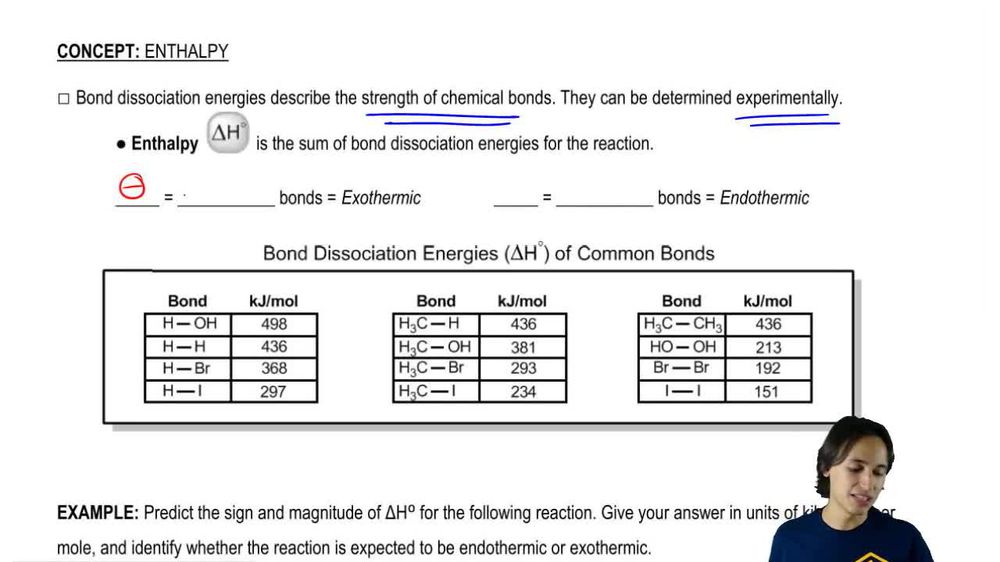
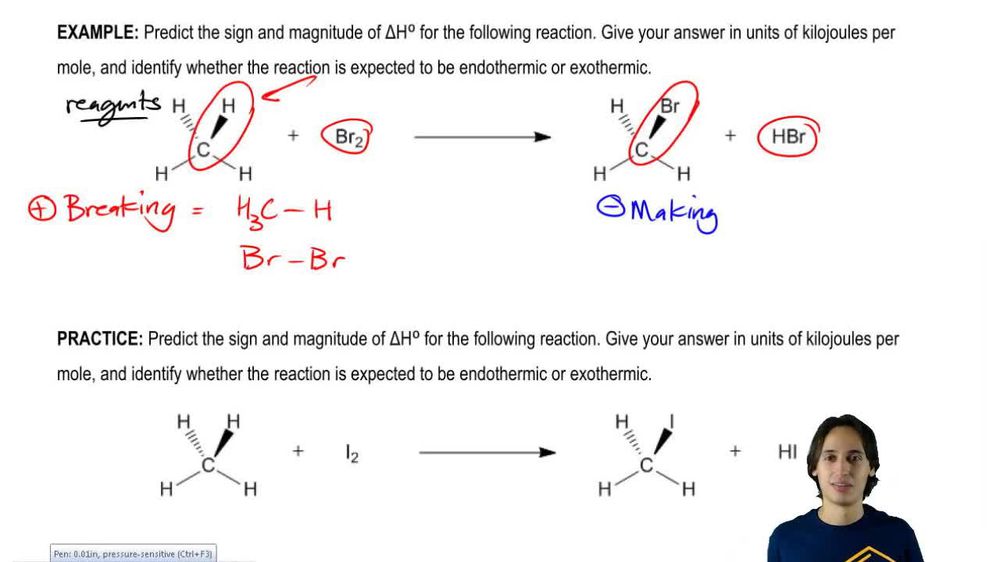
Use the bond dissociation energies (BDEs) to calculate the enthalpy change (∆H°). The formula is: ∆H° = Σ(BDE of bonds broken) - Σ(BDE of bonds formed). For this reaction, the BDE of the C=C π bond is approximately 65 kcal/mol, and you will need the BDEs of the bonds formed (e.g., C-H or C-X).
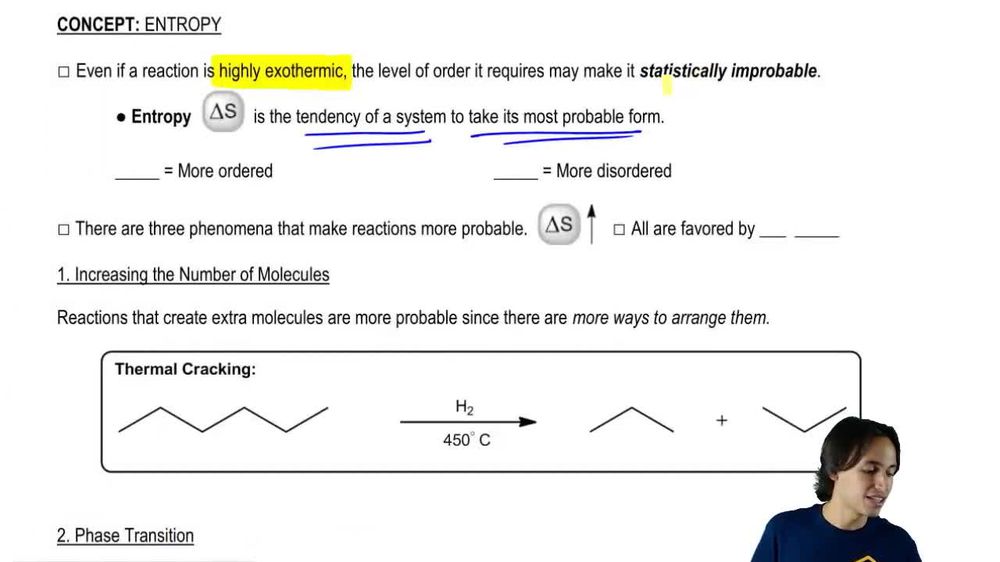
Predict the sign of ∆S° (entropy change). In an alkene addition reaction, two reactants combine to form a single product, which decreases the number of molecules and thus decreases entropy. Therefore, ∆S° is expected to be negative.
Substitute the known BDE values into the ∆H° formula to calculate the enthalpy change. Ensure that you account for all bonds broken and formed in the reaction.
Summarize the thermodynamic predictions: ∆H° will likely be negative (exothermic) if the bonds formed are stronger than the bonds broken, and ∆S° will be negative due to the decrease in molecular randomness.
Verified video answer for a similar problem:
This video solution was recommended by our tutors as helpful for the problem above
Video duration:
4m
Play a video:
0 Comments
Key Concepts
Here are the essential concepts you must grasp in order to answer the question correctly.
Enthalpy Change (∆H°)
Enthalpy change (∆H°) refers to the heat content change of a system at constant pressure during a chemical reaction. In the context of alkene addition reactions, it is crucial to calculate the energy required to break bonds in the reactants and the energy released when new bonds are formed in the products. A negative ∆H° indicates an exothermic reaction, while a positive value indicates an endothermic reaction.
Bond dissociation energy (BDE) is the energy required to break a specific bond in a molecule, resulting in the formation of free radicals. In this question, the BDE for the C―C π bond is given as approximately 65 kcal/mol, which is essential for calculating the enthalpy change of the reaction. Understanding BDE helps predict how much energy is needed to initiate the reaction and how it influences the overall reaction energetics.
How to calculate enthalpy using bond dissociation energies.
Entropy Change (∆S°)
Entropy change (∆S°) measures the disorder or randomness in a system. In chemical reactions, a positive ∆S° indicates an increase in disorder, while a negative ∆S° suggests a decrease. For the alkene addition reaction, predicting the sign of ∆S° involves considering the number of reactant and product molecules; typically, if fewer gas molecules are produced, ∆S° is negative, reflecting a decrease in disorder.