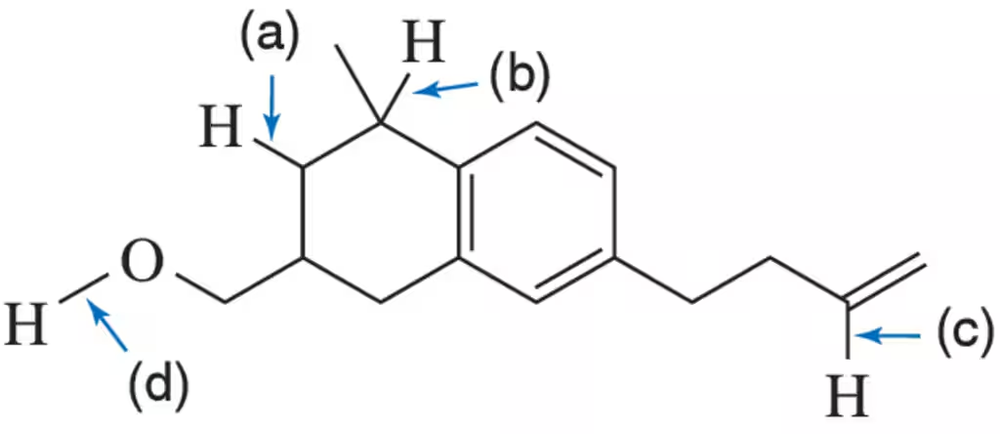
Give the approximate bond-dissociation energy for each indicated bond.
Verified step by step guidance
1
Identify the bonds in question for which the bond-dissociation energy (BDE) is required. For example, if the problem specifies a C-H bond or a C-C bond, note these bonds explicitly.
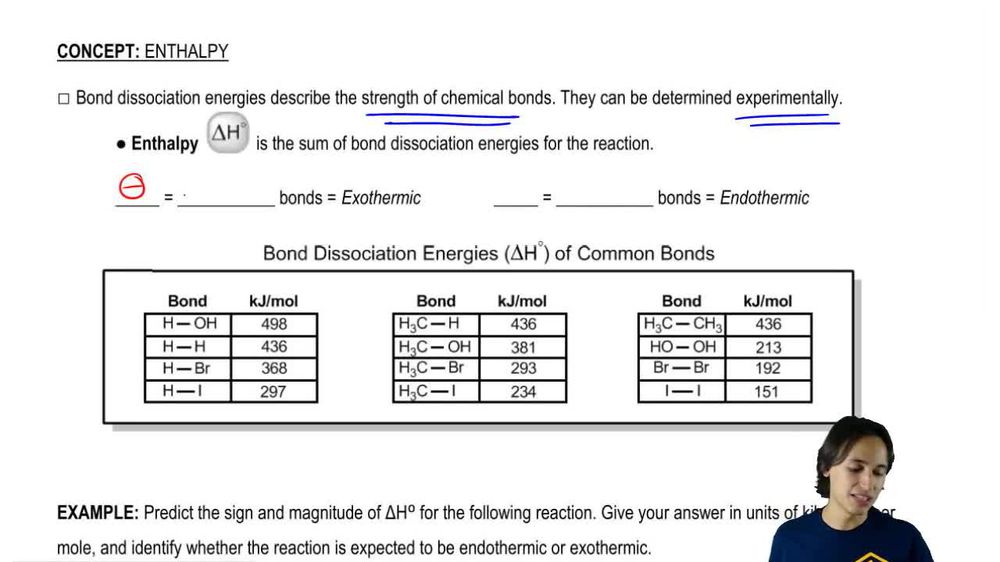
Consult a table of standard bond-dissociation energies for common bonds in organic molecules. These tables are typically found in textbooks or reliable online resources. For example, the BDE for a C-H bond in methane is approximately 104 kcal/mol, while for a C-C bond in ethane, it is about 88 kcal/mol.
For part (b), if additional inferences are required, analyze the molecular environment of the bond. For instance, if the bond is in a strained ring system or adjacent to an electronegative atom, the BDE may differ from the standard value. Consider how factors like resonance, hybridization, or steric effects might influence the bond strength.
Use the information gathered to approximate the BDE for each bond. If the bond is not directly listed in the table, interpolate or extrapolate based on similar bonds. For example, if the bond is a C-H bond in an sp2 hybridized carbon (as in an alkene), its BDE will be slightly higher than that of a C-H bond in an sp3 hybridized carbon.
Summarize the approximate BDE values for each bond, ensuring that your reasoning and any assumptions made are clearly stated. This will help validate your approximations and provide a logical basis for your conclusions.
Verified video answer for a similar problem:
This video solution was recommended by our tutors as helpful for the problem above
Video duration:
2m
Play a video:
0 Comments
Key Concepts
Here are the essential concepts you must grasp in order to answer the question correctly.
Bond-Dissociation Energy (BDE)
Bond-dissociation energy is the energy required to break a specific bond in a molecule, resulting in the formation of two radicals. It is a measure of bond strength; stronger bonds have higher BDE values. BDE can vary depending on the molecular environment and the types of atoms involved, making it essential for predicting reaction outcomes and stability.
How to calculate enthalpy using bond dissociation energies.
Types of Bonds
In organic chemistry, bonds can be classified as single, double, or triple bonds, each with distinct characteristics and bond-dissociation energies. Single bonds (sigma bonds) are generally weaker than double (one sigma and one pi bond) and triple bonds (one sigma and two pi bonds). Understanding these types helps in estimating BDE and predicting reactivity in chemical reactions.
Resonance refers to the delocalization of electrons in a molecule, which can affect bond strength and stability. Hybridization describes the mixing of atomic orbitals to form new hybrid orbitals, influencing bond angles and lengths. Both concepts are crucial for making inferences about bond-dissociation energies, as they can alter the expected values based on molecular structure.