Use bond-dissociation enthalpies (Table 4-2, p. 167) to calculate values of ΔH° for the following reactions. d. CH3CH2CH3 + H2 → CH3CH3 + CH4
Verified step by step guidance
1
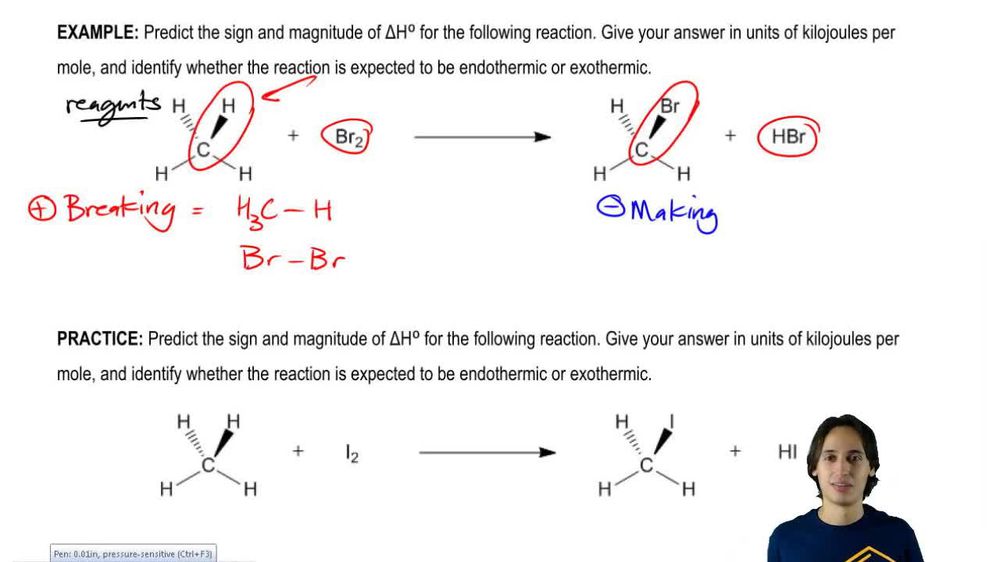
Identify the bonds broken and formed in the reaction. In this case, the bonds broken are one C-H bond in CH3CH2CH3 (propane) and one H-H bond in H2. The bonds formed are one C-H bond in CH3CH3 (ethane) and one C-H bond in CH4 (methane).
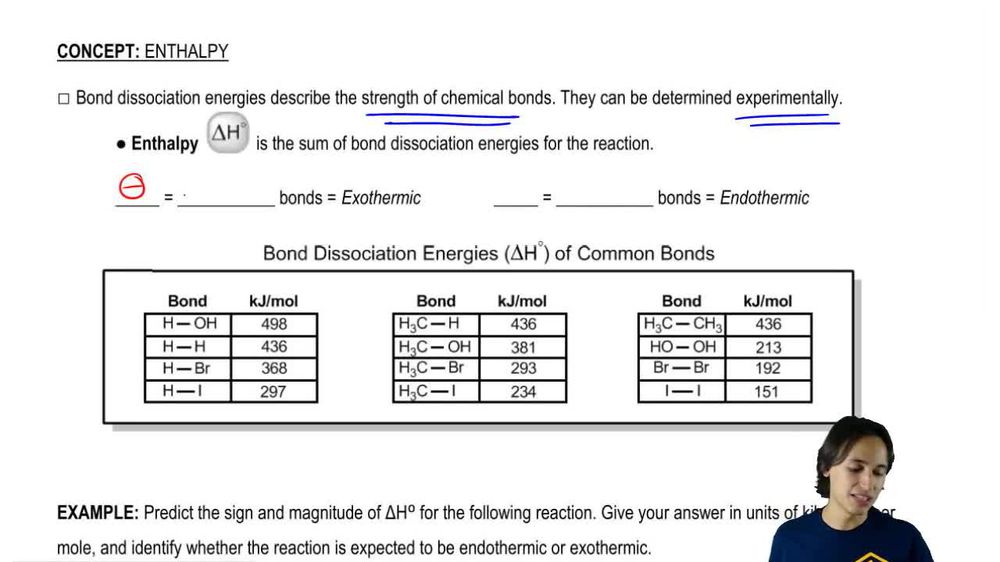
Refer to the bond-dissociation enthalpy table (TABLE 4-2, p. 167) to find the bond-dissociation enthalpy values for each bond involved. For example, the bond-dissociation enthalpy for a C-H bond and an H-H bond will be listed in the table.
Calculate the total energy required to break the bonds. This is done by summing the bond-dissociation enthalpy values for the bonds broken (C-H in propane and H-H in H2).
Calculate the total energy released when the new bonds are formed. This is done by summing the bond-dissociation enthalpy values for the bonds formed (C-H in ethane and C-H in methane).
Determine the overall enthalpy change (ΔH°) for the reaction by subtracting the total energy released (bonds formed) from the total energy required (bonds broken). Use the formula: ΔH° = Σ(bonds broken) - Σ(bonds formed).
Verified video answer for a similar problem:
This video solution was recommended by our tutors as helpful for the problem above
Video duration:
5m
Play a video:
0 Comments
Key Concepts
Here are the essential concepts you must grasp in order to answer the question correctly.
Bond-Dissociation Enthalpy
Bond-dissociation enthalpy (BDE) is the energy required to break a specific bond in a molecule, resulting in the formation of free radicals. It is a crucial concept in thermochemistry, as it helps predict the stability of molecules and the energy changes during chemical reactions. BDE values are typically expressed in kilojoules per mole (kJ/mol) and vary depending on the type of bond and the molecular environment.
How to calculate enthalpy using bond dissociation energies.
Enthalpy Change (ΔH°)
The enthalpy change (ΔH°) of a reaction is the difference in enthalpy between the products and reactants under standard conditions. It indicates whether a reaction is exothermic (releases heat, ΔH° < 0) or endothermic (absorbs heat, ΔH° > 0). Calculating ΔH° using bond-dissociation enthalpies involves summing the BDEs of bonds broken in the reactants and subtracting the BDEs of bonds formed in the products.
A reaction mechanism describes the step-by-step sequence of elementary reactions by which overall chemical change occurs. Understanding the mechanism is essential for predicting the products and energy changes in a reaction. In the context of the given reaction, recognizing the bonds involved and their respective BDEs allows for accurate calculation of the overall enthalpy change, reflecting the energy dynamics of the process.