Ch. 15 - Reactions of Carboxylic Acids and Carboxylic Acid Derivatives
Bruice - Organic Chemistry 8th Edition
Bruice8th EditionOrganic ChemistryISBN: 9780135213711Not the one you use?Change textbook
Chapter 16, Problem 32

Propose a mechanism for the following reaction. (Hint: Number the carbons to help you see where they end up in the product.)
Chemical reaction diagram illustrating Fischer esterification with numbered carbons for product identification.

Verified step by step guidance
1
Step 1: Analyze the reactants and conditions. The starting material is a conjugated diene, and the reaction occurs in the presence of sulfuric acid (H2SO4), which acts as a strong acid and proton donor. This suggests an electrophilic addition mechanism.
Step 2: Protonation of the diene. The sulfuric acid donates a proton (H+) to one of the double bonds in the conjugated diene, forming a carbocation intermediate. Number the carbons in the diene to track the movement of atoms during the reaction.
Step 3: Resonance stabilization of the carbocation. The carbocation formed can undergo resonance, redistributing the positive charge across the conjugated system. This step is crucial for determining the most stable carbocation intermediate.
Step 4: Nucleophilic attack by water. Water (H2O), present in the reaction mixture, acts as a nucleophile and attacks the carbocation, forming an alcohol intermediate.
Step 5: Deprotonation to form the final product. The alcohol intermediate loses a proton (H+) to regenerate the acidic environment and form the final product, which is a hydrated ketone or aldehyde depending on the position of the carbocation.

Verified video answer for a similar problem:

This video solution was recommended by our tutors as helpful for the problem above.
Video duration:
6m
Was this helpful?

Key Concepts

Here are the essential concepts you must grasp in order to answer the question correctly.

Fischer Esterification

Fischer esterification is a chemical reaction that forms an ester from a carboxylic acid and an alcohol in the presence of an acid catalyst, typically sulfuric acid. The reaction involves the nucleophilic attack of the alcohol on the carbonyl carbon of the carboxylic acid, leading to the formation of a tetrahedral intermediate, which subsequently loses a water molecule to yield the ester.
Recommended video:
1:21
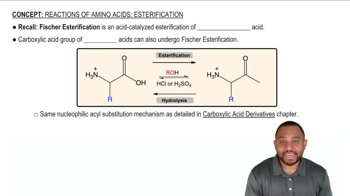
Reactions of Amino Acids: Esterification Concept 1

Mechanism of Reaction

Understanding the mechanism of a reaction involves breaking down the steps that occur during the transformation of reactants to products. In Fischer esterification, the mechanism includes protonation of the carbonyl oxygen, nucleophilic attack by the alcohol, formation of the tetrahedral intermediate, and elimination of water. Each step is crucial for predicting the outcome and understanding the reaction conditions.
Recommended video:
Guided course
02:16
Heck Reaction Mechanism

Role of Acid Catalyst

An acid catalyst, such as H2SO4, plays a vital role in Fischer esterification by protonating the carbonyl oxygen of the carboxylic acid, increasing its electrophilicity. This enhances the reactivity of the carbonyl carbon, making it more susceptible to nucleophilic attack by the alcohol. The presence of the acid catalyst also helps to drive the equilibrium towards ester formation by removing water from the reaction mixture.
Recommended video:
2:50
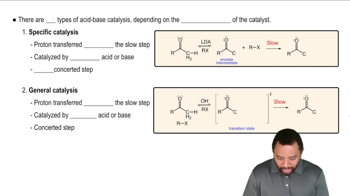
Acid-Base Catalysis Concept 3