Ch. 3 - An Introduction to Organic Compounds:Nomenclature, Physical Properties, and Structure
Bruice - Organic Chemistry 8th Edition
Bruice8th EditionOrganic ChemistryISBN: 9780135213711Not the one you use?Change textbook
Chapter 4, Problem 48a,b,c

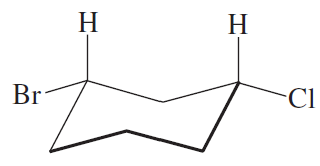
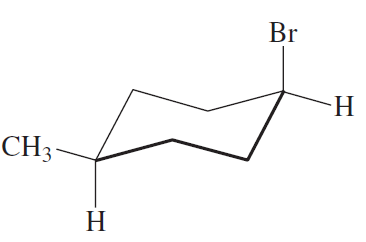
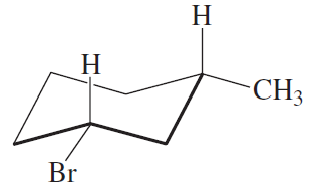
Is each of the following a cis isomer or a trans isomer?
a, Structural diagram showing a molecule with bromine and chlorine substituents, indicating cis and trans isomer configurations.
b. Structural diagram of a molecule showing cis and trans isomers with labeled atoms CH3, H, and Br.
c. Structural diagram of a molecule showing cis and trans isomers with labeled hydrogen and bromine atoms.

Verified step by step guidance
1
Step 1: Understand the concept of cis and trans isomers. Cis isomers have substituents on the same side of a reference plane, while trans isomers have substituents on opposite sides of the reference plane.
Step 2: Analyze structure A. Identify the substituents (Br and NH2) and their positions relative to the cyclohexane ring. Determine if they are on the same side (cis) or opposite sides (trans).
Step 3: Analyze structure B. Identify the substituents (CH3 and OH) and their positions relative to the cyclohexane ring. Determine if they are on the same side (cis) or opposite sides (trans).
Step 4: Analyze structure C. Identify the substituents (OH and NH2) and their positions relative to the cyclohexane ring. Determine if they are on the same side (cis) or opposite sides (trans).
Step 5: Summarize the findings for each structure (A, B, and C) based on the spatial arrangement of the substituents and classify them as cis or trans isomers.

Verified video answer for a similar problem:

This video solution was recommended by our tutors as helpful for the problem above.
Video duration:
3m
Was this helpful?

Key Concepts

Here are the essential concepts you must grasp in order to answer the question correctly.

Cis-Trans Isomerism

Cis-trans isomerism is a type of stereoisomerism where compounds have the same molecular formula but differ in the spatial arrangement of atoms. In cis isomers, similar groups are on the same side of a double bond or ring structure, while in trans isomers, they are on opposite sides. This difference can significantly affect the physical and chemical properties of the compounds.
Recommended video:
Guided course
00:44
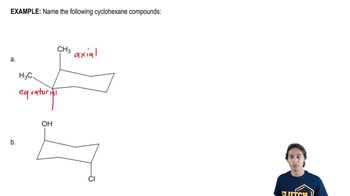
Is the following cyclohexane cis or trans?

Double Bonds and Restricted Rotation

Double bonds create a rigid structure that restricts rotation around the bond, allowing for the existence of cis and trans isomers. In alkenes, the presence of a double bond between carbon atoms prevents the free rotation that is possible in single bonds, leading to distinct geometric configurations. This rigidity is crucial for identifying and classifying isomers.
Recommended video:
Guided course
06:00
Single bonds, double bonds, and triple bonds.

Priority Rules in Isomer Identification

To determine whether a compound is a cis or trans isomer, priority rules based on the Cahn-Ingold-Prelog system are applied. These rules assign priority to substituents attached to the double-bonded carbons based on atomic number and connectivity. The arrangement of these high-priority groups relative to each other helps classify the isomer as cis or trans.
Recommended video:
Guided course
01:10
What is a constitutional isomer?