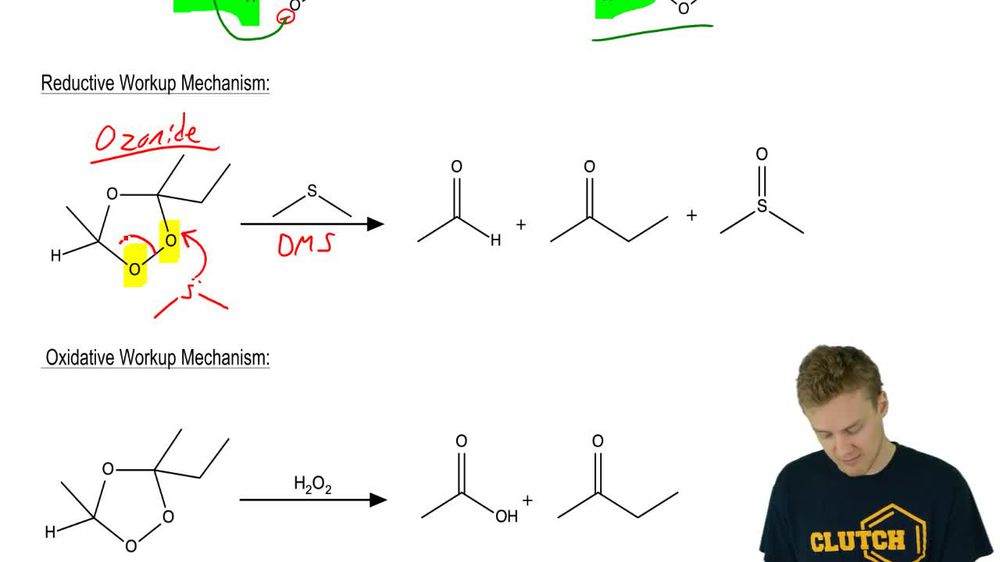
Draw the product(s) you'd expect when each of these alkenes is treated first with O3, then with CH3SCH3 (c)
Verified step by step guidance
1
Identify the alkene in the given structure. The double bond is located between the two carbon atoms at the top of the structure.
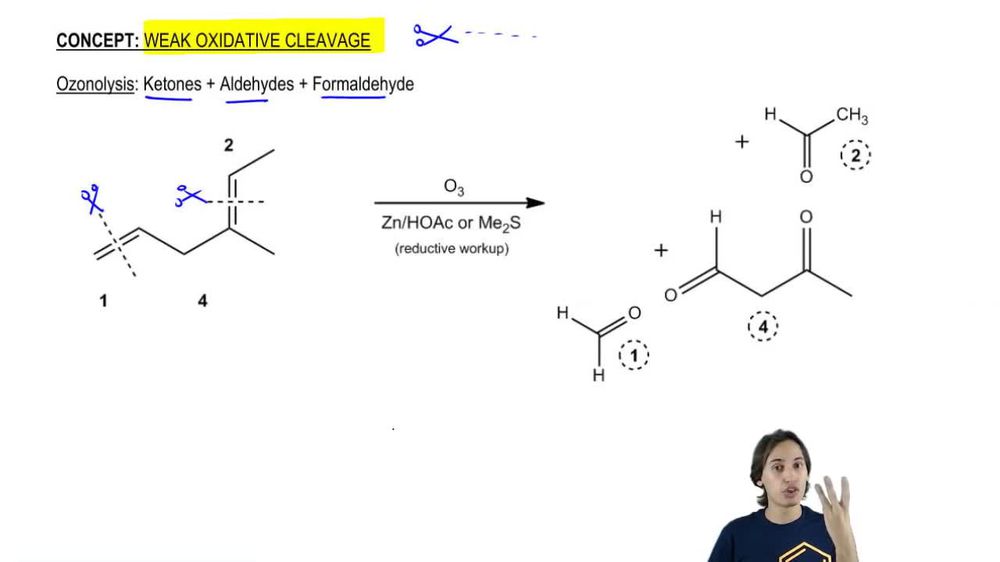
Understand the reaction: Ozonolysis is a reaction where ozone (O₃) cleaves the double bond of an alkene, forming two carbonyl groups. The use of dimethyl sulfide (CH₃SCH₃) as a reducing agent will ensure that the carbonyl groups remain as aldehydes or ketones.
Draw the structure of the alkene with the double bond cleaved. This involves breaking the double bond and adding an oxygen atom to each of the carbon atoms that were originally part of the double bond.
Determine the type of carbonyl groups formed: If the carbon atom is bonded to two other carbon atoms, a ketone is formed. If it is bonded to one carbon and one hydrogen, an aldehyde is formed.
Draw the final products: Based on the structure, identify and draw the aldehyde and/or ketone products that result from the ozonolysis reaction.
Verified video answer for a similar problem:
This video solution was recommended by our tutors as helpful for the problem above
Video duration:
4m
Play a video:
0 Comments
Key Concepts
Here are the essential concepts you must grasp in order to answer the question correctly.
Ozonolysis
Ozonolysis is a reaction where ozone (O₃) cleaves alkenes to form carbonyl compounds. The reaction involves the formation of an ozonide intermediate, which is then reduced to yield aldehydes or ketones. In this context, the alkene is treated with O₃, followed by a reducing agent like CH₃SCH₃, to break the double bond and form the corresponding carbonyl products.
Reductive workup in ozonolysis involves using a reducing agent, such as dimethyl sulfide (CH₃SCH₃), to convert the ozonide intermediate into stable carbonyl compounds. This step prevents the formation of carboxylic acids or other oxidized products, ensuring that the reaction yields aldehydes or ketones, depending on the structure of the original alkene.
The structure of the alkene determines the products formed during ozonolysis. In the given image, the alkene has a terminal double bond and a cyclopentene ring. The ozonolysis will cleave the double bond, resulting in the formation of a ketone from the terminal alkene and an aldehyde from the cyclopentene, reflecting the positions of the double bonds in the original structure.

 4:29 minutes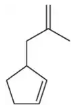
 Verified step by step guidance
 06:30
06:30