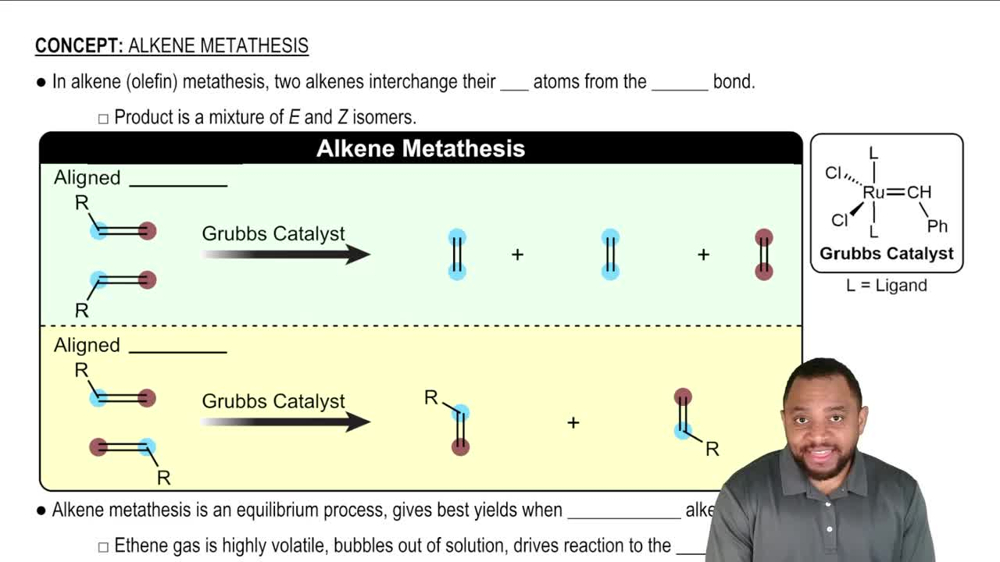
What alkenes would give only an aldehyde with four carbons as a product of oxidative cleavage
Verified step by step guidance
1
Identify the reaction type: Oxidative cleavage of alkenes typically involves reagents like ozone (O₃) followed by a reducing agent (e.g., Zn/H₂O) or KMnO₄ under acidic conditions. This reaction breaks the double bond and converts the resulting fragments into carbonyl compounds (aldehydes or ketones).
Determine the product: The problem specifies that the product is an aldehyde with four carbons. This means the alkene must be cleaved in such a way that one of the fragments forms an aldehyde with exactly four carbon atoms.
Analyze the structure of the product: An aldehyde with four carbons has the general formula CH₃(CH₂)₂CHO. This indicates that the alkene must have been cleaved to produce this specific aldehyde fragment.
Work backward to deduce the alkene: To form an aldehyde with four carbons, the double bond in the alkene must be positioned such that one of the resulting fragments after cleavage is CH₃(CH₂)₂CHO. For example, the alkene could be 1-hexene (CH₂=CH(CH₂)₃CH₃) or 2-hexene (CH₃CH=CH(CH₂)₂CH₃), as these would yield the desired aldehyde upon oxidative cleavage.
Verify the possibilities: Ensure that the proposed alkenes meet the criteria of producing only the specified aldehyde as a product. For example, symmetrical alkenes like 2-hexene would produce two identical aldehyde molecules, while unsymmetrical alkenes like 1-hexene would produce one aldehyde and one other fragment.
Verified video answer for a similar problem:
This video solution was recommended by our tutors as helpful for the problem above
Video duration:
8m
Play a video:
0 Comments
Key Concepts
Here are the essential concepts you must grasp in order to answer the question correctly.
Oxidative Cleavage
Oxidative cleavage is a reaction where alkenes are broken down into smaller carbonyl compounds, typically aldehydes or ketones, through the addition of oxidizing agents. This process involves the cleavage of the carbon-carbon double bond, resulting in the formation of carbonyl groups. Understanding the conditions and reagents used in oxidative cleavage is crucial for predicting the products formed from specific alkenes.
Aldehydes are organic compounds characterized by the presence of a carbonyl group (C=O) at the end of a carbon chain. The general formula for aldehydes is RCHO, where R represents a hydrocarbon group. In the context of the question, identifying alkenes that yield a four-carbon aldehyde requires knowledge of how the carbon skeleton is rearranged during oxidative cleavage.
Alkenes are unsaturated hydrocarbons with at least one carbon-carbon double bond, making them reactive towards various chemical reactions, including oxidation. The position and substitution of the double bond in the alkene influence the products formed during reactions. Recognizing which alkenes can lead to a specific aldehyde product is essential for solving the question regarding oxidative cleavage.

 8:50 minutes
 Verified step by step guidance
 06:41
06:41