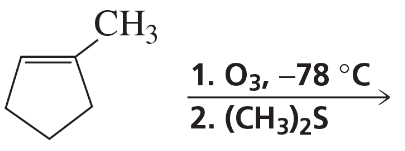
What are the products of the following reactions? Indicate whether each reaction is an oxidation or a reduction. c.
Verified step by step guidance
1
Step 1: Recognize the reaction type. The reaction involves ozonolysis, which is a method used to cleave alkenes into smaller carbonyl compounds (aldehydes or ketones). The reagents are ozone (O₃) followed by dimethyl sulfide ((CH₃)₂S). This is a reductive ozonolysis reaction.
Step 2: Analyze the structure of the starting material. The compound is a methyl-substituted cyclopentene. The double bond in the cyclopentene ring will be cleaved during the reaction.
Step 3: Predict the cleavage products. Ozonolysis breaks the double bond and forms two carbonyl groups at the positions where the double bond was located. Since this is reductive ozonolysis, aldehydes will be formed instead of carboxylic acids.
Step 4: Draw the products. The double bond in the cyclopentene ring will split into two fragments: one fragment will be a formaldehyde (CH₂O) and the other will be an aldehyde with a methyl group attached to the carbonyl carbon.
Step 5: Determine the reaction classification. Since the reaction involves breaking a double bond and forming carbonyl compounds, it is classified as an oxidation reaction because the carbon atoms involved in the double bond increase their oxidation state.
Verified video answer for a similar problem:
This video solution was recommended by our tutors as helpful for the problem above
Video duration:
3m
Play a video:
0 Comments
Key Concepts
Here are the essential concepts you must grasp in order to answer the question correctly.
Oxidation and Reduction
Oxidation and reduction are chemical processes that involve the transfer of electrons between substances. Oxidation refers to the loss of electrons or an increase in oxidation state, while reduction involves the gain of electrons or a decrease in oxidation state. These reactions are often coupled, meaning that when one substance is oxidized, another is reduced.
Identifying the products of a chemical reaction requires understanding the reactants' structures and the type of reaction occurring. This involves applying knowledge of functional groups, reaction mechanisms, and the principles of conservation of mass. Analyzing the reaction conditions can also provide insights into the expected products.
Reaction mechanisms describe the step-by-step sequence of elementary reactions that lead to the overall transformation of reactants into products. Understanding mechanisms is crucial for predicting the products of a reaction, as they reveal how bonds are broken and formed. Familiarity with common mechanisms, such as nucleophilic substitution or elimination, can aid in determining the nature of the products.