Which of the following compounds reacts with HBr more rapidly?
Verified step by step guidance
1
Step 1: Analyze the chemical structures provided. Both compounds contain a benzene ring with a substituent group attached to the ring and a vinyl group (-CH=CH2) attached to the benzene ring. The first compound has a methyl group (-CH3) attached to the benzene ring, while the second compound has a methoxy group (-CH3O) attached to the benzene ring.
Step 2: Consider the reactivity of the vinyl group (-CH=CH2) with HBr. The reaction typically proceeds via electrophilic addition, where the π-electrons of the double bond attack the proton (H+) from HBr, forming a carbocation intermediate.
Step 3: Evaluate the stability of the carbocation intermediate formed during the reaction. The substituent groups on the benzene ring influence the carbocation stability through resonance and inductive effects. The methoxy group (-CH3O) is an electron-donating group via resonance, which stabilizes the carbocation more effectively than the methyl group (-CH3), which is only weakly electron-donating via inductive effects.
Step 4: Understand that the more stable the carbocation intermediate, the faster the reaction with HBr will proceed. Since the methoxy group stabilizes the carbocation more effectively, the compound with the methoxy group reacts more rapidly with HBr.
Step 5: Conclude that the compound with the methoxy group (-CH3O) attached to the benzene ring reacts with HBr more rapidly than the compound with the methyl group (-CH3) attached to the benzene ring.
Verified video answer for a similar problem:
This video solution was recommended by our tutors as helpful for the problem above
Video duration:
1m
Play a video:
0 Comments
Key Concepts
Here are the essential concepts you must grasp in order to answer the question correctly.
Reactivity of Alkenes
The reactivity of alkenes with hydrogen halides like HBr is influenced by the stability of the carbocation intermediate formed during the reaction. More substituted alkenes tend to form more stable carbocations, leading to faster reactions. Understanding the structure of the alkenes in question is crucial for predicting which will react more rapidly.
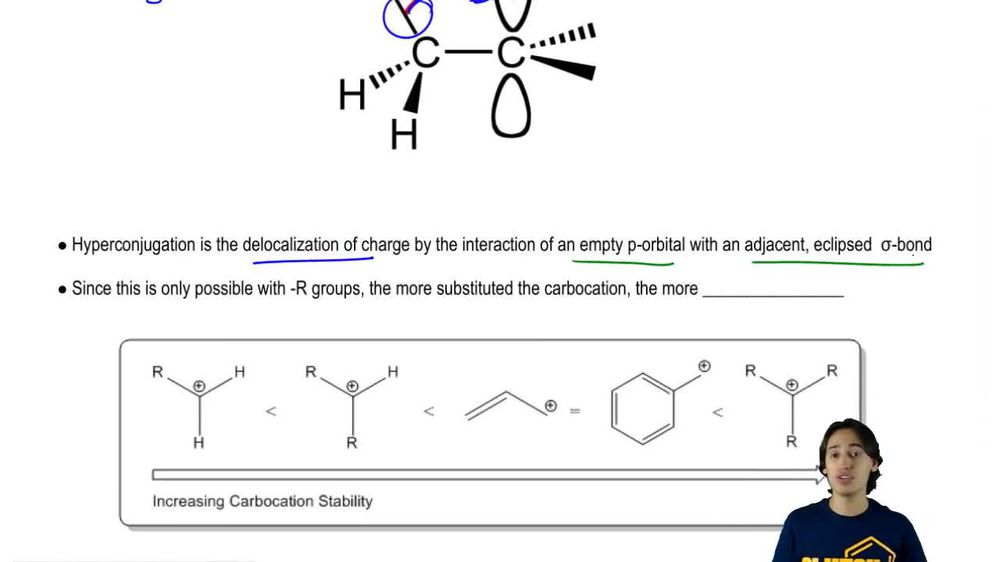
Carbocation stability is a key factor in determining the rate of reaction with HBr. Tertiary carbocations are more stable than secondary, which are more stable than primary. The stability is influenced by the inductive effect and hyperconjugation from adjacent alkyl groups, making it essential to analyze the structure of the compounds involved.
Markovnikov's Rule states that when HX (like HBr) adds to an alkene, the hydrogen atom will attach to the carbon with the greater number of hydrogen atoms already attached. This rule helps predict the major product of the reaction and is important for understanding the regioselectivity of the reaction, which can also influence the rate of reaction.

 1:33 minutes
 Verified step by step guidance
 2:09
2:09