What is the major product obtained from the addition of HBr to the following compound?
Verified step by step guidance
1
Step 1: Identify the functional group in the compound. The compound contains a benzene ring attached to a propene group (CH2=CH-CH2). The double bond in the propene group is the site of reactivity for the addition of HBr.
Step 2: Recall the mechanism of electrophilic addition of HBr to alkenes. The reaction proceeds via the formation of a carbocation intermediate. The H+ from HBr adds to one of the carbons in the double bond, leaving the other carbon with a positive charge.
Step 3: Apply Markovnikov's rule to determine the major product. According to Markovnikov's rule, the H+ will add to the carbon in the double bond that has more hydrogen atoms, resulting in the formation of the more stable carbocation. In this case, the H+ will add to the terminal carbon (CH2), forming a secondary carbocation at the middle carbon (CH).
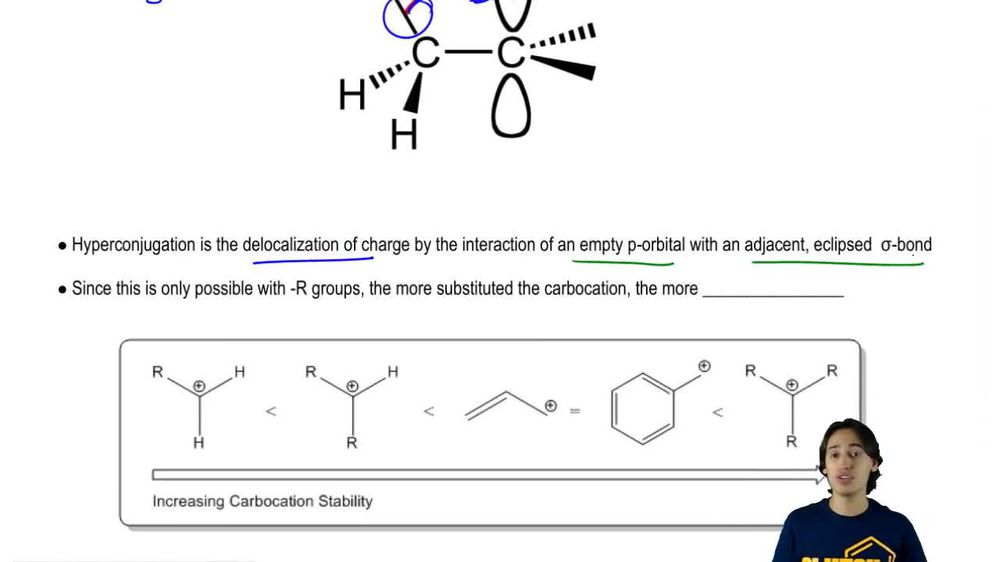
Step 4: Consider the stability of the carbocation. The secondary carbocation formed is stabilized by hyperconjugation and the inductive effect from the benzene ring. This makes the secondary carbocation more stable than a primary carbocation.
Step 5: Complete the reaction by adding the Br- ion to the carbocation. The Br- will attack the positively charged carbon, resulting in the formation of the major product, which is 1-bromo-2-phenylpropane.
Verified video answer for a similar problem:
This video solution was recommended by our tutors as helpful for the problem above
Video duration:
1m
Play a video:
0 Comments
Key Concepts
Here are the essential concepts you must grasp in order to answer the question correctly.
Electrophilic Addition
Electrophilic addition is a fundamental reaction mechanism in organic chemistry where an electrophile reacts with a nucleophile, typically involving alkenes or alkynes. In this process, the double or triple bond is broken, allowing new atoms or groups to be added to the molecule. Understanding this mechanism is crucial for predicting the products of reactions involving unsaturated compounds.
Markovnikov's Rule states that when HX (where X is a halogen) adds to an alkene, the hydrogen atom will attach to the carbon with the greater number of hydrogen atoms already attached. This rule helps predict the regioselectivity of the addition reaction, guiding chemists in determining the major product formed during the reaction with HBr.
Carbocation stability is a key concept in organic chemistry that refers to the relative stability of positively charged carbon species. Carbocations are stabilized by alkyl groups through hyperconjugation and inductive effects, with tertiary carbocations being the most stable. Understanding carbocation stability is essential for predicting the pathway and products of electrophilic addition reactions.

 1:44 minutes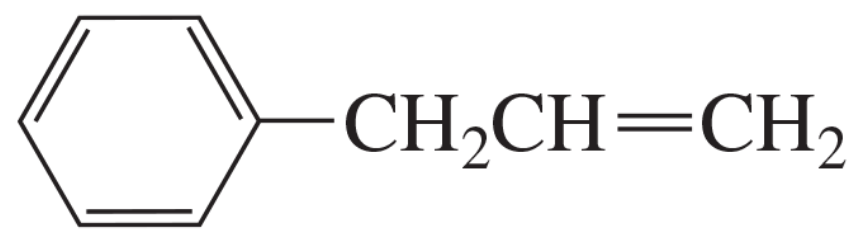
 Verified step by step guidance
 09:23
09:23