Which member of each pair is the stronger base? a. ethylamine or aniline b. ethylamine or ethoxide ion
Verified step by step guidance
1
Step 1: Analyze the chemical structures in part (a). Ethylamine (ii) is an aliphatic amine, while aniline (i) is an aromatic amine. The lone pair on the nitrogen in aniline is delocalized into the aromatic ring, reducing its availability to accept protons. In contrast, the lone pair on the nitrogen in ethylamine is localized and readily available for protonation, making ethylamine a stronger base.
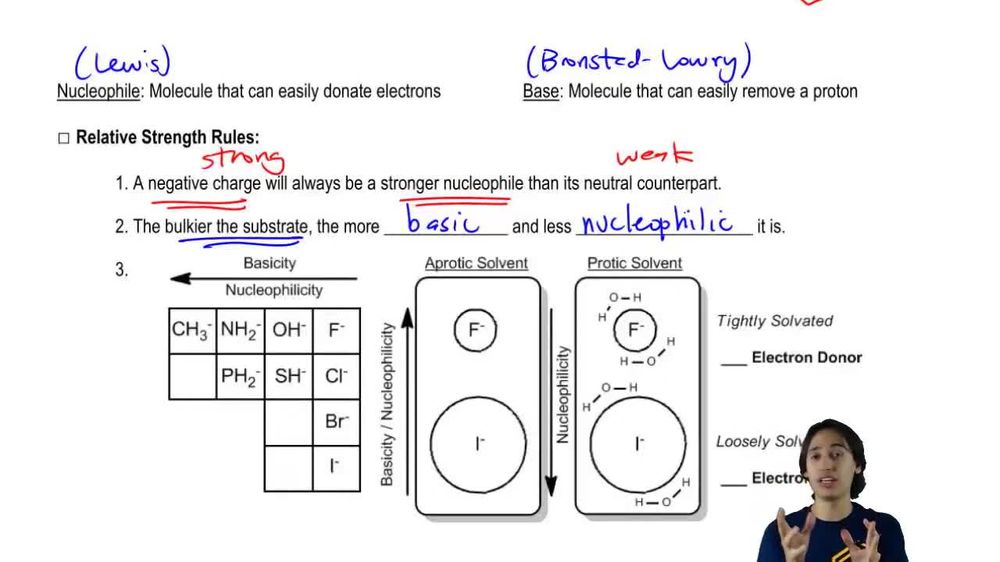
Step 2: Compare the chemical structures in part (b). Ethylamine (i) is a neutral amine, while ethoxide ion (ii) is an alkoxide ion with a negative charge. The negative charge on the ethoxide ion makes it more nucleophilic and a stronger base compared to the neutral ethylamine. Bases with negative charges are generally stronger than their neutral counterparts.
Step 3: Consider the role of resonance in part (a). The delocalization of the nitrogen's lone pair in aniline decreases its basicity because resonance stabilizes the molecule, making it less likely to donate electrons. Ethylamine lacks resonance stabilization, which increases its basicity.
Step 4: Evaluate the inductive effects in part (b). The ethoxide ion has a strong electron-donating effect due to its negative charge, which enhances its ability to act as a base. Ethylamine, being neutral, does not have this additional electron density, making it a weaker base in comparison.
Step 5: Summarize the findings. In part (a), ethylamine is the stronger base due to the lack of resonance stabilization. In part (b), ethoxide ion is the stronger base due to its negative charge and higher electron density.
Verified video answer for a similar problem:
This video solution was recommended by our tutors as helpful for the problem above
Video duration:
5m
Play a video:
0 Comments
Key Concepts
Here are the essential concepts you must grasp in order to answer the question correctly.
Basicity and Electron Density
Basicity refers to the ability of a compound to accept protons (H+). The strength of a base is influenced by the electron density on the atom that donates the lone pair. In amines, the presence of electron-donating groups increases electron density, enhancing basicity, while electron-withdrawing groups decrease it.
Understanding the difference between basicity and nucleophilicity.
Aromaticity and Resonance
Aromatic compounds, like aniline, exhibit resonance stabilization, where the lone pair on the nitrogen can delocalize into the aromatic ring. This delocalization reduces the availability of the lone pair for protonation, making aniline a weaker base compared to aliphatic amines like ethylamine, which lack such resonance effects.
Alkoxide ions (e.g., ethoxide) are generally stronger bases than amines due to their negative charge and the absence of resonance stabilization. The alkoxide's oxygen atom has a high electron density, making it more eager to accept protons compared to the nitrogen in amines, which may have resonance effects that stabilize the lone pair.

 5:09 minutes
 Verified step by step guidance
 06:21
06:21