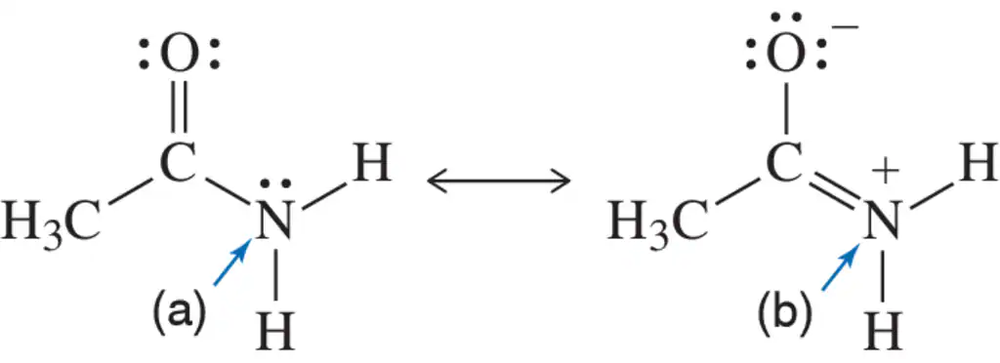
Assign the hybridization of the nitrogen in each resonance structure of acetamide.
Verified step by step guidance
1
Identify the structure of acetamide (CH3CONH2). It consists of a carbonyl group (C=O) attached to a methyl group (CH3) and an amide group (NH2). The nitrogen atom in question is part of the amide group.
Draw all possible resonance structures of acetamide. In one resonance structure, the nitrogen has a lone pair of electrons, and in another, the lone pair is delocalized into the carbonyl group, forming a partial double bond between the nitrogen and the carbonyl carbon.
For the resonance structure where the nitrogen has a lone pair and no delocalization, the nitrogen forms three sigma bonds (one to carbon and two to hydrogen) and has one lone pair. This corresponds to sp³ hybridization because the nitrogen has four regions of electron density (three bonds and one lone pair).
For the resonance structure where the lone pair on nitrogen is delocalized into the carbonyl group, the nitrogen forms two sigma bonds (one to carbon and one to hydrogen) and one pi bond (as part of the delocalized system). This corresponds to sp² hybridization because the nitrogen has three regions of electron density (two sigma bonds and one pi bond).
Conclude that the hybridization of the nitrogen in acetamide depends on the resonance structure: it is sp³ in the structure where the lone pair is localized and sp² in the structure where the lone pair is delocalized into the carbonyl group.
Verified video answer for a similar problem:
This video solution was recommended by our tutors as helpful for the problem above
Video duration:
4m
Play a video:
0 Comments
Key Concepts
Here are the essential concepts you must grasp in order to answer the question correctly.
Hybridization
Hybridization is the concept in organic chemistry that describes the mixing of atomic orbitals to form new hybrid orbitals. These hybrid orbitals are used to form covalent bonds in molecules. The type of hybridization (e.g., sp, sp2, sp3) depends on the number of electron groups around the atom, influencing the geometry and bonding properties of the molecule.
Resonance structures are different Lewis structures for the same molecule that depict the delocalization of electrons. They are used to represent molecules where a single structure cannot adequately describe the electron distribution. The actual structure is a hybrid of these resonance forms, contributing to the stability and reactivity of the molecule.
Acetamide is an amide with the formula CH3CONH2, featuring a carbonyl group (C=O) adjacent to a nitrogen atom. The nitrogen in acetamide can exhibit different hybridization states depending on the resonance structures considered. Understanding the hybridization of nitrogen in these structures is crucial for predicting the molecule's reactivity and properties.