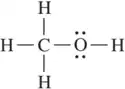
Refer to the following Lewis structures. (a) (b) Predict the hybridization of all non-hydrogen atoms.
Verified step by step guidance
1
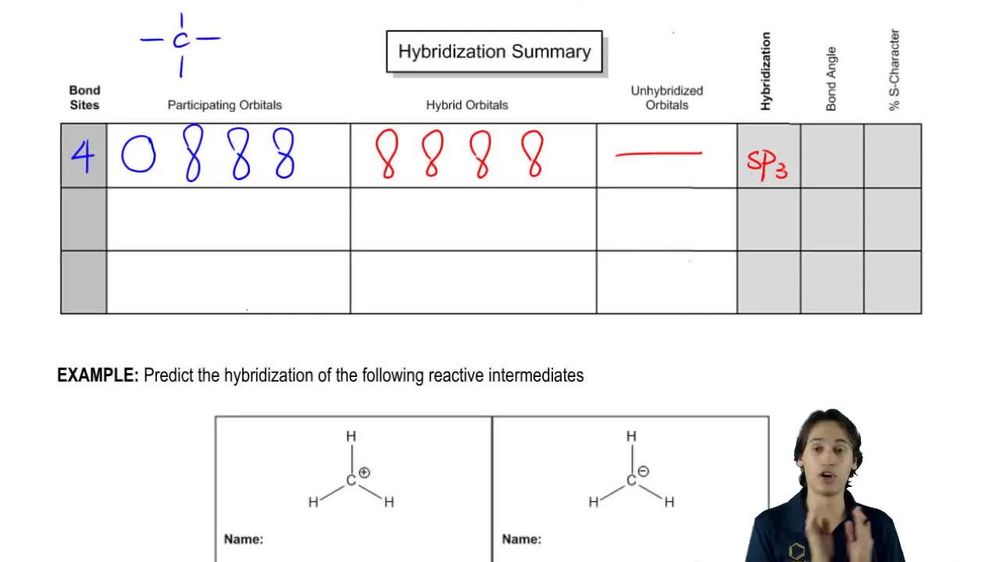
Step 1: Understand the concept of hybridization. Hybridization is the mixing of atomic orbitals to form new hybrid orbitals that are suitable for bonding. The type of hybridization depends on the number of electron domains (bonding pairs and lone pairs) around the atom.
Step 2: Examine the Lewis structures provided in the problem. Identify all non-hydrogen atoms and count the number of electron domains around each atom. Electron domains include single bonds, double bonds, triple bonds, and lone pairs.
Step 3: Use the electron domain count to determine the hybridization. For example: (a) 2 electron domains = sp hybridization, (b) 3 electron domains = sp² hybridization, (c) 4 electron domains = sp³ hybridization.
Step 4: Apply the hybridization rules to each non-hydrogen atom in the Lewis structures. For example, if a carbon atom has 4 single bonds, it will have sp³ hybridization. If a carbon atom has a double bond and two single bonds, it will have sp² hybridization.
Step 5: Summarize the hybridization for all non-hydrogen atoms in the Lewis structures. Ensure that lone pairs are also considered when counting electron domains, as they contribute to the hybridization.
Verified video answer for a similar problem:
This video solution was recommended by our tutors as helpful for the problem above
Video duration:
3m
Play a video:
0 Comments
Key Concepts
Here are the essential concepts you must grasp in order to answer the question correctly.
Lewis Structures
Lewis structures are diagrams that represent the bonding between atoms in a molecule and the lone pairs of electrons that may exist. They provide a visual way to understand the arrangement of electrons and how atoms are connected, which is crucial for predicting molecular geometry and reactivity.
Hybridization is the concept of mixing atomic orbitals to form new hybrid orbitals that can accommodate the bonding requirements of atoms in a molecule. The type of hybridization (e.g., sp, sp2, sp3) determines the geometry of the molecule and the angles between bonds, which are essential for understanding molecular shape and reactivity.
In organic chemistry, non-hydrogen atoms typically refer to carbon, nitrogen, oxygen, and other elements that form the backbone of organic molecules. Understanding the hybridization of these atoms is critical for predicting how they will interact with each other and with hydrogen, influencing the overall structure and properties of the compound.

 3:37 minutes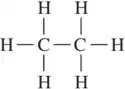
 Verified step by step guidance
 04:12
04:12