
For each of the following compounds and ions, 1. Draw a Lewis structure. 2. Show the kinds of orbitals that overlap to form each bond. 3. Give approximate bond angles around each atom except hydrogen. a. [NH2]–
Verified step by step guidance
1
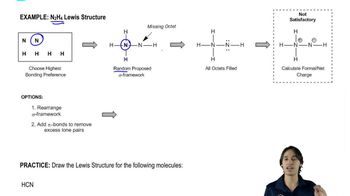
Step 1: Draw the Lewis structure for the [NH2]- ion. Start by counting the total number of valence electrons. Nitrogen (N) has 5 valence electrons, and each hydrogen (H) has 1 valence electron. The negative charge indicates an additional electron, giving a total of 8 valence electrons.
Step 2: Arrange the atoms with nitrogen as the central atom. Place the two hydrogen atoms around nitrogen and distribute the electrons to satisfy the octet rule for nitrogen. Each hydrogen will form a single bond with nitrogen, using 2 electrons per bond.
Step 3: Assign the remaining electrons as lone pairs on the nitrogen atom. After forming two N-H bonds, 4 electrons are used, leaving 4 electrons to be placed as two lone pairs on nitrogen.
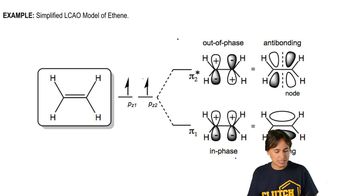
Step 4: Identify the types of orbitals involved in bonding. The N-H bonds are formed by the overlap of the sp3 hybrid orbitals of nitrogen with the 1s orbitals of hydrogen.
Step 5: Determine the approximate bond angles. The [NH2]- ion has a bent shape due to the lone pairs on nitrogen, which repel the bonding pairs. The bond angle is slightly less than the tetrahedral angle, approximately 104.5 degrees.
Verified video answer for a similar problem:
This video solution was recommended by our tutors as helpful for the problem above
Video duration:
5m
Play a video:
0 Comments
Key Concepts
Here are the essential concepts you must grasp in order to answer the question correctly.
Lewis Structure
A Lewis structure is a diagram that represents the valence electrons of atoms within a molecule. It shows how electrons are shared between atoms to form covalent bonds and indicates lone pairs. For NH2-, the nitrogen atom is central, bonded to two hydrogen atoms, with a lone pair and an extra electron to account for the negative charge.
Orbital overlap refers to the interaction between atomic orbitals that leads to bond formation. In NH2-, the nitrogen atom uses sp3 hybrid orbitals to overlap with the 1s orbitals of hydrogen atoms, forming sigma bonds. Understanding orbital overlap helps in visualizing how atoms connect in a molecule.
Bond angles are the angles between adjacent bonds around a central atom. They are influenced by the hybridization and the presence of lone pairs. In NH2-, the bond angle is slightly less than the tetrahedral angle of 109.5° due to the repulsion caused by the lone pair on nitrogen, typically around 104.5°.