Predict the approximate bond angles for c. the H—C—N bond angle in (CH3)2NH. d. the H—C—O bond angle in CH3OCH3
Verified step by step guidance
1
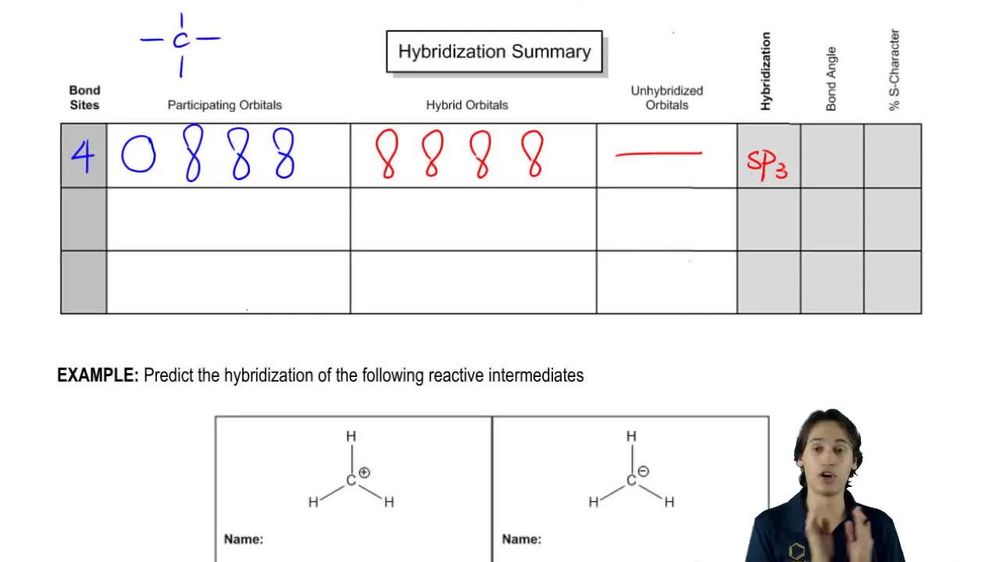
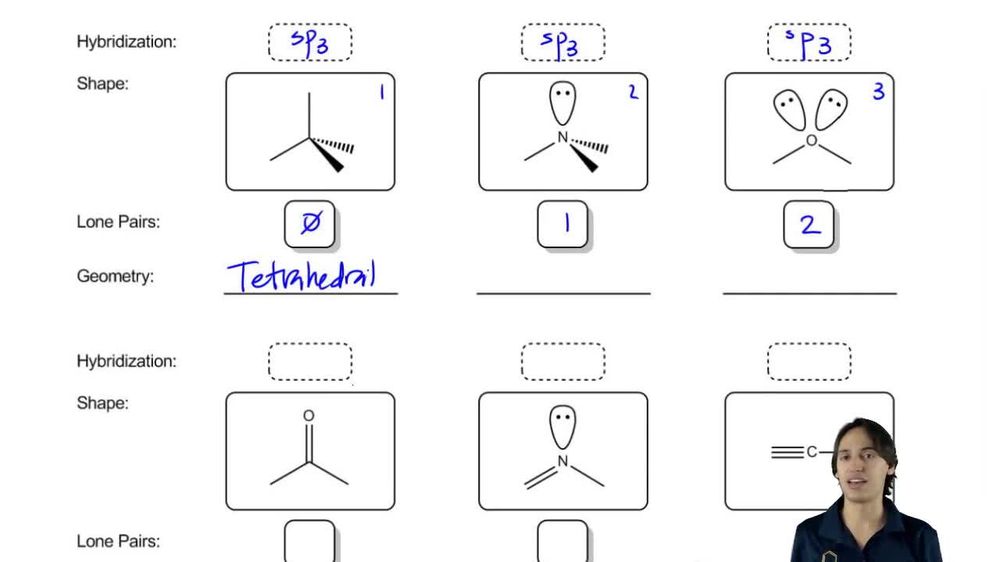
Step 1: Understand the molecular geometry of the compounds. For (CH3)2NH, the nitrogen atom is sp3 hybridized, and the molecule has a trigonal pyramidal geometry due to the lone pair on nitrogen. For CH3OCH3, the oxygen atom is sp3 hybridized, and the molecule has a bent geometry due to the two lone pairs on oxygen.
Step 2: Recall the ideal bond angles for sp3 hybridized atoms. In a perfect tetrahedral geometry, the bond angles are approximately 109.5°. However, lone pairs exert greater repulsion than bonding pairs, which reduces the bond angles slightly.
Step 3: For (CH3)2NH, the lone pair on nitrogen causes the H—C—N bond angle to be slightly less than 109.5°. The repulsion from the lone pair compresses the bond angle, making it closer to approximately 107°.
Step 4: For CH3OCH3, the two lone pairs on oxygen exert repulsion on the bonding pairs, reducing the H—C—O bond angle. This bond angle is slightly less than 109.5°, typically around 104.5°.
Step 5: Summarize the reasoning: The bond angles are influenced by the hybridization of the central atom and the repulsion caused by lone pairs. Lone pairs reduce bond angles compared to the ideal tetrahedral angle of 109.5°.
Verified video answer for a similar problem:
This video solution was recommended by our tutors as helpful for the problem above
Video duration:
7m
Play a video:
0 Comments
Key Concepts
Here are the essential concepts you must grasp in order to answer the question correctly.
VSEPR Theory
Valence Shell Electron Pair Repulsion (VSEPR) Theory is a model used to predict the geometry of individual molecules based on the repulsion between electron pairs in the valence shell of the central atom. According to VSEPR, electron pairs will arrange themselves to minimize repulsion, leading to specific bond angles characteristic of different molecular shapes.
Hybridization is the concept of mixing atomic orbitals to form new hybrid orbitals that can accommodate bonding. In organic molecules, carbon typically undergoes sp3 hybridization, resulting in tetrahedral geometry with bond angles of approximately 109.5 degrees, while nitrogen can exhibit sp3 hybridization as well, influencing the bond angles in amines like (CH3)2NH.
Molecular geometry refers to the three-dimensional arrangement of atoms within a molecule. The geometry is determined by the number of bonding pairs and lone pairs of electrons around the central atom, which directly influences bond angles. For example, in CH3OCH3, the presence of lone pairs on oxygen affects the H—C—O bond angle, leading to deviations from the ideal tetrahedral angle.

 7:05 minutes
 Verified step by step guidance

 10:48
10:48