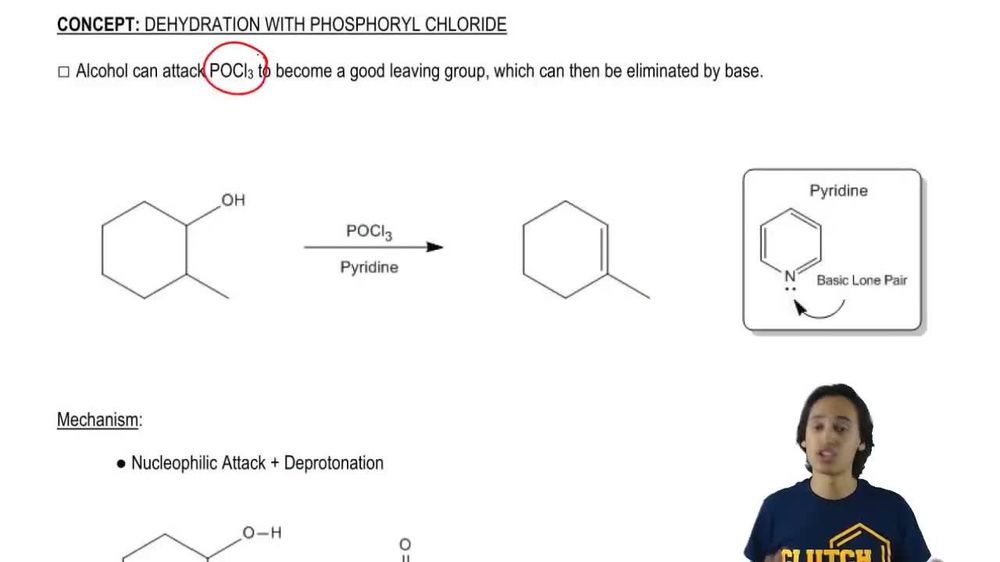
Identify the alcohol(s) that would produce the following alkenes under the given conditions. (b)
Verified step by step guidance
1
Step 1: Recognize the reaction type. The given reaction involves the dehydration of alcohols using sulfuric acid (H₂SO₄) as a catalyst. Dehydration reactions typically result in the formation of alkenes by eliminating a water molecule from the alcohol.
Step 2: Analyze the structure of the alkene product. The product shown is 2-methyl-2-pentene, which has a double bond between the second and third carbon atoms in a six-carbon chain with a methyl group attached to the second carbon.
Step 3: Determine the alcohol precursor. To form this alkene, the alcohol precursor must have a hydroxyl (-OH) group attached to the carbon that will lose a hydrogen during the elimination process. This is typically the carbon adjacent to the double bond in the product.
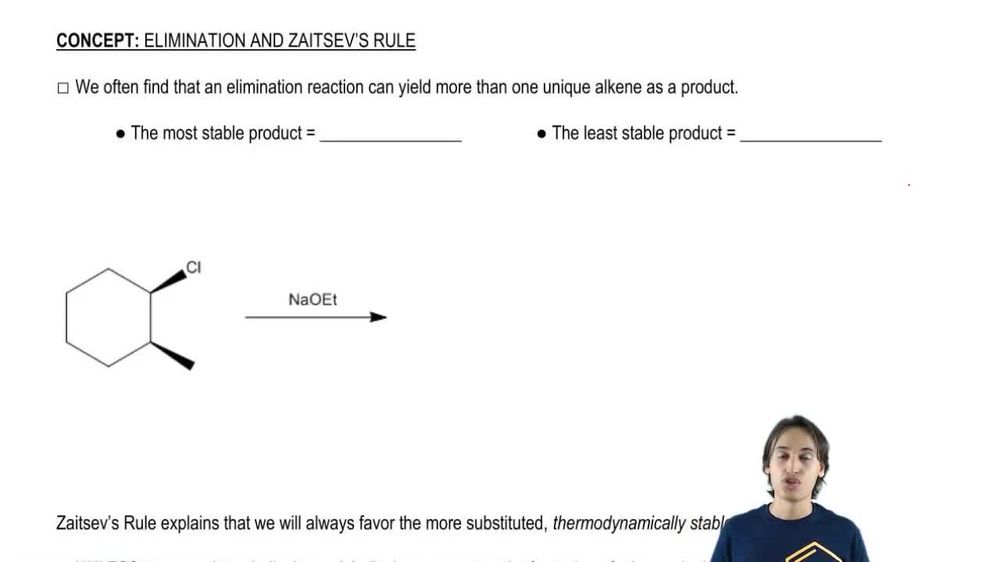
Step 4: Apply Zaitsev's rule. Zaitsev's rule states that the more substituted alkene is favored during elimination. Therefore, the alcohol precursor is likely 2-methyl-2-pentanol, as dehydration of this alcohol would lead to the formation of the most stable, highly substituted alkene.
Step 5: Consider alternative alcohols. Another possible alcohol precursor could be 2-methyl-3-pentanol, which could also undergo dehydration to form the same alkene product under acidic conditions. Both alcohols are valid precursors for the given alkene.
Verified video answer for a similar problem:
This video solution was recommended by our tutors as helpful for the problem above
Video duration:
2m
Play a video:
0 Comments
Key Concepts
Here are the essential concepts you must grasp in order to answer the question correctly.
Alcohols and Alkenes
Alcohols are organic compounds containing one or more hydroxyl (-OH) groups, while alkenes are hydrocarbons that contain at least one carbon-carbon double bond. The conversion of alcohols to alkenes typically involves dehydration, where water is removed, leading to the formation of a double bond. Understanding the structure of both alcohols and alkenes is crucial for predicting the products of such reactions.
A dehydration reaction is a chemical process where a water molecule is removed from a compound, often resulting in the formation of a double bond. In the context of alcohols, this reaction can be catalyzed by acids and typically occurs under heat. Recognizing the conditions that favor dehydration, such as temperature and the presence of catalysts, is essential for determining which alcohols can yield specific alkenes.
Regioselectivity refers to the preference of a chemical reaction to yield one structural isomer over others. Zaitsev's Rule states that in elimination reactions, the more substituted alkene is typically the major product. This principle helps predict which alkenes will form from specific alcohols during dehydration, guiding the identification of the correct alcohols that lead to the desired alkenes.

 2:05 minutes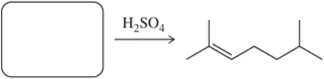
 Verified step by step guidance
 2:09
2:09