Suggest a mechanism for the following reactions. (c) Elimination:
Verified step by step guidance
1
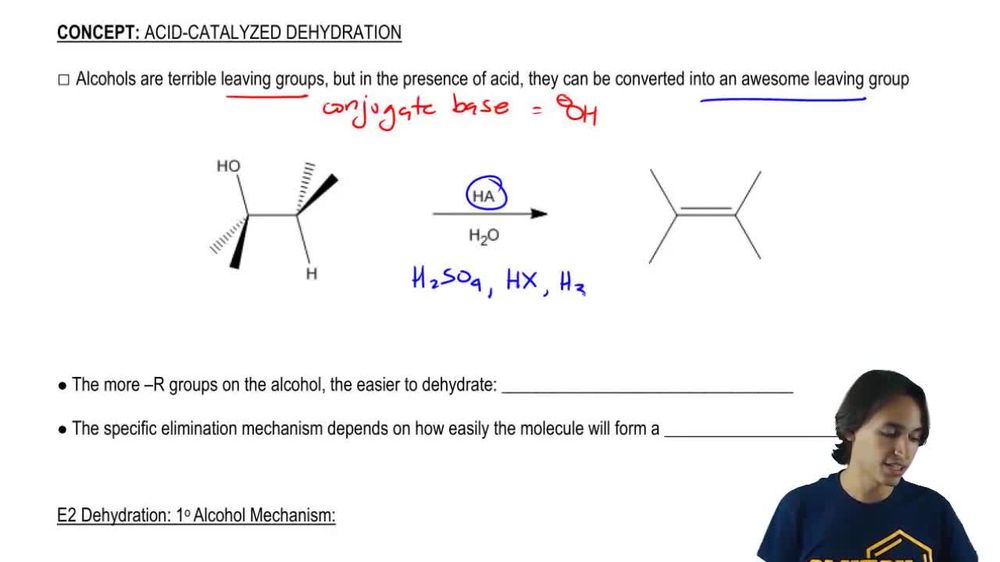
Step 1: Protonation of the alcohol group - The reaction begins with the alcohol group (-OH) being protonated by sulfuric acid (H₂SO₄). This converts the hydroxyl group into a better leaving group, forming water (H₂O). The protonation step can be represented as: .
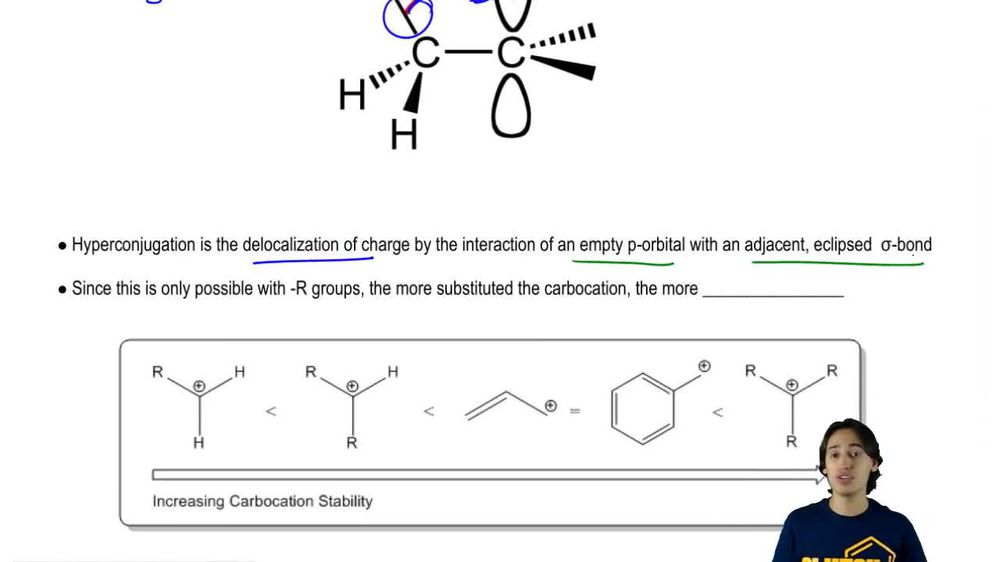
Step 2: Formation of the carbocation - After protonation, the water molecule leaves, generating a carbocation intermediate. This step is crucial as it determines the stability of the intermediate. The carbocation formed is tertiary, which is highly stable due to hyperconjugation and inductive effects.
Step 3: Rearrangement (if necessary) - In some cases, carbocation rearrangement may occur to form a more stable carbocation. However, in this reaction, the carbocation is already tertiary and stable, so no rearrangement is needed.
Step 4: Elimination of a proton - A base (often the bisulfate ion, HSO₄⁻, from sulfuric acid) abstracts a proton from a β-carbon adjacent to the carbocation. This leads to the formation of a double bond (alkene) via the E1 elimination mechanism. The most substituted alkene is formed due to Zaitsev's rule.
Step 5: Final product formation - The reaction concludes with the formation of the alkene product (2-methylcyclohexene) and water as a byproduct. The alkene is the major product due to its stability and adherence to Zaitsev's rule.
Verified video answer for a similar problem:
This video solution was recommended by our tutors as helpful for the problem above
Play a video:
0 Comments
Key Concepts
Here are the essential concepts you must grasp in order to answer the question correctly.
Elimination Reactions
Elimination reactions involve the removal of atoms or groups from a molecule, resulting in the formation of a double bond or a ring structure. In organic chemistry, these reactions often occur with the loss of a small molecule, such as water or hydrogen halide. The most common types are E1 and E2 mechanisms, which differ in their steps and conditions.
Acid-catalyzed dehydration is a specific type of elimination reaction where an alcohol is converted into an alkene through the removal of water. In this process, an acid, such as sulfuric acid (H2SO4), protonates the alcohol, making it a better leaving group. This leads to the formation of a carbocation intermediate, which can then lose a proton to form the double bond.
Carbocation stability is crucial in elimination reactions, as the stability of the carbocation intermediate influences the reaction pathway. Carbocations are classified as primary, secondary, or tertiary based on the number of alkyl groups attached to the positively charged carbon. Tertiary carbocations are the most stable due to hyperconjugation and inductive effects, making them more favorable in elimination mechanisms.


 Verified step by step guidance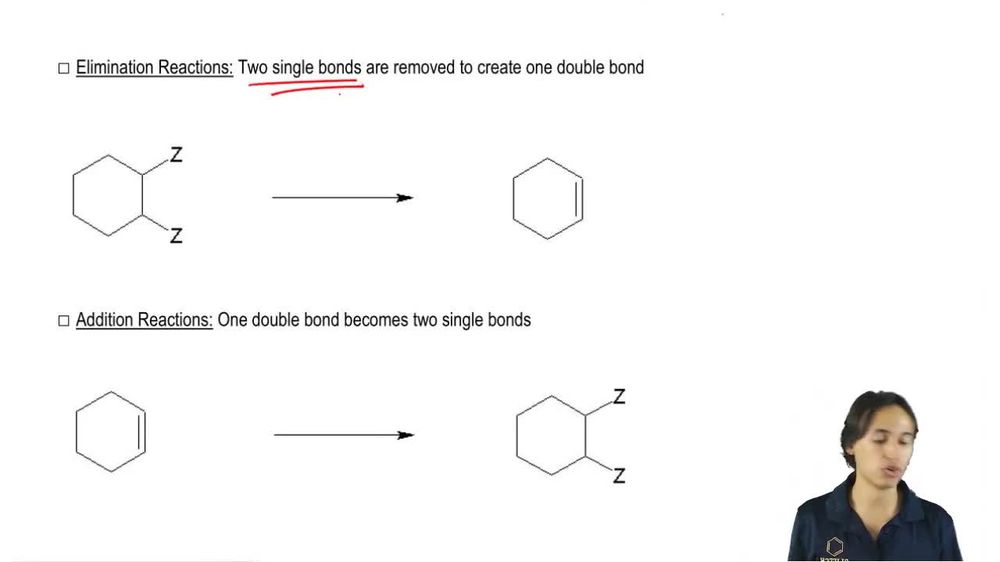
 00:40
00:40