When using sulfuric acid, but in the absence of other nucleophiles like water or bromide ion, less stable alkenes can be isomerized to their more stable isomer. Provide a mechanism for these acid-catalyzed isomerization reactions. [This is one illustration of the principle of microscopic reversibility.] (a)
Verified step by step guidance
1
Step 1: Protonation of the less stable alkene - The reaction begins with the sulfuric acid (H₂SO₄) donating a proton (H⁺) to the double bond of the less stable alkene. This forms a carbocation intermediate. The protonation occurs at the less substituted carbon of the double bond, following Markovnikov's rule.
Step 2: Carbocation rearrangement - The carbocation formed in Step 1 undergoes rearrangement to form a more stable carbocation. This stability is achieved through hydride or alkyl shifts, ensuring the positive charge is located on the most substituted carbon (tertiary carbocation is more stable than secondary or primary).
Step 3: Deprotonation to form a new double bond - A base (often the bisulfate ion, HSO₄⁻, from sulfuric acid) abstracts a proton from a β-hydrogen adjacent to the carbocation. This results in the formation of a new double bond, yielding the more stable alkene isomer.
Step 4: Principle of microscopic reversibility - The reaction mechanism illustrates the principle of microscopic reversibility, where the forward and reverse reactions follow the same pathway. The acid-catalyzed isomerization ensures the equilibrium favors the formation of the more thermodynamically stable alkene.
Step 5: Final product - The more stable alkene is formed as the major product due to the thermodynamic preference for the more substituted double bond. This is evident in the provided reaction, where the initial alkene is isomerized to a more substituted and stable alkene structure.
Verified video answer for a similar problem:
This video solution was recommended by our tutors as helpful for the problem above
Video duration:
4m
Play a video:
0 Comments
Key Concepts
Here are the essential concepts you must grasp in order to answer the question correctly.
Acid-Catalyzed Isomerization
Acid-catalyzed isomerization involves the rearrangement of molecular structures under acidic conditions, typically facilitated by protonation of a double bond. This process allows less stable alkenes to convert into more stable isomers by overcoming energy barriers through the formation of carbocation intermediates. The presence of sulfuric acid provides protons that enhance the reactivity of the alkene, enabling the isomerization to occur.
Microscopic reversibility is a principle stating that the mechanism of a reaction can be reversed at the molecular level. In the context of acid-catalyzed isomerization, this means that the steps leading to the formation of a more stable isomer can also be followed in reverse to regenerate the original alkene. This concept emphasizes the symmetry in chemical reactions, where the forward and reverse pathways share similar transition states.
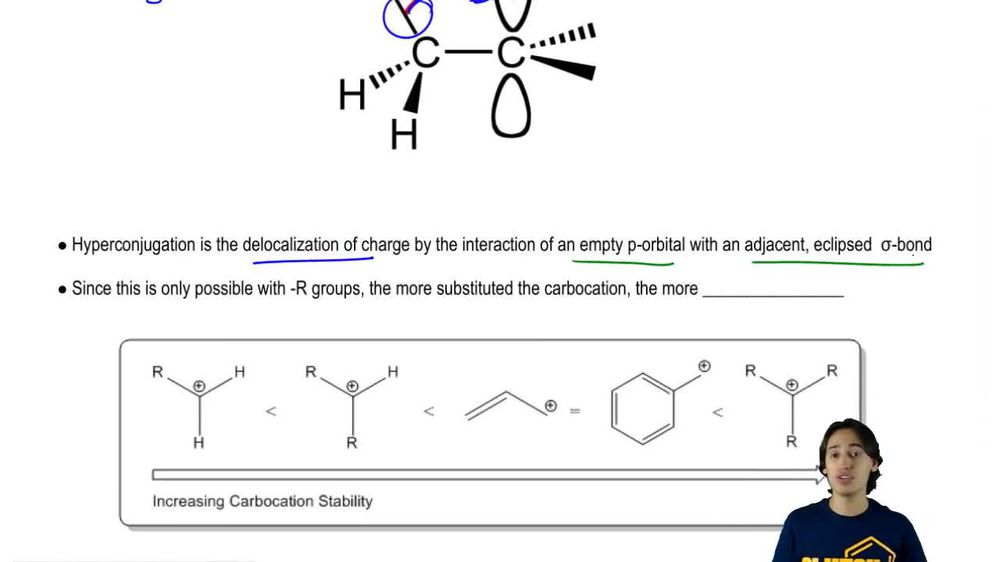
Carbocation stability is a key factor in determining the outcome of reactions involving alkenes. Carbocations are positively charged intermediates that can vary in stability based on their structure; tertiary carbocations are more stable than secondary or primary ones due to hyperconjugation and inductive effects. Understanding the stability of carbocations is crucial for predicting the favored isomerization pathway and the final product in acid-catalyzed reactions.

 4:11 minutes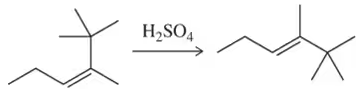
 Verified step by step guidance
 03:09
03:09