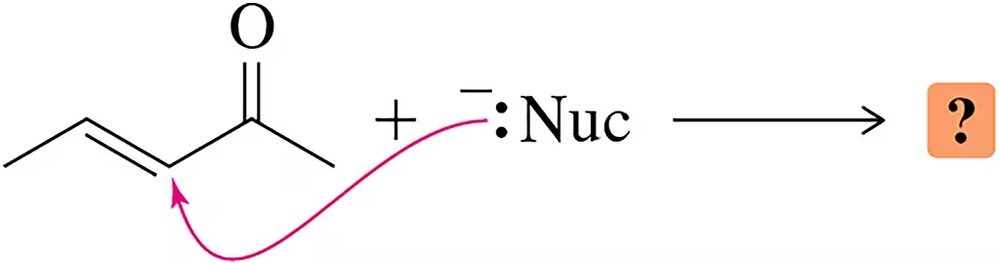
a. Could a nucleophile ever add to C₃? b. Why or why not?
Verified step by step guidance
1
Step 1: Understand the concept of a nucleophile. A nucleophile is a chemical species that donates an electron pair to form a chemical bond in relation to a reaction. Nucleophiles are typically rich in electrons and are attracted to positively charged or electron-deficient areas.
Step 2: Identify the structure of the molecule in question. C₃ refers to the third carbon in a given organic molecule. To determine if a nucleophile can add to C₃, we need to consider the electronic environment around this carbon.
Step 3: Analyze the electronic environment of C₃. If C₃ is part of a functional group that is electron-deficient, such as a carbonyl group (C=O), it may be susceptible to nucleophilic attack. Conversely, if C₃ is surrounded by electron-donating groups, it may be less likely to attract nucleophiles.
Step 4: Consider steric factors. Even if C₃ is electron-deficient, steric hindrance (the crowding of atoms around C₃) can prevent a nucleophile from accessing it. Evaluate the surrounding atoms or groups to determine if they might block the nucleophile's approach.
Step 5: Evaluate resonance and conjugation effects. If C₃ is part of a conjugated system, resonance can stabilize the electron deficiency, making it more or less reactive to nucleophiles. Consider how resonance structures might affect the electron density at C₃.
Verified video answer for a similar problem:
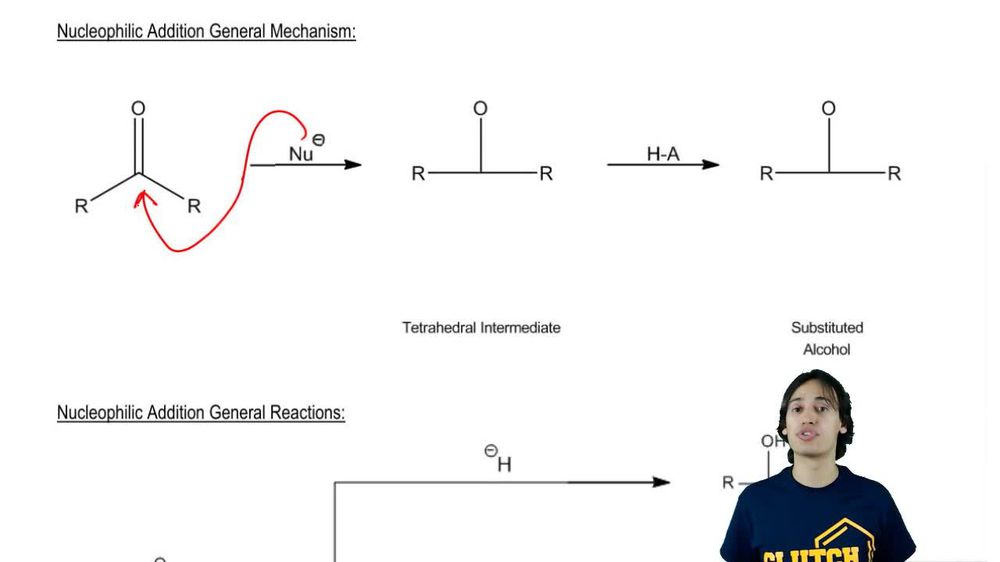
This video solution was recommended by our tutors as helpful for the problem above
Video duration:
4m
Play a video:
0 Comments
Key Concepts
Here are the essential concepts you must grasp in order to answer the question correctly.
Nucleophiles
Nucleophiles are species that donate an electron pair to form a chemical bond in reaction mechanisms. They are typically negatively charged or neutral molecules with lone pairs of electrons, such as OH⁻, NH₃, or H₂O. Understanding nucleophiles is crucial for predicting their behavior in organic reactions, especially in addition reactions.
Electrophilic centers are atoms or regions in a molecule that are electron-deficient and can accept electron pairs from nucleophiles. These centers are often positively charged or polarized, making them attractive to nucleophiles. Identifying electrophilic centers is essential for understanding where nucleophiles might add in a molecule.
The structure of a molecule, including the arrangement of atoms and the presence of functional groups, influences its reactivity and the likelihood of nucleophilic addition. Factors such as steric hindrance, electronic effects, and resonance can affect whether a nucleophile can add to a specific carbon, like C₃, in a molecule. Analyzing these factors helps predict reaction outcomes.