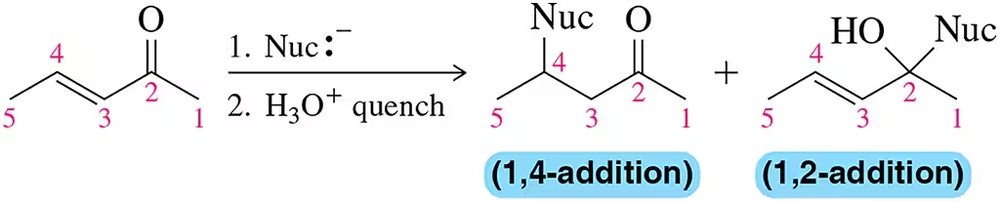
Nucleophilic addition to the α,β-unsaturated ketone shown can occur at either C₂ or C₄. Why?
Verified step by step guidance
1
Identify the structure of the α,β-unsaturated ketone. This type of ketone has a carbonyl group (C=O) adjacent to a carbon-carbon double bond (C=C). The α-carbon is directly attached to the carbonyl group, and the β-carbon is the next carbon in the chain.
Understand the concept of nucleophilic addition. Nucleophiles are species that donate an electron pair to form a chemical bond. In the context of α,β-unsaturated ketones, nucleophiles can attack either the carbonyl carbon (C₂) or the β-carbon (C₄) of the double bond.
Consider the electronic effects. The carbonyl group is highly electrophilic due to the polarization of the C=O bond, making the carbonyl carbon (C₂) a potential site for nucleophilic attack. Additionally, the conjugated system of the α,β-unsaturated ketone allows for resonance stabilization, which can make the β-carbon (C₄) electrophilic as well.
Analyze the resonance structures. Draw the resonance structures of the α,β-unsaturated ketone to visualize the electron delocalization. This will show how the positive charge can be distributed between the carbonyl carbon (C₂) and the β-carbon (C₄), explaining why both sites are susceptible to nucleophilic attack.
Consider the reaction conditions. The choice of nucleophilic attack site can depend on the reaction conditions, such as the type of nucleophile and solvent used. Under certain conditions, one site may be favored over the other due to kinetic or thermodynamic factors.
Verified video answer for a similar problem:
This video solution was recommended by our tutors as helpful for the problem above
Video duration:
5m
Play a video:
0 Comments
Key Concepts
Here are the essential concepts you must grasp in order to answer the question correctly.
Nucleophilic Addition
Nucleophilic addition is a fundamental reaction in organic chemistry where a nucleophile forms a bond with an electrophilic carbon atom. In the context of α,β-unsaturated ketones, the nucleophile can attack the electrophilic sites, leading to the addition across the double bond or at the carbonyl carbon.
α,β-Unsaturated ketones are compounds containing a carbonyl group adjacent to a carbon-carbon double bond. This conjugation results in resonance stabilization, making both the β-carbon and the carbonyl carbon electrophilic and susceptible to nucleophilic attack, which explains the potential for addition at C₂ or C₄.
The difference between saturated and unsaturated molecules.
Resonance Stabilization
Resonance stabilization in α,β-unsaturated ketones involves the delocalization of electrons across the π-system, which includes the carbonyl and the adjacent double bond. This electron delocalization increases the electrophilicity of both the β-carbon and the carbonyl carbon, allowing nucleophilic attack at multiple sites.