What product is formed when 3-methyl-2-cyclohexenone reacts with each of the following reagents? c. HBr d. CH3CH2SH
Verified step by step guidance
1
Identify the structure of 3-methyl-2-cyclohexenone. It is a cyclohexenone ring with a methyl group attached to the third carbon and a double bond between carbons 2 and 3. The carbonyl group is located at carbon 1.
For part (c), HBr is a strong acid and a source of bromide ions (Br⁻). The reaction will proceed via electrophilic addition to the double bond. The proton (H⁺) from HBr will add to the less substituted carbon of the double bond (Markovnikov's rule), forming a carbocation intermediate at the more substituted carbon.
The bromide ion (Br⁻) will then attack the carbocation, resulting in the formation of a bromo-substituted product. The final product will have a bromine atom attached to the more substituted carbon of the original double bond.
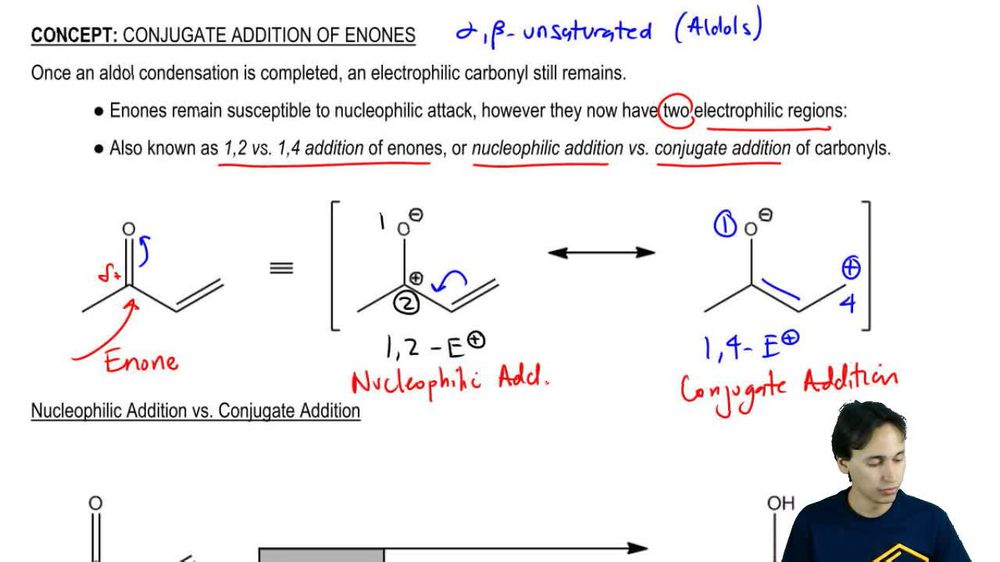
For part (d), CH3CH2SH is a thiol (a sulfur-containing compound). In the presence of a base or acidic catalyst, the thiol can act as a nucleophile. The carbonyl group in 3-methyl-2-cyclohexenone is electrophilic and can undergo nucleophilic addition. The sulfur atom of CH3CH2SH will attack the carbonyl carbon, forming a thioether (sulfur-containing compound) as the product.
Ensure to draw the structures of the products for both reactions to visualize the changes. For part (c), the product will have a bromine atom added to the cyclohexenone ring. For part (d), the product will have a CH3CH2S group attached to the former carbonyl carbon.
Verified video answer for a similar problem:
This video solution was recommended by our tutors as helpful for the problem above
Video duration:
1m
Play a video:
0 Comments
Key Concepts
Here are the essential concepts you must grasp in order to answer the question correctly.
Electrophilic Addition
Electrophilic addition is a fundamental reaction mechanism in organic chemistry where an electrophile reacts with a nucleophile, typically involving alkenes or alkynes. In the case of 3-methyl-2-cyclohexenone reacting with HBr, the double bond acts as a nucleophile, attacking the electrophilic hydrogen, leading to the formation of a bromoalkane. Understanding this mechanism is crucial for predicting the products of reactions involving unsaturated compounds.
Nucleophilic substitution is a reaction where a nucleophile replaces a leaving group in a molecule. When 3-methyl-2-cyclohexenone reacts with CH3CH2SH, the sulfur atom acts as a nucleophile, attacking the carbon atom bonded to the leaving group (if present) or the carbonyl carbon. This concept is essential for understanding how different nucleophiles can interact with electrophilic centers in organic compounds.
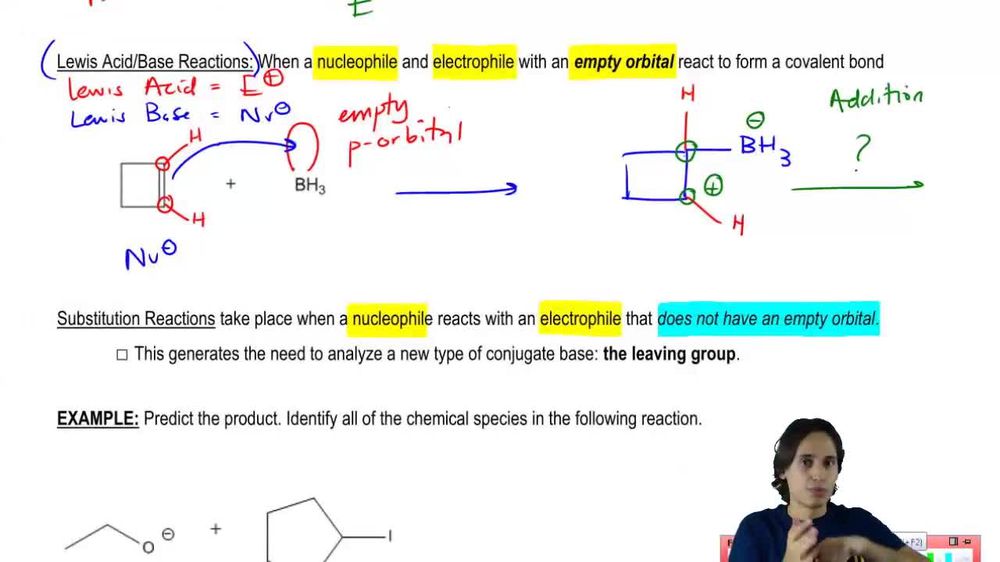
Nucleophiles and Electrophiles can react in Substitution Reactions.
Regioselectivity
Regioselectivity refers to the preference of a chemical reaction to occur at one location over another in a molecule, leading to the formation of a specific product. In the reactions of 3-methyl-2-cyclohexenone with HBr and CH3CH2SH, the regioselectivity will determine which carbon atom the electrophile or nucleophile will bond to, influencing the final product's structure. Recognizing regioselectivity is vital for predicting the outcomes of organic reactions.