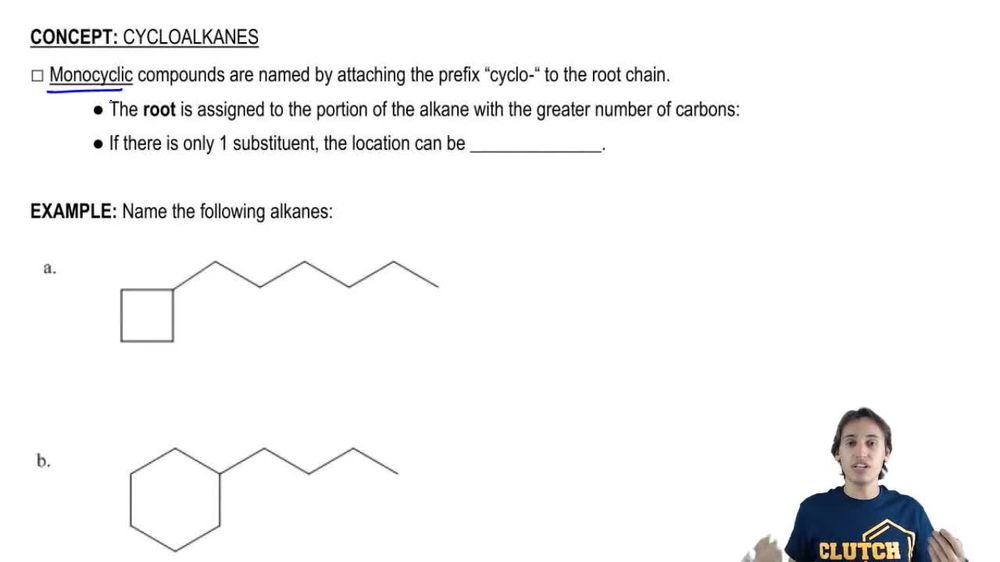
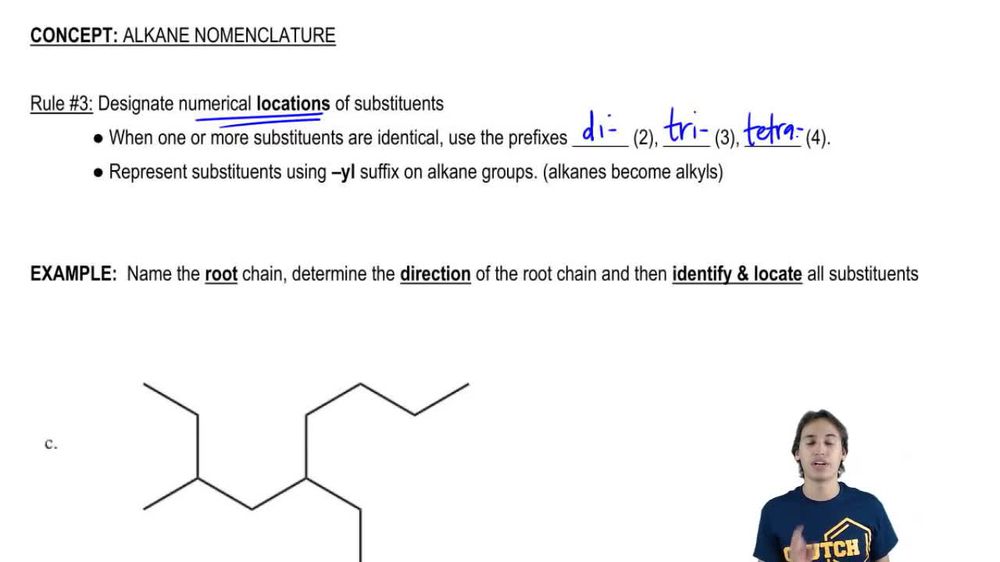
Draw the structure and give the molecular formula for each of the following compounds. a. 1-ethyl-3-methylcycloheptane b. isobutylcyclohexane
Verified step by step guidance
1
Step 1: Understand the naming conventions for organic compounds. The name '1-ethyl-3-methylcycloheptane' indicates a cycloheptane ring with an ethyl group attached to the first carbon and a methyl group attached to the third carbon. Similarly, 'isobutylcyclohexane' indicates a cyclohexane ring with an isobutyl group attached.
Step 2: Draw the base ring structure for each compound. For '1-ethyl-3-methylcycloheptane', draw a seven-membered ring (cycloheptane). For 'isobutylcyclohexane', draw a six-membered ring (cyclohexane).
Step 3: Add the substituents to the ring. For '1-ethyl-3-methylcycloheptane', add an ethyl group (CH₃CH₂-) to the first carbon and a methyl group (CH₃-) to the third carbon of the cycloheptane ring. For 'isobutylcyclohexane', add an isobutyl group ((CH₃)₂CHCH₂-) to one of the carbons in the cyclohexane ring.
Step 4: Count the total number of each type of atom in the structure to determine the molecular formula. For '1-ethyl-3-methylcycloheptane', count the carbons and hydrogens in the cycloheptane ring and the attached ethyl and methyl groups. For 'isobutylcyclohexane', count the carbons and hydrogens in the cyclohexane ring and the attached isobutyl group.
Step 5: Write the molecular formula for each compound based on the atom count. Ensure that the formula reflects the total number of carbon (C) and hydrogen (H) atoms present in the structure.
Verified video answer for a similar problem:
This video solution was recommended by our tutors as helpful for the problem above
Video duration:
6m
Play a video:
0 Comments
Key Concepts
Here are the essential concepts you must grasp in order to answer the question correctly.
IUPAC Nomenclature
IUPAC nomenclature is a standardized system for naming chemical compounds. It involves identifying the longest carbon chain, numbering the chain to give substituents the lowest possible numbers, and naming substituents as prefixes. Understanding this system is crucial for accurately drawing and naming organic compounds like 1-ethyl-3-methylcycloheptane and isobutylcyclohexane.
Cycloalkanes are saturated hydrocarbons with carbon atoms arranged in a ring structure. They are named based on the number of carbon atoms in the ring, with 'cyclo-' as a prefix. Recognizing cycloalkane structures is essential for drawing compounds like cycloheptane and cyclohexane, which form the base of the given compounds.
Substituents are groups attached to the main carbon chain or ring, altering the compound's structure and properties. Branching occurs when these groups, such as ethyl, methyl, or isobutyl, are attached to the main structure. Understanding how to identify and position these substituents is key to drawing the correct structure and determining the molecular formula.

 6:04 minutes
 Verified step by step guidance
 03:43
03:43