Draw skeletal structures for the following: d. propylcyclopentane
Verified step by step guidance
1
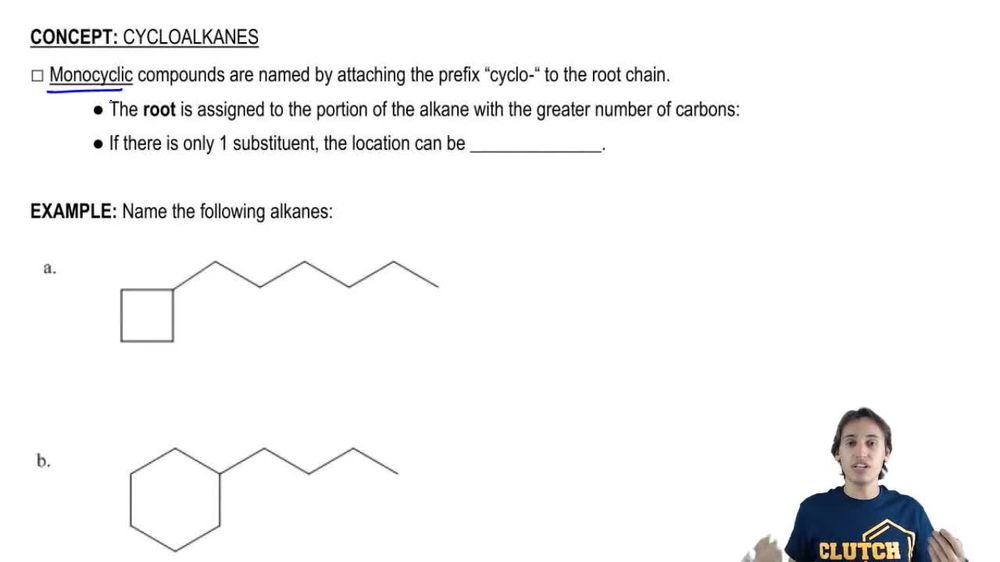
Start by identifying the main structure of the compound. In this case, the main structure is 'cyclopentane,' which is a cyclic alkane with five carbon atoms arranged in a ring. Draw a pentagon to represent the cyclopentane ring.
Next, identify the substituent group attached to the cyclopentane ring. The substituent is 'propyl,' which is a three-carbon alkyl group. The structure of the propyl group can be written as CH₃-CH₂-CH₂-.
Attach the propyl group to one of the carbon atoms in the cyclopentane ring. Since no specific position is mentioned, you can attach it to any carbon atom in the ring. Ensure that the attachment does not violate the valency of carbon (each carbon should have four bonds).
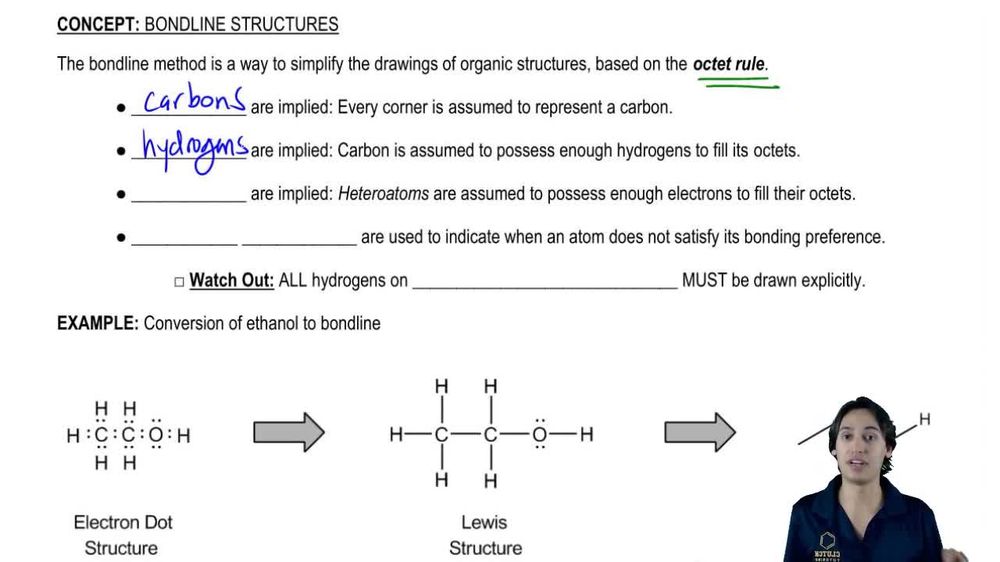
Simplify the structure into a skeletal formula. In a skeletal structure, carbon atoms are represented by vertices, and hydrogen atoms bonded to carbon are implied but not shown explicitly. Draw the cyclopentane ring as a pentagon and the propyl group as a three-line chain extending from one vertex of the pentagon.
Double-check the structure to ensure that it accurately represents propylcyclopentane. Verify that the cyclopentane ring has five carbons, the propyl group has three carbons, and all carbons have the correct number of bonds.
Verified video answer for a similar problem:
This video solution was recommended by our tutors as helpful for the problem above
Video duration:
6m
Play a video:
0 Comments
Key Concepts
Here are the essential concepts you must grasp in order to answer the question correctly.
Skeletal Structures
Skeletal structures, or line-angle formulas, are simplified representations of organic molecules where carbon atoms are implied at the ends of lines and at intersections. Hydrogen atoms attached to carbons are usually omitted for clarity. This notation allows chemists to visualize the molecular framework quickly, focusing on the connectivity and arrangement of atoms rather than individual bonds.
Cycloalkanes are a class of hydrocarbons characterized by carbon atoms arranged in a ring structure. They follow the general formula CnH2n, where 'n' is the number of carbon atoms. Understanding cycloalkanes is essential for drawing structures like propylcyclopentane, as it involves recognizing the cyclic nature of the molecule and how substituents, such as propyl groups, attach to the ring.
Substituents are atoms or groups of atoms that replace hydrogen atoms in a hydrocarbon chain or ring. In the case of propylcyclopentane, the propyl group (C3H7) is a substituent on the cyclopentane ring. Recognizing how substituents affect the structure and properties of the molecule is crucial for accurately drawing and understanding the skeletal structure.