Ch. 7 - The Reactions of Alkynes • An Introduction to Multistep Synthesis
Bruice - Organic Chemistry 8th Edition
Bruice8th EditionOrganic ChemistryISBN: 9780135213711Not the one you use?Change textbook
Chapter 8, Problem 40d

Answer Problem 39 , parts a–h, using 2-butyne as the starting material instead of propyne.
d. Br2 (2 mol)/CH2Cl2

Verified step by step guidance
1
Identify the starting material: The starting material is 2-butyne, which is a terminal alkyne with the structure CH3-C≡C-CH3.
Understand the reagent: The reagent is Br2 (2 mol) in CH2Cl2. Bromine (Br2) in an inert solvent like dichloromethane (CH2Cl2) is used to add bromine atoms across the triple bond of the alkyne.
Determine the reaction type: This is a halogenation reaction. When an alkyne reacts with 2 equivalents of Br2, the triple bond is fully saturated, resulting in a tetrahalide product.
Write the reaction mechanism: In the first step, one equivalent of Br2 adds across the triple bond, converting it into a dibromoalkene (CH3-CBr=CHBr-CH3). In the second step, the remaining equivalent of Br2 adds across the double bond, resulting in a tetrahalide (CH3-CBr2-CBr2-CH3).
Verify the product: The final product is 2,2,3,3-tetrabromobutane, where all four bromine atoms are added to the original carbon atoms of the triple bond.

Verified video answer for a similar problem:

This video solution was recommended by our tutors as helpful for the problem above.
Video duration:
4m
Was this helpful?

Key Concepts

Here are the essential concepts you must grasp in order to answer the question correctly.

Alkyne Reactivity

Alkynes, such as 2-butyne, are hydrocarbons with a carbon-carbon triple bond. This triple bond makes them more reactive than alkenes and alkanes, allowing them to undergo various addition reactions. Understanding the reactivity of alkynes is crucial for predicting the products formed when they react with halogens like Br2.
Recommended video:
Guided course
09:11
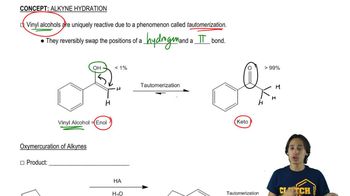
Alkyne Hydration

Electrophilic Addition

Electrophilic addition is a fundamental reaction mechanism in organic chemistry where an electrophile reacts with a nucleophile, resulting in the formation of a more saturated compound. In the case of 2-butyne reacting with Br2, the triple bond acts as a nucleophile, attacking the electrophilic bromine, leading to the formation of a dibrominated product.
Recommended video:
Guided course
09:23
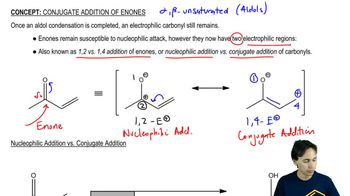
1,2 vs 1,4 Addition

Stereochemistry of Addition Reactions

Stereochemistry refers to the spatial arrangement of atoms in molecules and how this affects their chemical behavior. When Br2 adds to 2-butyne, the stereochemical outcome can lead to different isomers, such as cis and trans forms, depending on the reaction conditions. Understanding stereochemistry is essential for predicting the specific products and their configurations in addition reactions.
Recommended video:
1:38
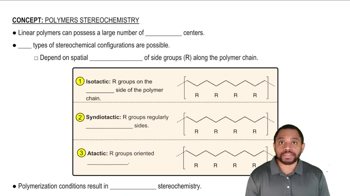
Polymer Stereochemistry Concept 1