Ch. 7 - The Reactions of Alkynes • An Introduction to Multistep Synthesis
Bruice - Organic Chemistry 8th Edition
Bruice8th EditionOrganic ChemistryISBN: 9780135213711Not the one you use?Change textbook
Chapter 8, Problem 40f

Answer Problem 39, parts a–h, using 2-butyne as the starting material instead of propyne.
f. R2BH in THF followed by H2O2/HO /H2O

Verified step by step guidance
1
Identify the starting material, 2-butyne, which is an alkyne with the structure CH≡C-CH2-CH3. The triple bond is located between the first and second carbons.
Understand the reagents: R2BH in THF is a hydroboration reagent that adds a boron atom and a hydrogen atom across the triple bond in a syn-addition manner. This step converts the alkyne into a trialkylborane intermediate.
Recognize the second step: H2O2/HO−/H2O is used to oxidize the trialkylborane intermediate into an enol. The enol then tautomerizes to form a carbonyl compound (a ketone or aldehyde).
Determine regioselectivity: Hydroboration-oxidation of terminal alkynes typically leads to the formation of aldehydes, while internal alkynes like 2-butyne yield ketones. The boron adds to the less substituted carbon of the triple bond, following anti-Markovnikov selectivity.
Conclude the product: The reaction of 2-butyne with R2BH followed by H2O2/HO−/H2O will result in the formation of a ketone, specifically 2-butanone, due to the internal alkyne structure and the regioselectivity of the reaction.

Verified video answer for a similar problem:

This video solution was recommended by our tutors as helpful for the problem above.
Video duration:
6m
Was this helpful?

Key Concepts

Here are the essential concepts you must grasp in order to answer the question correctly.

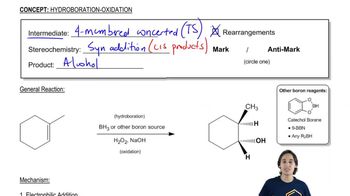
Hydroboration-Oxidation

Hydroboration-oxidation is a two-step reaction process used to convert alkenes and alkynes into alcohols. In the first step, a borane reagent (like R2BH) adds across the triple bond of the alkyne, forming a trialkylborane intermediate. The second step involves oxidation with hydrogen peroxide and a base, which replaces the boron with a hydroxyl group, yielding an alcohol. This method is notable for its anti-Markovnikov selectivity.
Recommended video:
Guided course
06:38
General properties of hydroboration-oxidation.

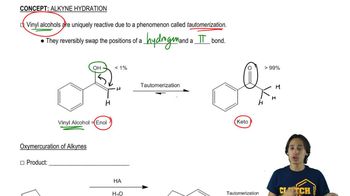
Alkyne Reactivity

Alkynes, characterized by their carbon-carbon triple bonds, exhibit unique reactivity compared to alkenes and alkanes. They can undergo various reactions, including addition reactions, where reagents add across the triple bond. The reactivity of alkynes is influenced by their hybridization and the presence of electron-withdrawing groups, making them versatile intermediates in organic synthesis.
Recommended video:
Guided course
09:11
Alkyne Hydration

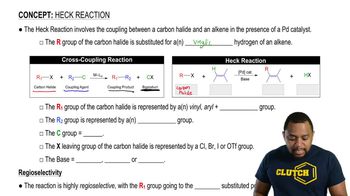
Regioselectivity

Regioselectivity refers to the preference of a chemical reaction to yield one structural isomer over others when multiple possibilities exist. In the context of hydroboration-oxidation, the reaction is regioselective, favoring the formation of the less substituted alcohol due to the mechanism of boron addition. Understanding regioselectivity is crucial for predicting the outcome of reactions involving unsaturated hydrocarbons.
Recommended video:
Guided course
05:09
Heck Reaction