Show an arrow-pushing mechanism that forms the product on the right from the reactant at left. Only one arrow is necessary in each reaction. [Don't forget to draw in the lone pairs on this and the next two assessments.] (d)
Verified step by step guidance
1
Step 1: Identify the nucleophile and electrophile in the reaction. The nucleophile is the species with lone pairs or a negative charge that can donate electrons, while the electrophile is the species that can accept electrons due to a positive charge or electron deficiency.
Step 2: Locate the lone pairs on the nucleophile. These lone pairs will be the source of electrons for the arrow-pushing mechanism. Ensure all lone pairs are drawn explicitly on the structure.
Step 3: Draw the curved arrow starting from the lone pair of the nucleophile and pointing toward the electrophilic atom or bond. This represents the movement of electrons from the nucleophile to the electrophile.
Step 4: If a bond is formed or broken during the reaction, adjust the structure accordingly. For example, if a bond is formed between the nucleophile and electrophile, show the new bond in the product structure.
Step 5: Verify the formal charges and electron count on all atoms in the product to ensure the mechanism is consistent with the rules of organic chemistry. Adjust lone pairs and charges as necessary.
Verified video answer for a similar problem:
This video solution was recommended by our tutors as helpful for the problem above
Video duration:
1m
Play a video:
0 Comments
Key Concepts
Here are the essential concepts you must grasp in order to answer the question correctly.
Arrow-Pushing Mechanism
Arrow-pushing mechanisms are a way to illustrate the movement of electrons during chemical reactions. In these diagrams, arrows represent the flow of electron pairs, indicating how bonds are formed or broken. Understanding this mechanism is crucial for visualizing reaction pathways and predicting the products of organic reactions.
Lone pairs are pairs of valence electrons that are not involved in bonding and are localized on an atom. They play a significant role in determining the reactivity and geometry of molecules. In arrow-pushing mechanisms, it is important to represent lone pairs accurately, as they can participate in reactions or influence the stability of intermediates.
In organic chemistry, reactants are the starting materials that undergo a chemical change, while products are the substances formed as a result of the reaction. Understanding the relationship between reactants and products is essential for predicting the outcome of a reaction and for drawing accurate mechanisms that depict how reactants transform into products.

 1:12 minutes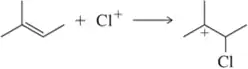
 Verified step by step guidance
 04:32
04:32