Would you expect the following species to be electrophiles or nucleophiles? Some may be both. Explain your answer. (c)
Verified step by step guidance
1
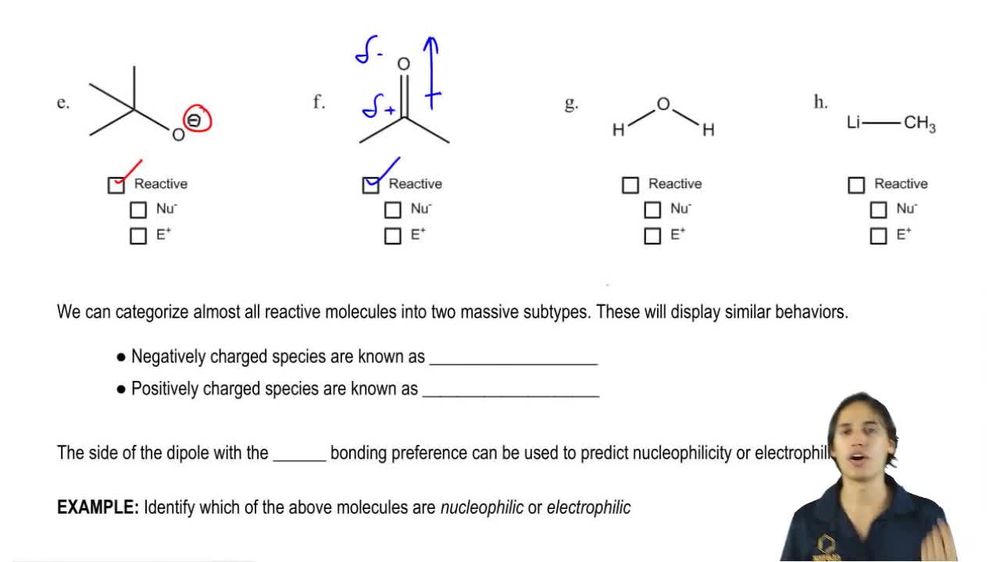
Step 1: Begin by understanding the definitions of electrophiles and nucleophiles. Electrophiles are species that are electron-deficient and can accept a pair of electrons, often having a positive charge or partial positive charge. Nucleophiles are species that are electron-rich and can donate a pair of electrons, often having a negative charge or lone pairs of electrons.
Step 2: Examine the structure and composition of the given species (c). Look for features such as lone pairs, negative charges, or electron-rich regions to determine nucleophilic behavior. Similarly, look for positive charges, partial positive charges, or electron-deficient regions to determine electrophilic behavior.
Step 3: Consider resonance effects, inductive effects, and hybridization of the atoms in the species. These factors can influence the electron density and determine whether the species acts as an electrophile or nucleophile. For example, resonance can delocalize electron density, affecting reactivity.
Step 4: Evaluate whether the species can act as both an electrophile and a nucleophile. Some species may have regions that are electron-rich (nucleophilic) and regions that are electron-deficient (electrophilic). For example, a molecule with a lone pair and a positive charge could exhibit dual behavior.
Step 5: Summarize your findings by explaining the reasoning behind the classification of the species as an electrophile, nucleophile, or both. Use the structural and electronic features of the species to justify your conclusion.
Verified video answer for a similar problem:
This video solution was recommended by our tutors as helpful for the problem above
Video duration:
2m
Play a video:
0 Comments
Key Concepts
Here are the essential concepts you must grasp in order to answer the question correctly.
Electrophiles
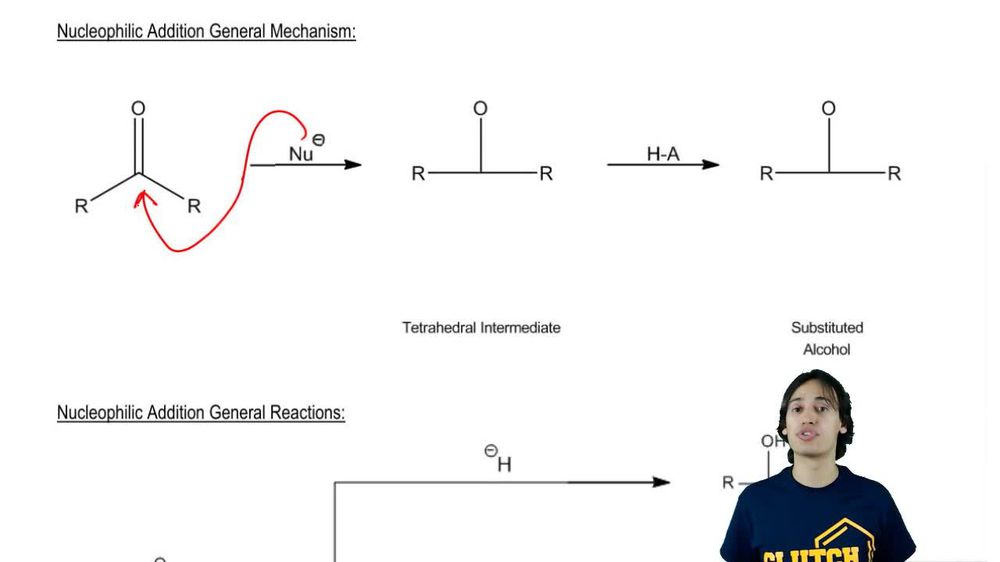
Electrophiles are species that are electron-deficient and seek to accept electrons from nucleophiles during chemical reactions. They typically have a positive charge or a partial positive charge due to electronegative atoms. Common examples include carbocations and carbonyl compounds, which can react with nucleophiles to form new bonds.
Nucleophiles are electron-rich species that donate an electron pair to electrophiles in a chemical reaction. They often possess a negative charge or have lone pairs of electrons available for bonding. Examples include anions like hydroxide (OH-) and neutral molecules like ammonia (NH3), which can attack electrophilic centers.
Some species can act as both electrophiles and nucleophiles depending on the reaction conditions and the other reactants involved. For instance, a molecule with both a nucleophilic site (like a lone pair) and an electrophilic site (like a carbonyl) can participate in different types of reactions, showcasing its versatility in organic chemistry.

 2:48 minutes
 Verified step by step guidance

 03:
03: